Legal Landscape of ROM Emulation in 2025
Emulators are legal, but downloading ROMs and current-gen circumvention remain risky.
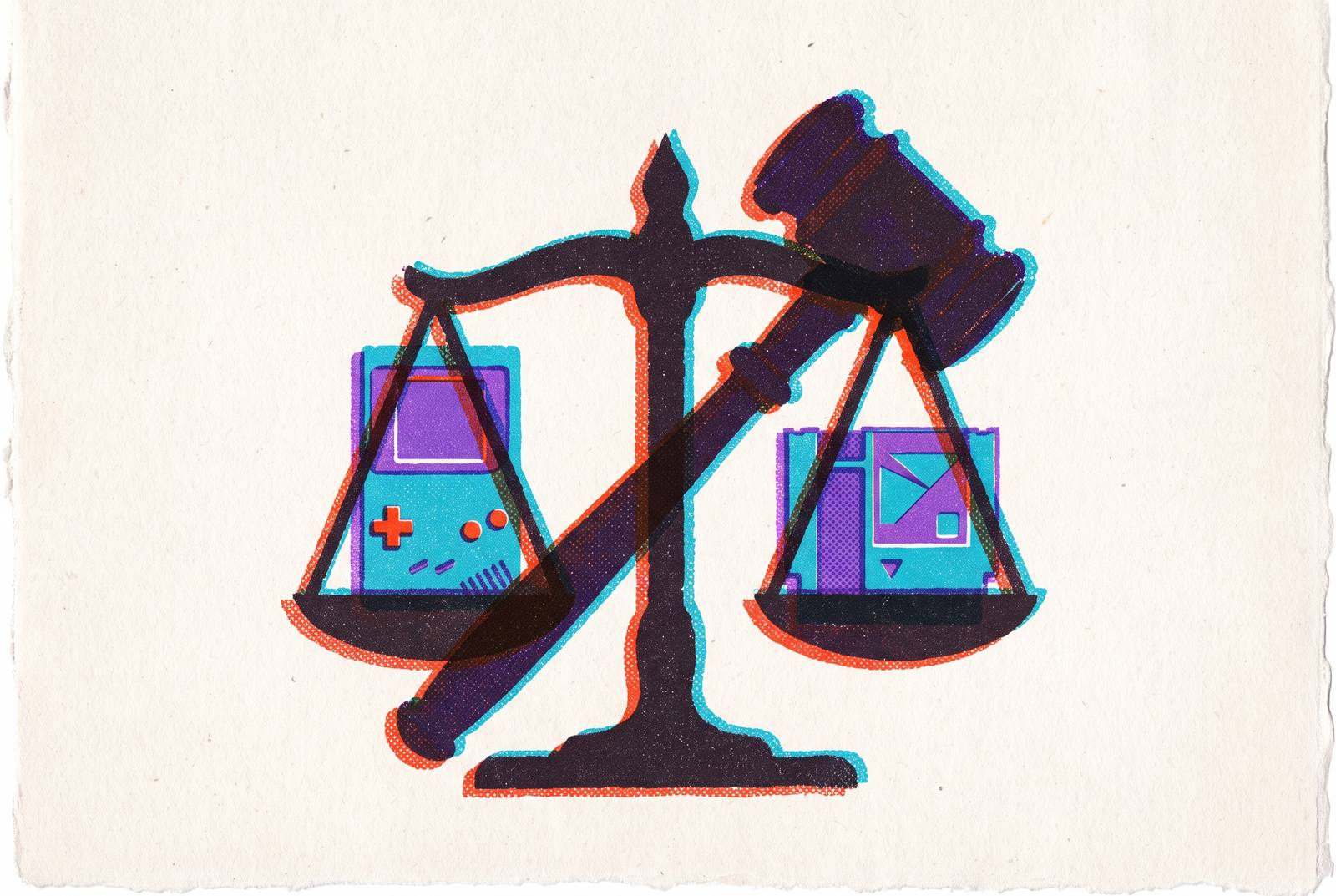
The legal landscape of ROM emulation in 2025 is less murky than its reputation suggests. Emulator software has strong legal protection in the United States, while game files and copy-protection bypasses have their own legal questions. Understanding those distinctions turns a vague fear that “emulation is illegal” into a practical map of clear permissions, clear infringement, and genuine grey areas.
What emulators actually are and why the law treats them differently from ROMs
The confusion usually starts with claims that sound interchangeable but are not. The claims go that emulators are illegal, that downloaded games are allowed if they are deleted within 24 hours, and that Yuzu’s shutdown means every emulator is now banned. Each claim blurs a distinction between the tool, the content, and the means of accessing that content. Separating those things is the foundation of the legal answer.
An emulator is software that mimics a console’s hardware behavior without containing game data or copied manufacturer code. A ROM is a digital copy of a game’s data, originally stored on a cartridge or disc. The former reproduces a machine’s behavior, while the latter reproduces the copyrighted creative work played on it. Legally, these are separate objects, so permission to use the tool does not supply permission to copy the content. The emulator is almost always legal, but the ROM’s status depends on how it was obtained.
Why emulator software is on firm legal ground in the United States
Court decisions protect independently developed emulators, so their legal status does not depend on manufacturers looking the other way. Sega Enterprises v. Accolade (1992) established that disassembling copyrighted code to reach its unprotected functional elements can qualify as fair use when no other route exists. That distinction matters because understanding how a system works is not the same as copying its protected expression into a competing product. Copying code during reverse engineering can be legal even when it is part of building new software.
Sony Computer Entertainment v. Connectix Corp. (2000) applied that reasoning directly to console emulation. Connectix studied Sony’s PlayStation BIOS while developing its Virtual Game Station, then built the finished product without including Sony’s code. The court ruled that the intermediate copying was fair use. Together, these Ninth Circuit decisions established the foundation that still controls this area of law. A clean-room product that independently replicates hardware behavior has firm legal protection.
Sony v. Bleem (2000) needs a narrower description than it sometimes receives. Its holding concerned the fair use of PlayStation screen shots in comparative advertising, rather than the legality of distributing an emulator itself. Connectix supplies the direct emulation precedent. RetroArch, Dolphin, PCSX2, MAME, and RPCS3 are legal software built through clean reverse engineering. Even Nintendo’s intellectual property lawyer, Koji Nishiura, acknowledged at the Tokyo eSports Festa that emulators are technically legal, distinguishing them from software that bypasses encryption, copies copyrighted console programs, or directs users to pirated material.
How the DMCA drew a new legal line that retro emulation mostly clears but current-gen emulation does not
DMCA Section 1201 targets the circumvention of technological protection measures. An emulator can therefore avoid copying a manufacturer’s software and still face a separate claim about bypassing access controls. “Emulators are legal” and “Switch emulation is fine” are not equivalent statements. One refers to software written independently, while the other may also require breaking encryption.
Retro consoles such as the SNES used a lockout chip, but they do not require encryption to be broken at runtime. The principle protecting reverse engineering for compatibility was also established before the DMCA. This places much retro emulation in different legal territory from current-generation emulation that requires DRM circumvention.
The Yuzu settlement in March 2024 illustrated the force of that distinction. Its developers acknowledged that their software could circumvent Nintendo’s technological protection measures. Because the case settled before trial, it created no binding legal precedent and did not overturn the decisions protecting emulator software. It nevertheless demonstrated a legal route that does not require proving that an emulator contains stolen code. Section 1201 also has its own rules for civil damages, separate from copyright infringement, and courts can award treble damages for repeat violations.
The ROM spectrum and the lines between downloading, personal dumps, and abandonware
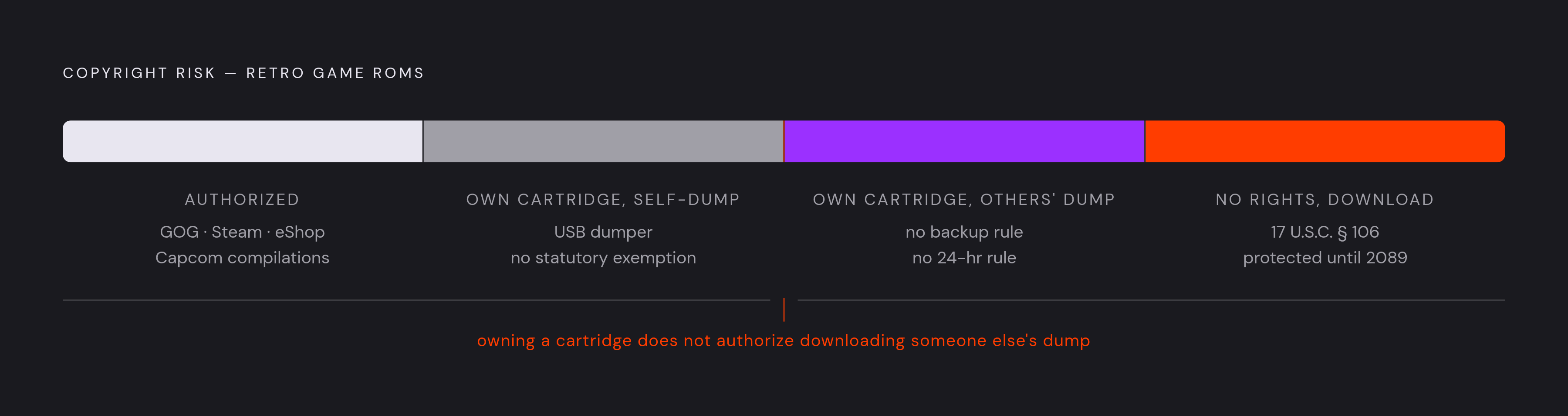
The clearest infringement zone is downloading a copyrighted game ROM without the rights holder’s permission. Under 17 U.S.C. § 106, only the copyright owner has the right to reproduce and distribute the work. Both an unauthorized uploader and a downloader infringe, because the download produces an unlicensed reproduction. Willful infringement can substantially increase statutory damages in a civil suit, creating significant exposure even for a small number of works.
The argument for format-shifting is that putting a game already owned into another format is like ripping a CD. That reasoning has persuasive force, but U.S. law contains no explicit statutory exemption for video game ROM format-shifting. USB cartridge dumpers and standard disc drives for CD-based games such as PS1 or Sega Saturn titles make personal copying possible. But owning the original does not give someone permission to download somebody else’s dump.
The supposed temporary-download or backup permission supplies no escape from that distinction. There is no 24-hour rule, no 48-hour rule, and no provision allowing a ROM download because the downloader once owned the cartridge. Deleting a copy later does not make it legal to download it without permission. Copyright law does not turn a stopwatch into a weekend rental.
“Abandonware” is another label without the legal effect players often attach to it. A game being old, out of print, or impossible to buy does not extinguish its copyright. Corporate works are protected for 95 years, so a game from 1994 will not enter the public domain until 2089. There is no legal abandonware status in most countries.
The clean zone consists of authorized copies. Official digital storefronts, collections from publishers, and compilations let people play classic games with a license. Some developers also release official ROM packs for particular titles. Those packs matter because a licensed classic game and a ROM supplied for use with an emulator are not necessarily the same offering. Permission, rather than nostalgia or ownership of unrelated media, is what makes this end of the spectrum clear.
What enforcement actually looks like and who bears the cost
Nintendo’s pattern targets ROM distribution sites, commercial piracy, and emulator developers whose software facilitates circumvention of current-generation DRM.
The Yuzu settlement imposed direct costs on its developer, Tropic Haze. It paid $2.4 million, shut down the project immediately, and transferred the domain yuzu-emu.org to Nintendo. Ryujinx, the other prominent Switch emulator of that era, folded in October 2024. Separately, Nintendo’s May 2024 GitHub notice removed a large number of Yuzu-linked repositories.
The same pattern continued in 2026, after the 2025 period this article covers. Nintendo’s February 2026 notice named 13 separate projects. Eden responded by publishing a new v0.2.0 build on GitHub days later. After GitHub disabled its Releases repository in March 2026, Eden moved future releases onto its own servers, outside GitHub’s DMCA takedown mechanism.
For individual players, the record is different. There is no documented case of an individual being sued merely for personally playing ROMs. Enforcement follows commercial scale and current-generation DRM circumvention, while the rules governing unauthorized copies remain separate.
Where the legal framework breaks down for game preservation
These rules are hardest on institutions trying to preserve games, more so than on players looking for free copies. The same anti-circumvention rules used against piracy can obstruct libraries and archives working with out-of-print material. A lawful emulator does not, by itself, give an archive the permissions needed to make a protected game accessible. The gap between preserving a work and permitting people to study it is where the framework becomes most strained.
The Video Game History Foundation has worked with the Software Preservation Network since 2021 to seek a DMCA exemption allowing libraries and archives to remotely share digital access to out-of-print games. The Copyright Office declined, writing that “there would be a significant risk that preserved video games would be used for recreational purposes”. Its reasoning addresses the possibility that access presented as preservation could also serve ordinary play. That concern is distinct from denying the historical value of games, but it still limits institutional access.
The VGHF’s study found that a large majority of classic video games released in the United States are critically endangered and commercially unavailable. Against that backdrop, the foundation argued that the refusal would push researchers and historians toward “extra-legal methods”. The tension is substantial because the absence of a commercial route does not remove the legal barriers to a scholarly one. Preservation supplies a strong reason for access without automatically supplying legal permission. That exposes a limit in what the legal map allows institutions to accomplish.
How to build a retro library that is legally clean and practically satisfying
For players, the clearest starting point is an authorized library. GOG, the Nintendo eShop, Steam, and publisher collections from Capcom, SNK, and others sell licensed classic games. Official compilations, including Castlevania, Mega Man, and Final Fantasy anthologies, offer another route to playing the originals on current hardware. Where developers supply official ROM packs, those provide a compliant source for the files themselves. These routes avoid treating commercial unavailability or an old cartridge as a substitute for permission.
Personal dumping is another way to get games, but it is still a legal grey area. Low-cost USB cartridge dumpers read data straight from cartridges people own and work with most retro consoles. For BIOS files, the recommended approach is to dump them from hardware already owned using appropriate tools. Keep personal dumps private, because owning a game does not authorize distributing copies of it.
Delta’s arrival on the iOS App Store after over a decade of Apple prohibiting emulators made the iPhone a viable platform for Game Boy Advance, Nintendo DS, and other classic Nintendo system games. Personally dumped ROMs can be used for those games, though their legal status is just as unclear on a phone as it is elsewhere. Modern Android devices can run systems from SNES and PS1 through PS2 on stronger hardware.
Streaming through Xbox Cloud Gaming, PlayStation Remote Play, Nvidia GeForce Now, and Steam Link offers ways to play modern and classic games on a phone without getting ROM files. Use legal emulator software freely, distinguish personal dumps from licensed copies, and recognize that unauthorized downloads and DRM circumvention cross separate legal lines.