Emulation Legality and ROM Ownership Explained
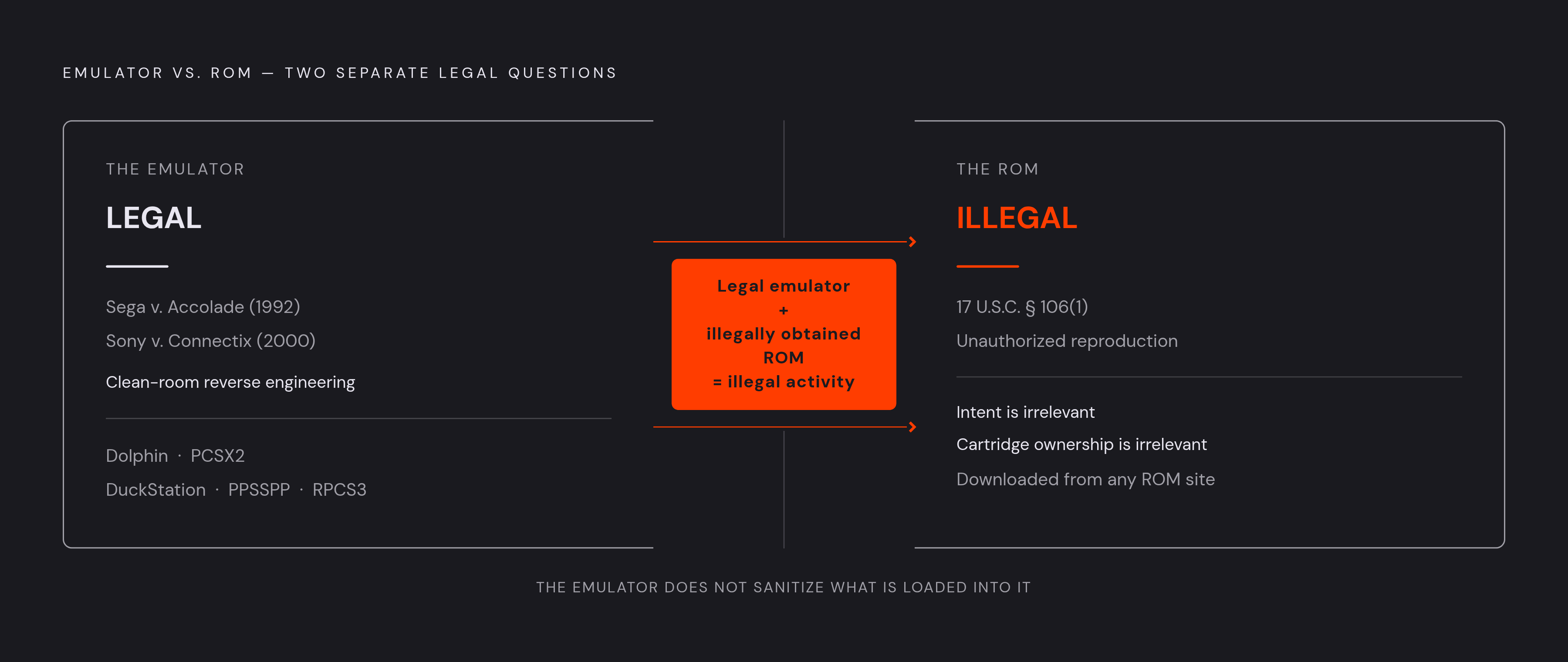
Emulators are legal, but the ROMs you load into them usually aren't.
Ask most players whether emulation is legal and you will get a shrug, a confident wrong answer, or a story about a friend who knows a guy. The reason the question produces such confusion is that it is not one question at all. Emulation legality splits into two distinct inquiries with different answers, and nearly every myth in this space traces back to treating them as a single issue.
The emulator and the ROM are used together, which makes them feel legally joined. They are not. One is software you install. The other is a file you load into it. Conflating them is like asking whether owning a DVD player is legal and expecting the answer to tell you something about the legitimacy of a burned disc someone handed you on the street. The 24-hour rule, the "I own the cartridge" defense, and the belief that Yuzu's shutdown made all emulation illegal all flow from this same failure to separate the two questions. This piece walks each question on its own terms, because the law has always done so.
Why the emulator itself is firmly legal under settled U.S. court precedent
The first question is whether the emulator, the software that mimics a console's hardware, is legal. In the United States, this is not a gray area. Two federal appellate decisions resolved it, and both remain good law today.
The first is Sega Enterprises Ltd. v. Accolade reverse-engineered Sega's console software to create compatible games, and the court held that this qualified as fair use when it was the only way to access functional, non-copyrightable elements. The case established a principle that would define the emulation landscape: copyright protects expression, not function. The second case is Sony Computer Entertainment Inc. v. Connectix built Virtual Game Station, a PlayStation emulator, through reverse engineering for interoperability. The court was explicit that the emulator replicated the function of the console, not its protected creative expression.
The mechanism that makes this work is clean-room reverse engineering. Developers write original code that mimics how hardware behaves without reproducing the original copyrighted console software. Legal Synopsis confirms the status those courts established holds in 2026.
The practical corollary matters more than the doctrine. Downloading and running RetroArch, Dolphin, PCSX2, DuckStation, PPSSPP, or RPCS3 is legal, provided the emulator was built through reverse engineering without copying proprietary code into the final product. The "clean" build is what matters. If the software you downloaded was assembled that way, you have not infringed anything by installing it.
Why the ROM is where copyright infringement actually happens
The second question is where the trouble lives. A ROM file is a copy of copyrighted software, and downloading one from the internet is unauthorized reproduction of that work. Age is irrelevant here. A game from decades ago is still under copyright.
The mechanics of the infringement are worth being precise about. Downloading from a ROM site is not the downloader making a backup. It is receiving someone else's unauthorized copy, which is infringement under 17 U.S.C. § 106(1) regardless of the downloader's intent. The statute asks whether an unauthorized reproduction occurred, and the answer is yes the moment the file arrives on your drive.
This is where the two questions rejoin in an uncomfortable way. A legal emulator does not sanitize what is loaded into it. A legal emulator plus an illegally obtained ROM equals an illegal activity. Some emulators support open-source BIOS replacements for certain systems as a clean alternative, and those are worth seeking out if you want to stay on defensible ground.
The myths that shape how most players think about ROM ownership — and why they are wrong
Between the legal reality and what most players believe sits a dense layer of folk law, most of it wrong. The most persistent beliefs, owning the cartridge, the 24-hour rule, abandonware, games being public domain, have no basis in U.S. copyright law. Each one is worth dismantling briefly, because each one feels true right up until you look at it closely.
The "I own the cartridge" defense is the most common. Owning a physical copy gives you a license to use that specific copy. It does not entitle you to obtain additional digital copies from unauthorized sources. Nintendo's own legal FAQ explicitly debunks this myth, which is either ironic or predictable depending on your disposition. Section 117 of the Copyright Act allows the owner of a copy of software to make an archival backup of that specific copy. Courts have interpreted this narrowly: a backup of the physical media you own, not a download of a copy someone else made. The distinction is the whole game.
The 24-hour rule is pure fantasy with no statutory hook anywhere. And the public domain claim is a math error with a long tail. Games from the Atari 2600 era are only now beginning to approach the threshold, and NES-era titles onward will not be public domain for decades. If you enjoyed playing a game in your childhood, you will not be alive to legally download it from a ROM site.
The one path that is actually defensible: dumping your own physical media
So the downloaded ROM is a problem, but there is a path that most players have never seriously considered. The argument in favor tracks the logic courts have accepted in other media contexts: format-shifting a copy you own for personal use. No private individual has ever been prosecuted for dumping their own cartridge, EmuDesk confirms.
The practical paths vary by platform, and the tools are more accessible than most players assume. For Nintendo cartridges from the GBA and DS eras, the GBxCart RW hardware dumper handles the job. For 3DS cartridges, GodMode9 on a modded 3DS outputs.cia or decrypted.3ds files. For GameCube and Wii discs, CleanRip on a modded Wii dumps ISO files directly. For PS3 discs, multiMAN on a jailbroken PS3 rips to an RPCS3-compatible format. BIOS files can be extracted from your own console using system-specific homebrew tools.
This is not the fastest path to a ROM. It is the only one where the file on your drive traces back to media you actually own. That distinction, rather than any courtroom argument, is what makes it defensible in practice.
Why Switch emulation sits in a categorically different legal position than retro emulation
Everything said so far about emulator legality applies cleanly to retro systems. Switch emulation sits in a categorically different legal position, and the reason is DMCA Section 1201's anti-circumvention provisions, which apply regardless of whether copyright infringement occurs. Retro consoles from the SNES, PS1, and PS2 eras had minimal or no encryption. The clean reverse-engineering defense that protected emulator developers applies straightforwardly because there is no technological protection measure being circumvented. The Switch is different. Every Switch game is encrypted with a cryptographic key. Running it on an emulator requires decrypting that content, which is circumventing a technological protection measure under DMCA § 1201, a separate violation from copyright infringement. The question is not "did you copy protected creative work" but "did you break our encryption." That is a genuinely different legal terrain.
This is the weapon Nintendo used against Yuzu, and it is the one the company continues to deploy against Switch emulator forks. The DMCA anti-circumvention theory lets Nintendo pressure projects without having to relitigate the settled legality of emulation in the abstract. The Yuzu settlement in March 2024, $2.4 million and a full shutdown, was settled before trial. Emulators that do not ship decryption keys and do not market themselves as piracy enablers, Dolphin, PCSX2, DuckStation, and PPSSPP among them, continue operating on solid legal ground. The Yuzu case confirmed that actively facilitating piracy at scale is the liability trigger, not emulation itself.
How Nintendo's enforcement campaign has reshaped the emulation landscape since 2024
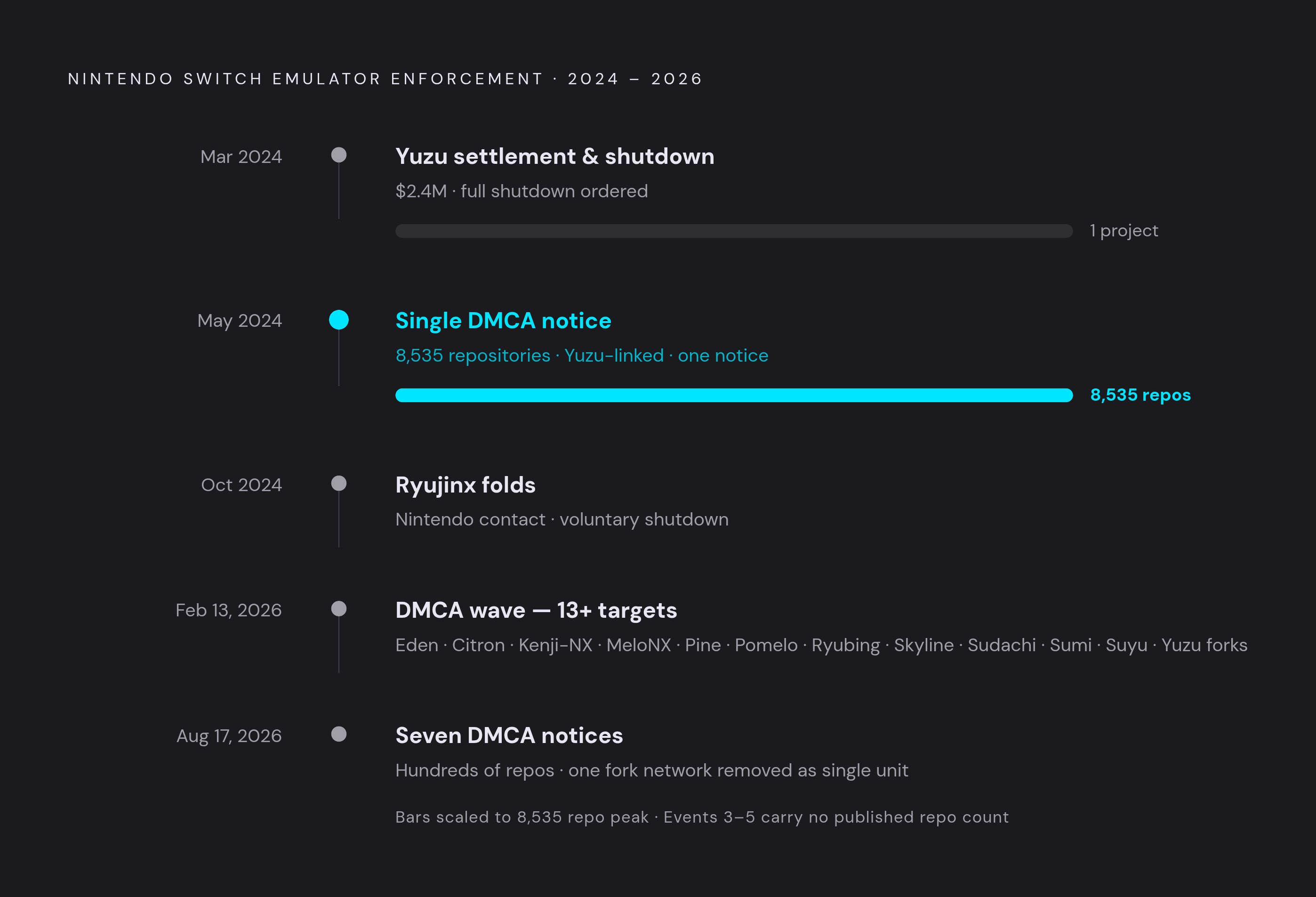
What the legal framework predicts, Nintendo has enacted. Since 2024, the company has run a sustained, multi-wave enforcement campaign that has shuttered or displaced every major Switch emulator project, using DMCA anti-circumvention as its primary legal tool. The timeline is concrete. Ryujinx, the other prominent Switch emulator of that era, folded in October 2024, months after the Yuzu settlement, following Nintendo contact with the developer. Then came three coordinated waves of GitHub sweeps. In May 2024, a single DMCA notice removed 8,535 Yuzu-linked repositories. On February 13, 2026, Nintendo's legal representatives issued a wave of DMCA takedown notices targeting every active and inactive Nintendo Switch emulator project on GitHub, including Eden, Citron, Kenji-NX, MeloNX, Pine, Pomelo, Ryubing, Ryujinx, Skyline, Sudachi, Sumi, Suyu, and Yuzu forks. On August 17, 2026, Nintendo filed seven DMCA notices with GitHub. By the time they were processed, hundreds of repositories were down, including one fork network removed as a single unit. Projects named include Suyu, Skyline, MonoNX, and assorted Yuzu forks.
The consistent pattern across all three waves is the legal theory, and it is worth stating precisely because it is often misunderstood. Nintendo's argument rests on DMCA § 1201 anti-circumvention: the emulators "circumvent a technological measure that effectively controls access" to copyrighted games, and distributing them constitutes trafficking under § 1201(a)(2). Nintendo is not claiming the emulator code itself is infringing. Projects like Citron and Eden did not bundle any copyrighted keys or game files. They required users to supply their own from modded consoles. The legal question is open. The practical outcome, for now, is not.
Where the preservation argument runs into the limits of current law
The strongest counterargument to aggressive ROM enforcement deserves to be stated at full strength before the law's response is applied. Emulation plays a role for gaming similar to what home video formats played for film preservation. That is not hyperbole. It is the actual mechanism by which much of this history remains playable.
The Video Game History Foundation's 2023 study found that a large majority of video games are "critically endangered," effectively inaccessible without either piracy or traveling to an authorized archive. The foundation and the Software Preservation Network then petitioned the U.S. Copyright Office in 2024 for a DMCA exemption that would let libraries and archives remotely share access to out-of-print games. Register of Copyrights Shira Perlmutter ruled that proponents "have not satisfied their burden to demonstrate that the requested uses are or are likely to be noninfringing." The VGHF warned that the game industry's position forces researchers toward extra-legal methods to access the vast majority of out-of-print titles.
The law's position is clear, however unsatisfying. Unavailability does not create a legal right to copy. The copyright persists whether or not the publisher is actively selling the game. The gap between the legal reality and the cultural need is real and unresolved, and the triennial DMCA rulemaking process is currently the only formal legal pathway for advocates to push for change. The next rulemaking window will allow another attempt. For now, the preservation argument is morally serious and legally weak, and players who care about access to gaming history should understand both halves of that sentence before deciding what they are comfortable doing.
What is fully legal to use today and how to get the most from it on mobile
The good news is that a legally clean emulation setup is more accessible on mobile in 2026 than at any prior point. The options span App Store-native emulators and fully licensed cloud alternatives, and they do not require you to bend any rules to use them. On Android, full emulator support is available via Google Play and sideloading, including RetroArch, PPSSPP, Dolphin, and others. The legally clean path on either platform is the same as the desktop path: use Delta or RetroArch loaded with ROMs you have self-dumped from cartridges and discs you own, or homebrew and freeware ROMs that are freely and legally distributed. Homebrew scenes for older systems are thriving, and their output is explicitly licensed for distribution. That is a real library of playable, legal software.
Cloud gaming offers a fully licensed alternative where the ROM question vanishes entirely. Xbox Cloud Gaming and GeForce NOW stream licensed titles with no ROM required. The game never lives on your device at all. 5G is now deployed across dozens of countries with sub-15ms latency in metro areas, and a majority of cloud gaming access is via smartphones, making the phone the natural primary screen for this model. The legal framework here is not an emulator question or a ROM question. It is a subscription question, and for many players that is exactly the clarity they wanted all along.