Best Emulation Handheld for PS2 and PSP Games
PSP is easy and cheap; PS2 demands a Snapdragon 8 Gen 1.
The PS2 and the PSP came from the same company in the same decade, and that's roughly where the similarity ends as far as emulation is concerned. The PS2 runs on a custom MIPS CPU paired with two Vector Processing Units working in parallel, a setup built to brute-force 3D geometry and physics math in a way that modern chips can't just translate and move past the way they can with simpler, older systems. The PSP, by contrast, is a far more linear piece of hardware to emulate, and PPSSPP (one of the most polished emulators in the hobby) takes full advantage of that, running PSP titles at full speed on hardware that would choke the moment you handed it a PS2 workload, while rendering games at multiples of the original 480×272 resolution on any modern screen. The practical result of that asymmetry: a buyer who only wants PSP can find genuinely good hardware for well under $100, while a buyer chasing reliable PS2 performance should plan to spend $150 or more and aim for a Snapdragon 8 Gen 1-class chip as a floor, not a ceiling. Budget chips from Allwinner and Rockchip top out around PS1, and a later fifth-generation console is only an occasional stretch goal. For PS2, those chips are a wall that doesn't move no matter how you tune the settings.
The chipset tiers that define what each device can do
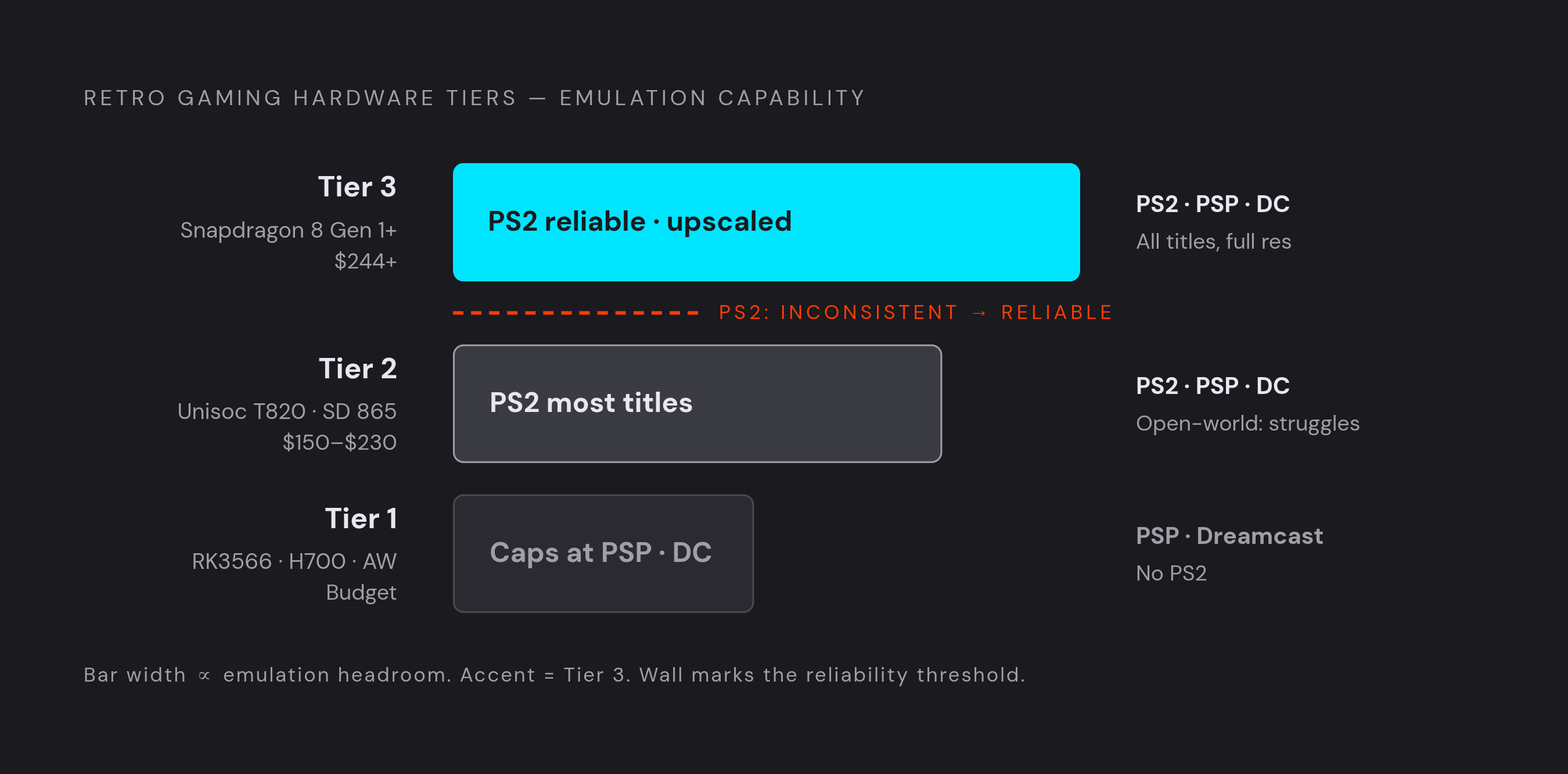
Once you accept that PS2 and PSP ask fundamentally different things of a processor, the handheld market sorts itself into three tiers almost automatically. Tier 1 covers budget chips, the RK3566, the H700, and various Allwinner parts, and these cap out at PSP and Dreamcast, full stop on ambition. Tier 2 is the mid-range, built around chips like the Unisoc T820 and the Snapdragon 865, typically priced between $150 and $230, and this is where PS2 compatibility becomes real but inconsistent: most titles run, but late-era, open-world PS2 games start to strain the hardware's single-core ceiling. The Retroid Pocket 4 Pro costs around $140 to $160 and sits comfortably in this tier, handling PSP, Dreamcast, GameCube, and a wide swath of the PS2 library without pretending to be a flagship device. Tier 3 is where the Snapdragon 8 Gen 1 and newer chips live, and this tier runs PS2 reliably at upscaled resolutions. 8GB of RAM is enough for both PS2 and GameCube emulation, and the extra memory on 12GB configurations mostly helps heavier Android multitasking or Switch emulation, not PS2 itself. Treat this tier map as the first filter, because everything that follows, from software choice to specific device picks, only makes sense once you know which tier your target games actually require.
The PS2 emulator landscape on Android and PC in 2026
Hardware is only half the equation. The software running on top of it determines how much of that hardware's potential actually reaches the screen. On Android, NetherSX2 remains the working standard for PS2 emulation, a community fork that picked up the project after the original AetherSX2 developer went dark. The most recent tracked build, version 2.2n-4248 (nicknamed the "Turnip" build and updated April 18, 2026), relies on the open-source Vulkan driver for Adreno GPUs, and it isn't distributed through Google Play. Buyers have to sideload the APK from a verified community source, which adds a small amount of friction but nothing close to a dealbreaker for anyone who's sideloaded an app before. A native alternative is gradually closing the gap with NetherSX2, but NetherSX2 still sets the bar most Android buyers measure against. On PC handhelds running a mainstream PC operating system, PCSX2 remains the definitive choice, carrying a claimed 98% compatibility rate along with full 4K upscaling support, numbers no Android solution currently matches. As for what hardware those emulators need to actually work: Android PS2 emulation wants a Snapdragon 855, Dimensity 1000, or Exynos 990-class chip with 6GB of RAM for most 2D and low-polygon 3D titles, while smooth higher-resolution output calls for a Snapdragon 8 Gen 1 or Dimensity 9000 or newer, paired with 8GB of RAM. The software side of this hobby is in good shape in 2026. The limiting factor is almost always the chip underneath it, not the emulator running on top.
The PSP-first buyer's path: what to buy at each price point
PSP is forgiving enough that if your interest starts and ends there, you can walk away with excellent results for well under $200, though the right specific pick still depends heavily on which PSP games actually top your must-play list. Under $100, two devices cover light to medium PSP use reasonably well. The R36S, priced around $79.99, runs on a 3.5-inch IPS screen and handles timing-light titles like the Patapon series, LocoRoco, Tactics Ogre, and Final Fantasy Tactics, though results get noticeably more variable on anything more demanding. The R36MAX, around $99.99, bumps the screen up to 4 inches but runs the same budget-tier chip, so the size of the display is the real difference buyers are paying for, not any gain in raw horsepower. Both devices belong squarely in what's best described as the "timing, menus, and action" category of PSP titles. If you're eyeing something more demanding or more open-world, confirm compatibility before buying.
For PSP purists, a modded PS Vita remains a legitimate option worth the extra research. Running the Adrenaline homebrew app, a modded Vita offers near-native, hardware-assisted PSP compatibility across most of the PSP and PS1 library, with only a small number of titles showing slowdowns or quirks. The PCH-1000 model carries a 5-inch OLED screen, and its second analog stick can be mapped to camera control in games that originally relied on the D-pad, a real gameplay upgrade for anyone replaying Monster Hunter. There's no efficient way to upscale beyond native resolution, and finding a Vita in good condition keeps getting harder as the years go by.
For buyers who want the PSP experience pushed as far as it can go under $200, the Retroid Pocket Flip 2, starting around $179, is the practical ceiling. Its 5.5-inch AMOLED 1080p display, Hall effect sticks, 5000mAh battery, and clamshell form factor make it the most capable PSP machine in this price range. The Flip 2 doesn't carry the PS2 reliability of the Snapdragon 8 Gen 2 tier, so it should be read as a PSP ceiling and not mistaken for a PS2 recommendation. Across every device in this price range, PPSSPP renders games at a substantially higher resolution, so the original console's blurry little screen gets replaced by something sharp no matter which PSP-capable handheld ends up in your pocket. The software does that heavy lifting on its own.
The PS2-capable shortlist: matching device to use case within the flagship tier
Once you move into flagship-tier chips, Snapdragon 8 Gen 2 and comparable silicon, the raw PS2 performance gap between competing devices shrinks to almost nothing. What actually separates these picks is display format, form factor, battery capacity, and a handful of ergonomic trade-offs that matter more than a small amount of extra frame-rate headroom.
The Retroid Pocket 6, priced from roughly $244 to $279, stands as the best overall value for anyone splitting time between PS2 and PSP. It runs a Snapdragon 8 Gen 2 with an Adreno 740 GPU, paired with a 5.5-inch full-HD 120Hz AMOLED display, a 6000mAh battery, active cooling, Hall effect sticks, WiFi 7, and Android 13. For PSP specifically, that 16:9 display lines up with the wide shape of PSP games better than the 4:3 panels found on some competitors. The RP6 uses analog L2/R2 triggers rather than digital shoulder buttons, a detail that matters for certain PS2 racing games. The 8GB RAM configuration is enough for PS2 and GameCube, with the 12GB version mostly paying off on heavier workloads elsewhere. Retroid's own launcher also gets consistent praise as the most beginner-friendly interface on any Android handheld, which makes initial setup and navigation easier for anyone configuring emulation for the first time.
The AYN Thor, priced between $299 and $399, runs the identical Snapdragon 8 Gen 2 chip, so its PS2 output matches the RP6 game for game: God of War runs, Shadow of the Colossus runs, Burnout 3 runs, Final Fantasy X runs. What the Thor adds is a pair of AMOLED displays in a dual-screen layout that mirrors original DS and 3DS hardware more closely than any single-screen device can.
The AYN Odin 2 Portal, starting around $259 to $299 and up, runs the same Snapdragon 8 Gen 2 and Adreno 740 combination but puts it behind a 7-inch OLED screen and a 6000mAh battery. It weighs 430 grams against the RP6's 320 grams, a difference that's real in the hand over a long session. Buyers for whom PS2 is the primary target, and who'd rather have a bigger screen than a lighter device, have good reason to pick the Odin 2 Portal over the RP6.
The newest entry, the Retroid Pocket Nova, launched in July 2026 and drew strong early reviews, particularly for its upscaled PS2 emulation and for a 4:3 AMOLED panel described as one of the best displays ever put in a portable retro handheld. That 4:3 aspect ratio makes a real difference for libraries leaning toward systems built around that older screen shape.
PS2 game compatibility on handhelds
The chipset tiers described above aren't abstract categories. They appear directly in how specific PS2 games behave on real hardware. A solid chunk of the PS2 library runs well even on Tier 2 hardware. Burnout 3: Takedown holds a locked 60fps on capable Tier 2 devices, making it one of the cleanest results in PS2 emulation generally. Sly Cooper and the Thievius Raccoonus fits naturally into portable play thanks to its episodic mission structure. Ratchet & Clank's level-based progression and generous quick-saving hold up well even when upscaled. Kingdom Hearts has frequent save points, and it still looks sharp at a higher upscaled resolution. Final Fantasy X's turn-based combat and sphere grid system suit the start-and-stop nature of handheld sessions well. Jak and Daxter rounds out the list with short missions and forgiving checkpoints.
Other titles demand Tier 3 hardware, Snapdragon 865-class at an absolute minimum and Snapdragon 8 Gen 2 recommended, to be genuinely playable. God of War I and II hit full speed on the Retroid Pocket 6's 8 Gen 2 chip, but performance drops off at Tier 2 during the games' busier combat sequences. Shadow of the Colossus ranks among the most demanding PS2 titles to emulate at all; it's playable on the RP6 with some per-game tuning, and its jungle and arena environments are consistently the bottleneck. Metal Gear Solid 3: Snake Eater runs at native resolution on Tier 2 hardware once settings are adjusted, with its dense jungle environments again being the main obstacle. Gran Turismo 4 sits at the far end of the difficulty curve: Tier 3 hardware makes the simulation racing genuinely playable, while Tier 2 hardware can't guarantee consistent frame pacing. The Retroid Pocket 6 uses digital shoulder buttons rather than analog triggers, and Gran Turismo 4 specifically benefits from analog trigger input, a reminder that chipset tier isn't the only variable that decides whether a game feels right in hand.
The case for the Steam Deck OLED as a PS2 machine
The Steam Deck OLED is the single most compatible PS2 emulation device on the market today, running PCSX2 at a claimed 98% compatibility rate that neither NetherSX2 nor its emerging native rival on Android has yet matched. That number alone makes a strong case for the Deck as the serious PS2 player's machine. But compatibility isn't the only variable in the purchase decision, and the honest counter-argument is that a Snapdragon 8 Gen 2 Android handheld around $244 closes most of that compatibility gap anyway, while costing less and fitting in a pocket the Deck never will. So which one should you actually buy? That depends on what else is on the shopping list. If the goal is PS2 and PSP specifically, the Android flagship tier gets you most of the way there for less money and less bulk. If you want PS2 alongside GameCube, Wii, and native PC gaming on the same device, the price and weight premium of the Steam Deck OLED buys genuine added range that no Android handheld currently replicates. For a buyer who only wants PSP, the Steam Deck OLED is overkill in every direction, price, size, and raw ambition alike.
Cloud gaming and remote play as a complement to emulation on the same device
The same Snapdragon 8 Gen 2 handhelds built for PS2 emulation double as solid cloud gaming devices, so the money spent on one of these devices stretches across both retro emulation and access to current-generation titles. The Retroid Pocket 5, running a Snapdragon 865, surprised testers with how well it handled Steam Link streaming from a desktop, pulling off demanding modern titles with minimal latency; its smaller screen also happens to hide compression artifacts that would be more obvious on a larger panel. If you want both a retro library and access to modern games without buying two separate devices, GeForce NOW running on an Android handheld covers both needs from the same hardware. That overlap is an underrated reason to spend a bit more on the flagship tier, since it pays off beyond just the PS2 purchase.
Matching your must-play list to the right tier before buying
The most common mistake buyers make is choosing a device by price point, ignoring the specific games that sent them shopping. The fix is to run your own must-play list through a few direct questions before spending anything.
Is the list PSP-only, and does it lean toward rhythm or strategy titles, Patapon, Tactics Ogre, Final Fantasy Tactics, LocoRoco? The R36S at roughly $79.99 or the R36MAX at roughly $99.99 are reasonable starting points, though it's worth confirming timing accuracy on your specific titles before committing to either one.
Does the PSP list instead include demanding action titles, God of War: Chains of Olympus, Metal Gear Solid: Peace Walker, Gran Turismo PSP? The Retroid Pocket Flip 2, starting around $179, is the only device under $200 confirmed to run all three at full speed, which makes it the clear answer for that specific list rather than a general recommendation for every PSP buyer.
Does the list stretch into PS2 territory at all, even occasionally? That single fact moves the hardware floor up substantially, from under $100 to $150 and beyond, and points the search toward Snapdragon 8 Gen 1 or newer silicon rather than anything in the budget Allwinner or Rockchip tier.
And finally, does the list include a PS2 racing game, Gran Turismo 4 especially? That's the detail buyers overlook most often: it's a controller question, and the Retroid Pocket 6's digital shoulder buttons will feel different in that specific game than a device with true analog triggers. Matching chipset tier to target system gets a buyer most of the way to the right handheld. Matching the controller to the specific game on the list is what gets the rest of the way there.