Budget Handheld Gaming Consoles Under 200 Dollars
Mobile phones with controllers are quietly beating dedicated handhelds under two hundred dollars.
Under $200 used to mean settling for last-gen leftovers. Now it's the price band where the actually interesting decisions in gaming hardware happen, and a phone with a controller clipped onto it beats most of the dedicated boxes on the shelf. My controller drawer has three Backbones, a Retroid, and a Miyoo Mini Plus that mostly plays Pokémon Crystal while I wait for coffee to brew, so this isn't theoretical for me. I want to walk through where the audience actually went, what the ecosystem-locked boxes cost you, and why the thing already in your pocket is quietly winning a fight nobody entered it into.
What the mobile gaming numbers say about where gaming has actually moved
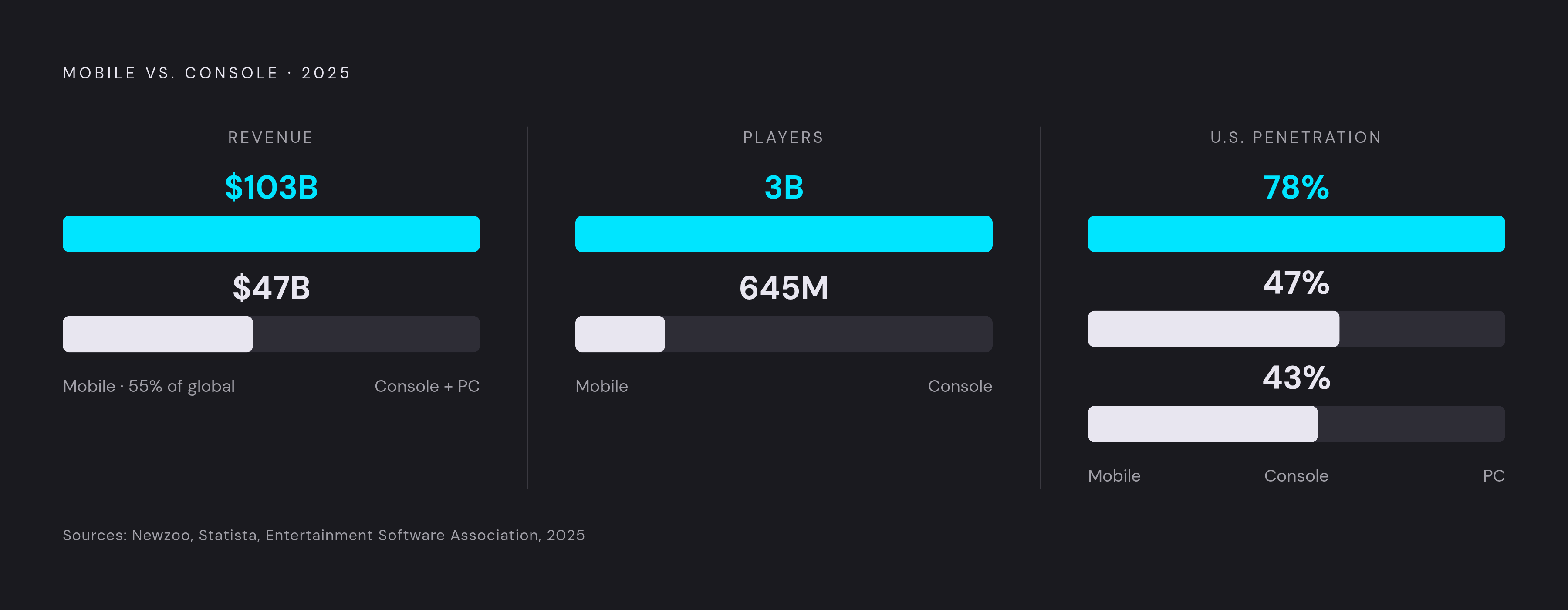
Mobile gaming pulled in $103 billion in 2025, more than console and PC combined. That's 55% of global gaming revenue sitting on a device most of us also use to check the weather and message friends about dinner plans.
The player count makes it sharper. Something like 3 billion people play games on mobile worldwide, against 645 million on console, and that's a significant gap. It explains why studios keep chasing phone screens instead of TV screens.
Growth backs it up: mobile gaming revenue grew 63% between 2020 and 2025, while console crept up 7% over the same stretch, and the ESA's 2024 U.S. player study found 78% of players gaming on mobile, versus 47% on console and 43% on PC. Mobile has stretched its lead every year anyone's bothered to measure it.
None of that holds up cleanly, though, and I'd be lying if I pretended the argument doesn't wobble a bit here. A good chunk of that $103 billion comes from match-three puzzles and idle clickers that nobody shopping for a handheld console actually wants. Mobile dominates by volume, but volume alone doesn't answer whether the phone in your pocket can play like a dedicated handheld without the usual compromises, and that's the question actually worth chasing.
The Nintendo Switch Lite and PlayStation Portal: what ecosystem-locked devices offer and what they cost you
Nintendo Switch Lite is the cleanest answer for one kind of buyer: someone who wants Zelda, Animal Crossing, and Mario, and could not care less about anything else. Build quality is genuinely sturdy, more so than most of the Chinese emulation handhelds coming up in the next section, and there's no setup friction to speak of. You buy it, you turn it on, you're in Hyrule twenty minutes later.
The trade-off is baked into the hardware: no TV output, no dock, no hybrid mode, portable full stop. That hasn't hurt Nintendo one bit; the Switch has built one of the largest install bases in handheld history. Big install base, deep exclusive library, and deep libraries are sticky by design. Still, the cost of entry never closes out. You pay for the hardware, then pay again for every exclusive, because none of it exists anywhere else on earth.
The PlayStation Portal is a streaming terminal built around the PS5 ecosystem. It started as Remote Play tethered to a home PS5; now it also does cloud streaming for PS Plus Premium subscribers, pulling from the Premium catalog without the console even needing to be on. At $199.99 it sits at the exact ceiling of this entire bracket.
The dependency is real, not theoretical. Take away a PS5 or a PS Plus Premium subscription and the Portal's value collapses toward zero, fast. It's a screen and a set of buttons waiting for a service to justify their existence. For someone already living inside PlayStation's world, that's a smart, focused buy. For everyone else, it's a significant wager on infrastructure they don't own.
Both devices tie you to one company's decisions about what you're allowed to play. Nintendo decides the Switch Lite's library, Sony decides the Portal's, and neither is a knock against either product since both do exactly what they were built to do. There's nothing shameful about buying into a walled garden if you actually like what it offers.
The emulation handhelds — Retroid Pocket 5, Retroid Pocket Flip 2, Miyoo Mini Plus, Anbernic, and Mangmi — and how to sort them
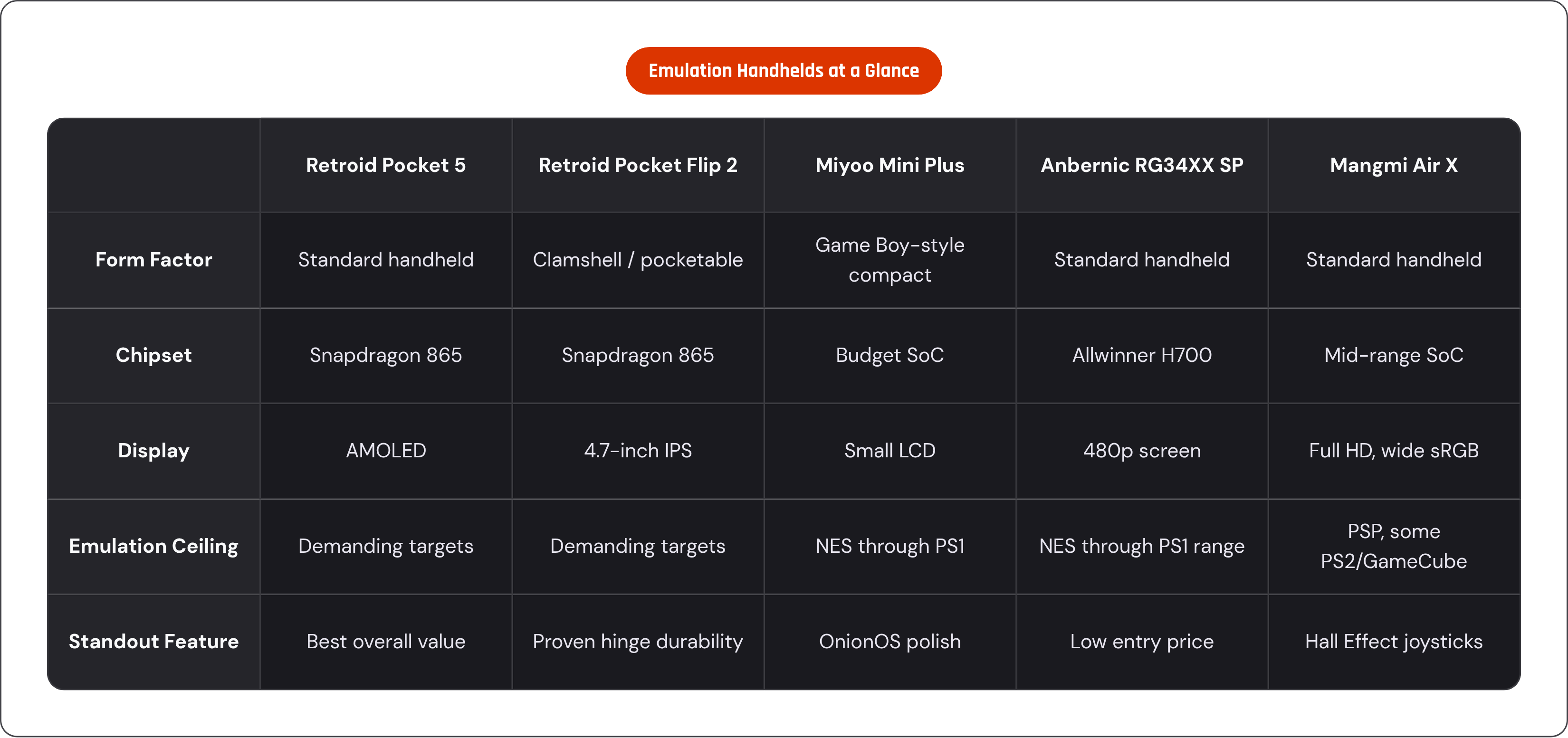
This corner of the market rewards people who read spec sheets for fun, which, if you're still with me eight paragraphs in, might include you. It sorts fastest along three lines: screen size and quality, OS choice between Linux simplicity and Android flexibility, and battery capacity. Everything else is decoration stacked on top.
The Retroid Pocket 5 gets called the best value in the tier because it earns it. It runs a Snapdragon 865, carries an AMOLED display, and chews through demanding emulation targets without choking. If you want something close to a premium Android handheld and refuse to cross $200 doing it, start here and stop looking; I did exactly that and haven't second-guessed it since.
The Retroid Pocket Flip 2 takes the same Snapdragon 865 guts and folds them into a clamshell borrowed from the old GBA SP's shape, with a 4.7-inch IPS screen. It's genuinely pocketable in a way most handhelds aren't, and people who've put real hours on it report the hinge holding up fine over time, no creak, no wobble.
Then there's the Miyoo Mini Plus, the budget champion, priced well under $200 and small enough to feel like a Game Boy in your hand. What makes it worth mentioning by name is OnionOS, the community firmware that turns the stock experience into something with a game switcher, box art scraper, even a blue light filter, the kind of polish you'd expect from something twice the price. Just don't ask it to run PS2 or GameCube; it stays in its lane, NES through PS1, and knows it.
Anbernic's RG34XX SP runs about $67.99 to $84 on Amazon depending on storage, with a 480p display, a 3,300 mAh battery, and an Allwinner H700 chipset. Worth flagging: the January 2026 update to the Metallic Blue version quietly dropped RAM to 1 GB. Nobody put that in the marketing copy, and you find out the first time you try to push it past its limits. Still fine for buyers who want cheap and capable and don't mind a few asterisks along the way.
The Mangmi Air X, a late 2025 release, aims at the mid-range with specs that used to live much higher on the ladder: a Full HD screen, wide sRGB coverage, 450 nits of brightness, Hall Effect joysticks. It handles PSP smoothly and gets through some PS2, GameCube, and 3DS titles with reasonable stability, though it's upfront about where the ceiling sits.
Step back and the value proposition holds across all five: decades of gaming history, open ecosystems, no subscription tax. What you give up is new releases, online multiplayer, and cloud gaming that works without extra fuss. These devices are built for what's already shipped, not for what's shipping next month. Fair trade, as long as you know it walking in.
Why a smartphone plus a controller can outperform every device listed above
The phone already in your pocket almost certainly runs a faster processor, a better screen, and a bigger battery than most of what's listed above. A controller doesn't add power to that equation; it unlocks power that's already sitting there, currently spending its life on email and getting otherwise ignored.
The library gap isn't close, and that's arithmetic, not enthusiasm. Apple Arcade, Google Play, Xbox Cloud Gaming, PS Remote Play, Steam Link, Nvidia GeForce Now, plus the entire native mobile catalog, all live on the same slab of glass. No sub-$200 handheld touches that breadth, however good its chipset, and it was never really a fair fight.
Cloud gaming is the actual differentiator, because it's the only route in this price range to current-generation games instead of emulated classics from twenty years back. Cloud gaming has grown well past fringe experiment territory, with platforms building multi-year roadmaps around it. It's infrastructure now, the kind platforms build multi-year roadmaps around. Xbox Cloud Gaming, PS Remote Play, GeForce Now, and Steam Link all run through a phone, though PS Remote Play still needs a PlayStation console to stream from and Steam Link still needs a PC sitting somewhere doing the actual work. The phone is just the terminal.
The cost structure flips too. Every other device on this list asks you to buy the whole thing outright. Here, the phone is a sunk cost you paid off months or years ago, and the controller is the only new line item on the receipt. The phone also doesn't clock out when the game session ends; it still makes calls, still runs your maps app, still does the fifty other things a phone is supposed to do while you're not looking at it.
The real ceiling on this argument is the phone itself: if it's old or gasping for RAM, none of this holds up. This is a strategy for people who already own capable hardware, not a reason to run out and buy a new phone. If yours is five years old and struggles to load Instagram without stuttering, the math changes fast, and not in your favor.
What to look for in a mobile controller and how the top options compare
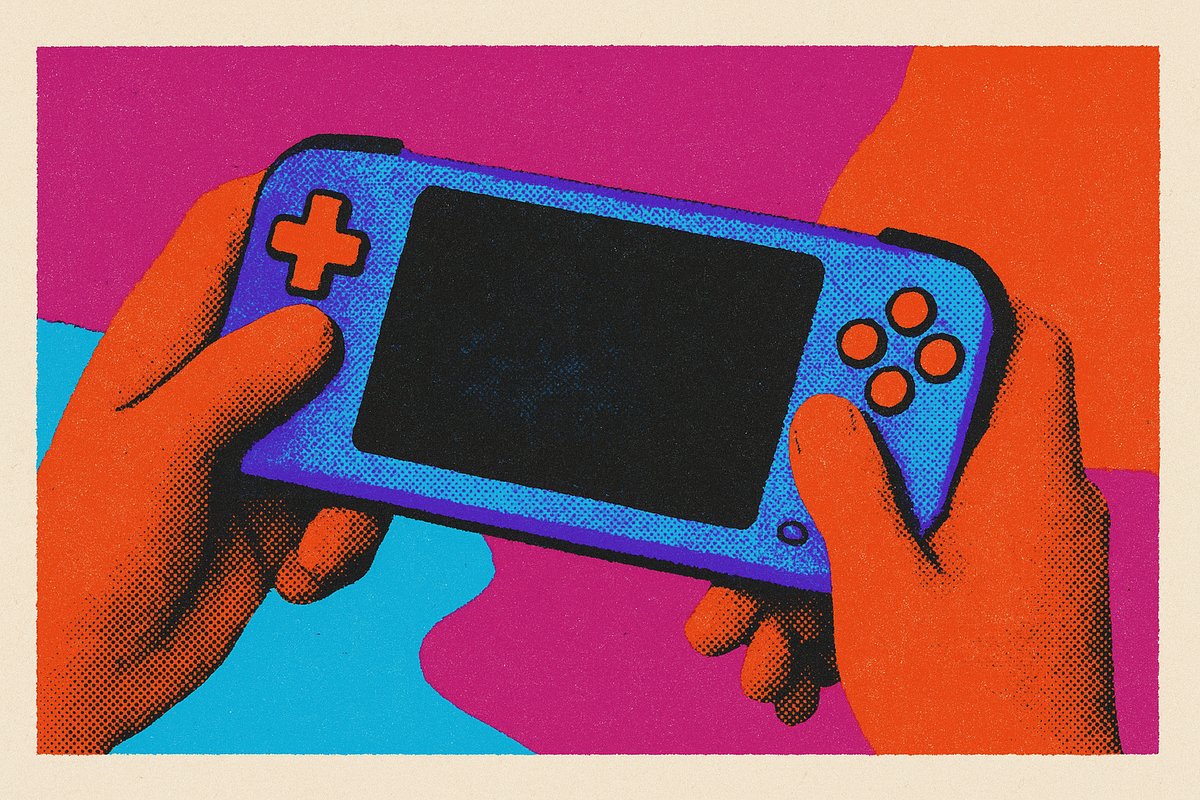
What decides whether phone-as-handheld actually feels like a handheld, rather than gripping a phone with plastic nubs glued to the sides, mostly comes down to the controller, and I learned this the hard way with a cheap clip-on that made Street Fighter feel unplayably stiff.
Input latency has to stay low enough that anything requiring precision, timing-based platformers, fighting games, doesn't feel sluggish, this is where the cheap ones fall apart first and fastest; ergonomics matter over a two-hour session in a way they never do during a five-minute store demo, so grip shape, trigger depth, and button feel are worth testing in person rather than reading about secondhand; and Hall Effect joysticks, the same tech the Mangmi Air X markets as a headline feature, eliminate the stick drift that eventually plagues almost every controller running old-style potentiometers.
Build quality is the one you genuinely cannot judge on day one; it shows up over months of backpack abuse, keys jangling against the case, the usual wear and tear nobody photographs for a review. The kind of engineering scrutiny that goes into a controller's design is what decides whether it survives two years or dies quietly at month eight.
The core product in this category connects directly to a phone and is built for comfort across long sessions rather than a five-minute burst. It works across iPhone and Android, and connects to Xbox Cloud, PS Remote Play, GeForce Now, Steam Link, Apple Arcade, and Google Play, basically the entire list from two sections back. It fits within the broader budget this guide covers, which leaves real budget room a Switch Lite or a Portal would swallow whole.
A higher-end option steps up from there, aimed at players chasing the closest thing to a real console controller feel on a mobile device. It's the upgrade for the enthusiasts and long-session players, the ones who notice haptic feedback and grip texture, the exact things all that part-iteration testing was solving for.
A companion app turns the hardware into something closer to a small ecosystem than a peripheral: game library organization, screen capture, community features baked in. Put together, the pitch is simple. It costs less than a dedicated handheld, works with a phone you already own, and doesn't lock you into any single publisher's walled garden.
How to match the right option to what you actually need
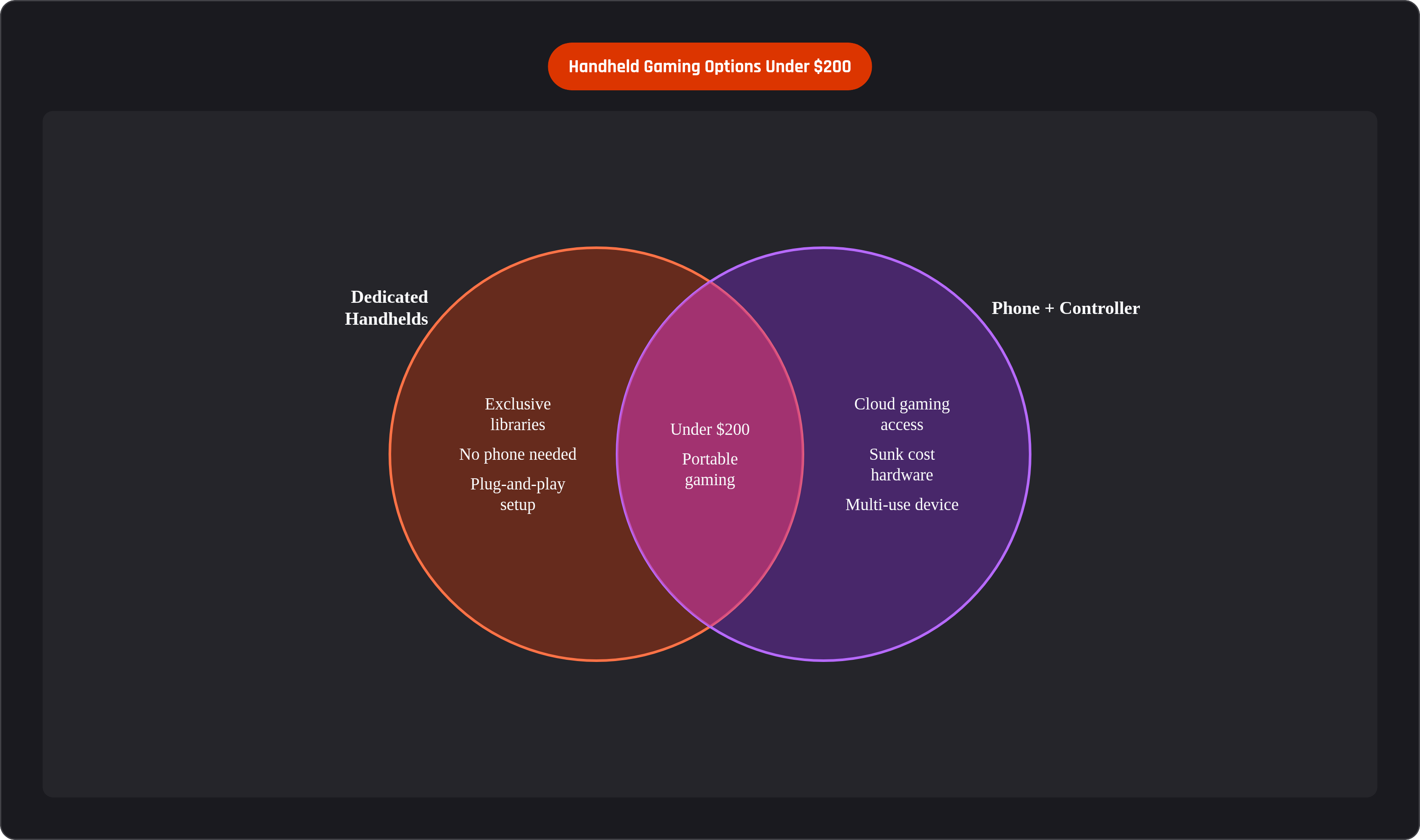
So who buys what? The Nintendo Switch Lite makes sense for exactly one buyer: someone who wants first-party Nintendo games and genuinely doesn't care what else exists in gaming. Not a small group, just a specific one, and it knows precisely what it wants walking in the door.
The PlayStation Portal makes sense for someone already deep inside PlayStation's world: PS5 under the TV, PS Plus Premium active, looking for a second screen for a library they've already bought into twice over. Outside that household, it's a narrower bet than the price tag lets on.
The emulation handhelds, Retroid, Miyoo, Anbernic, Mangmi, serve retro enthusiasts who want classic libraries without licensing headaches, and the pick among them comes down to ambition and shape. PS2 and GameCube reach, or content to live in NES-through-PS1 territory? Pocketable, or a bigger screen to actually see what's happening onscreen? Those two questions do most of the sorting for you, and if you can't answer them yet, that's fine; go hold a few in a store before you buy anything mail order.
The smartphone-plus-controller setup fits anyone who already owns a capable phone and wants the biggest library, cloud access, and flexibility without a second device cluttering the bag. That describes most people shopping in this price range, whether they've worked out the math yet or not.
Phone-plus-controller wins the most categories for the most people: lower total cost, the widest library by a wide margin, cloud-ready from day one, never boxed into a single job the way a dedicated handheld is. What counts as a "handheld gaming console" has quietly stretched past what it meant a few years ago. The better question is which device fits the games you actually play and the way you actually move through a day. For most people asking that question, the answer's already on the nightstand, charging, waiting for someone to finally clip a controller onto it and admit they've had the best handheld in the house the whole time.