Handheld PC Gaming Explained for Console Players
Inside the PC operating system hiding under a handheld's controller shell.
A handheld PC is a device shaped like a Nintendo Switch or a beefed-up Steam Deck controller, but underneath the plastic, it's running an actual PC operating system, either Windows 11 or SteamOS. That distinction sounds small until you realize it changes almost everything a console player assumes about how a gaming device works: how you buy games, how you troubleshoot them, and whether they run at all. This piece walks through what that difference actually means in practice, using the language console players already speak, so you can figure out whether one of these things belongs in your bag or on your coffee table.
Here's the plain version of the definition. Physically, a handheld PC looks like a console controller built around a screen: thumbsticks, triggers, bumpers, face buttons, a display built into the middle. But there's no dedicated game OS the way there is on a PlayStation or an Xbox. There's no cartridge slot, no console-exclusive storefront gating what you can install. You're buying from Steam, the Microsoft Store, Epic, wherever PC games live, and the library you get access to is the entire PC catalog. That's enormous. It's also got asterisks, which we'll get to.
Why does this matter enough to write 2,000 words about it? Because a console player picking one of these up for the first time is not buying a portable Xbox or a portable PlayStation, even when the box says "Xbox" on it. You're buying a small computer that can reach into those ecosystems, along with a much bigger one, but the rules of engagement change. It's a well-disguised laptop that happens to have thumbsticks.
The three devices console players are most likely to encounter
Three products dominate the conversation, and each one represents a different bet about what matters most to a buyer.
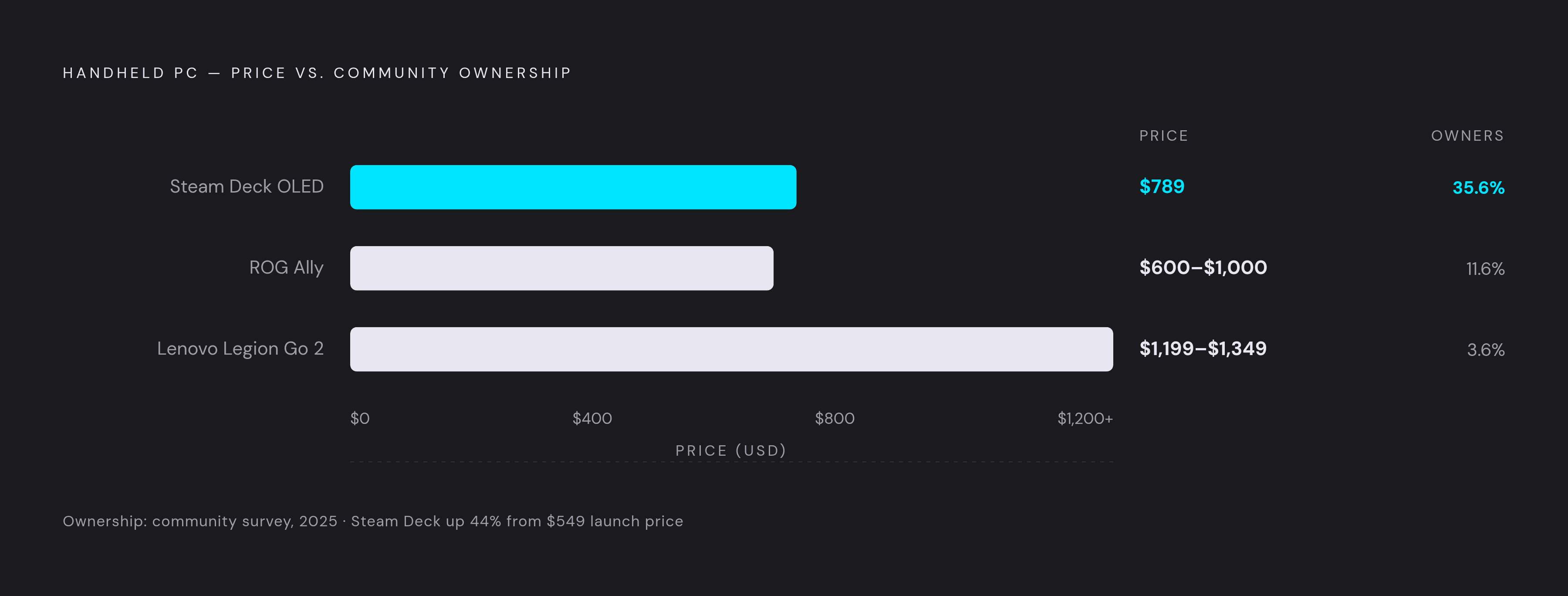
Valve's Steam Deck is the volume leader and the category's baseline. IDC data reported by The Verge puts shipments at somewhere between 3.7 and 4 million units since 2022, which is more than every Windows handheld combined. Engadget was still calling it the best balance of price, performance, and usability in the category as of mid-2026. That said, "best price" got a lot less flattering in May 2026, when Valve discontinued the LCD model and raised OLED pricing by 44%, from $549 to $789. The category isn't the budget play it used to be, and Steam Deck's own price history makes that clear.
ASUS takes the performance-first angle, and its newest move is co-developing the ROG Xbox Ally line directly with Microsoft. It launched in October 2025 across 45 countries, running Windows 11 dressed up with an Xbox full-screen interface, and it ships with three months of Game Pass Ultimate. Specs that'll actually mean something to a console player: a 7-inch 1080p 120Hz screen, 24GB of RAM, an 80Wh battery, and an AMD Ryzen Z2 Extreme chip that boosts to 5GHz. The Ally X runs $999.99; the base ROG Xbox Ally is $599.99. Circana analyst Mat Piscatella summed up its trajectory bluntly: it "had a nice month one and has come back down quite significantly." Translation: strong launch, not a Steam Deck killer.
Lenovo's Legion Go 2 goes all in on the screen. Its 8.8-inch OLED panel runs at 144Hz with HDR, and it's noticeably bigger and sharper than what the other two offer. It also costs the most: $1,199 for the SteamOS edition, $1,349 for the Windows Z2 Extreme configuration.
A TechPowerUp community poll of thousands of PC gamers in mid-2025 gives a snapshot of who actually owns what: Steam Deck at 35.6%, Nintendo Switch almost tied at 35.5%, ROG Ally at 11.6%, Legion Go at 3.6%. Steam Deck dominates the handheld PC slice, sure, but the near-tie with Switch ownership tells you something more interesting: the portable-console crowd and the handheld PC crowd are the same people, just deciding which shelf to buy from. Worth sitting with, since entry into this category now starts around $600 and tops out near $1,350, which is a wider price band than console shopping has ever really required.
How the operating system changes everything a console player expects
On a console, the operating system is invisible. You turn it on, it shows you your games, you play. Nobody thinks about "the PS5 OS" the way they think about which console to buy. On a handheld PC, the OS is a decision you make on purpose, and it's arguably the single biggest variable in how the device feels day to day.
There are two paths. SteamOS behaves the closest to a console: it boots into a controller-native interface, it handles game launching and controller mapping without you fiddling with settings, and it's tuned specifically for the hardware it runs on. Windows 11 behaves like a full desktop OS adapted for a handheld: maximum compatibility with anything PC gaming has ever produced, but more setup per game and more moments where you're staring at a settings menu instead of playing.
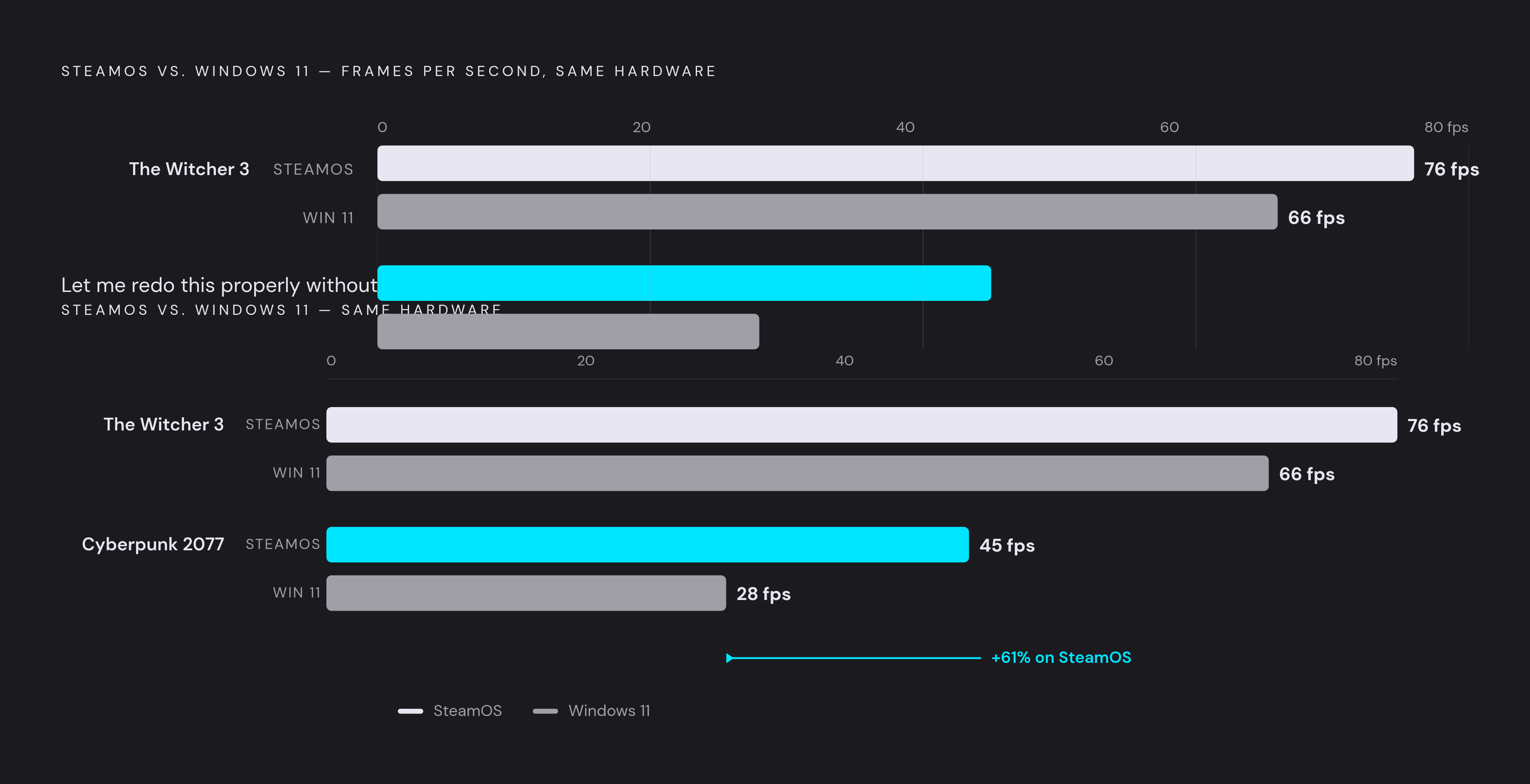
The performance gap between the two isn't a vibe, it's measurable. Dave2D's benchmarks showed SteamOS pulling up to 25% better frame rates than Windows 11 on identical hardware running Cyberpunk 2077. In The Witcher 3, SteamOS hit 76 fps against Windows 11's 66 fps, same machine, same settings. Broader testing found swings of 20% to 70% depending on the title, with one Cyberpunk test jumping from 28fps to 45fps just by switching operating systems. Why the gap? SteamOS strips out the background overhead that Windows carries around for general computing tasks. It's doing one job. Windows is doing several, and gaming is just one of them.
Here's the part that complicates the tidy "SteamOS good, Windows flexible" story: SteamOS isn't a Valve-exclusive anymore. Version 3.7.8, released in May 2025, officially added support for the ROG Ally and Legion Go. Lenovo went a step further and shipped the Legion Go S with SteamOS pre-installed that same month, the first non-Valve device to do that out of the box. So the operating system choice is peeling away from the hardware choice, which is good news for flexibility and slightly bad news for anyone who just wanted a simple answer.
What should a console player actually take from all this? SteamOS feels closer to what you already know from a PlayStation or Xbox. Windows gives you more, but it asks more of you in return; every extra megabyte of compatibility comes with an extra minute of configuration. The ROG Xbox Ally's whole pitch, an Xbox interface layered on top of Windows, is an attempt to get you the familiarity without giving up the flexibility. Whether that bridge holds depends almost entirely on which games you actually want to run, which brings us to the next question.
Which games actually run — and which ones don't
If you're running Windows on the handheld, the rule is simple: whatever runs on a gaming PC runs here, full stop. The only real question is whether the hardware can push a playable frame rate, and at 720p to 1080p with upscaling turned on, it generally can for most current releases.
SteamOS asks a different question, and the answer lives at ProtonDB, a community-run database that rates how well individual Steam games run through Proton, the compatibility layer that lets Windows-built games run on Linux-based SteamOS. Games get tagged Verified, Playable, or Borked. As of 2026, tens of thousands of games sit in the Verified or Playable camp, including Elden Ring, Cyberpunk 2077, Baldur's Gate 3, Hogwarts Legacy, Monster Hunter Wilds, and Helldivers 2. If your backlog looks anything like a normal console player's backlog, heavy on single-player RPGs and co-op action games, that library is effectively complete for you.
Now the honest caveat, and it's not a small one. Games running kernel-level anti-cheat, Valorant and a handful of battle royale titles among them, remain Borked on SteamOS. Proton simply can't grant the kind of Windows kernel access that these anti-cheat systems demand. Destiny 2 has bounced in and out of compatibility over time, which makes it a clear example of how unstable this particular corner of the ecosystem can be. If your gaming diet is mostly live-service competitive shooters, a SteamOS device is a real gamble. A Windows handheld doesn't have this problem at all, because Windows is the native environment those anti-cheat systems were built for.
Practical advice if you're coming from a console and eyeing SteamOS: check ProtonDB before you assume your favorite game just works. Set your resolution expectations at 720p or 800p, not 1080p; that's the realistic target on this class of hardware, not a compromise you're settling for. And pay more attention to stable frame times than to peak FPS numbers, because a handheld that dips and spikes feels worse than one that holds a steady, slightly lower number.
One more thing worth saying plainly: exclusives stay exclusive. A handheld PC doesn't magically put God of War on Steam if Sony hasn't ported it there. The advantage here is depth of the PC catalog, not some backdoor into console-only libraries.
Where handheld PCs sit in the broader portable gaming market
Zoom out and the numbers get interesting fast. The overall handheld gaming market, every portable device combined, was estimated at $12.9 billion in 2025, according to GM Insights. Handheld PCs specifically were a much smaller slice of that, around $2 billion in 2025, but that slice is projected to grow at a 20% compound annual rate through 2033, landing near $10 billion. In unit terms, Omdia estimates 2.3 million PC gaming handhelds sold in 2025, up 32% from 1.7 million the year before, with a forecast of 4.7 million units a year by 2029.
Nintendo, meanwhile, still owns the room. It held over 26.7% market share in 2025 across the broader handheld category, and the top five players overall, Nintendo, Valve, GPD, AYANEO, and Anbernic, together controlled 78.6% of the market. Omdia's own framing of the moment is worth quoting directly: "Switch's unique selling point of high-quality gaming on the go has now been commoditized." That's analyst-speak for a simple point: the thing that made Switch special isn't special anymore, and every handheld PC maker is racing to grab the attention Nintendo's upgrade cycle briefly loosens its grip on.
What does this mean for a console player sizing up the category? You're stepping into a market that's real but still finding its footing, not a mature, settled one. Hardware pricing is genuinely volatile, and Valve's own 44% price hike on the Steam Deck OLED is proof that even the category leader hasn't locked in a stable price floor. Regionally, Asia Pacific accounted for 46.8% of the global handheld gaming market in 2025, while the U.S. market alone was valued at $3.9 billion, which is a big part of why American console players are squarely in the crosshairs of every device launch you've read about so far.
How handheld PCs compare to traditional consoles on the things console players care about
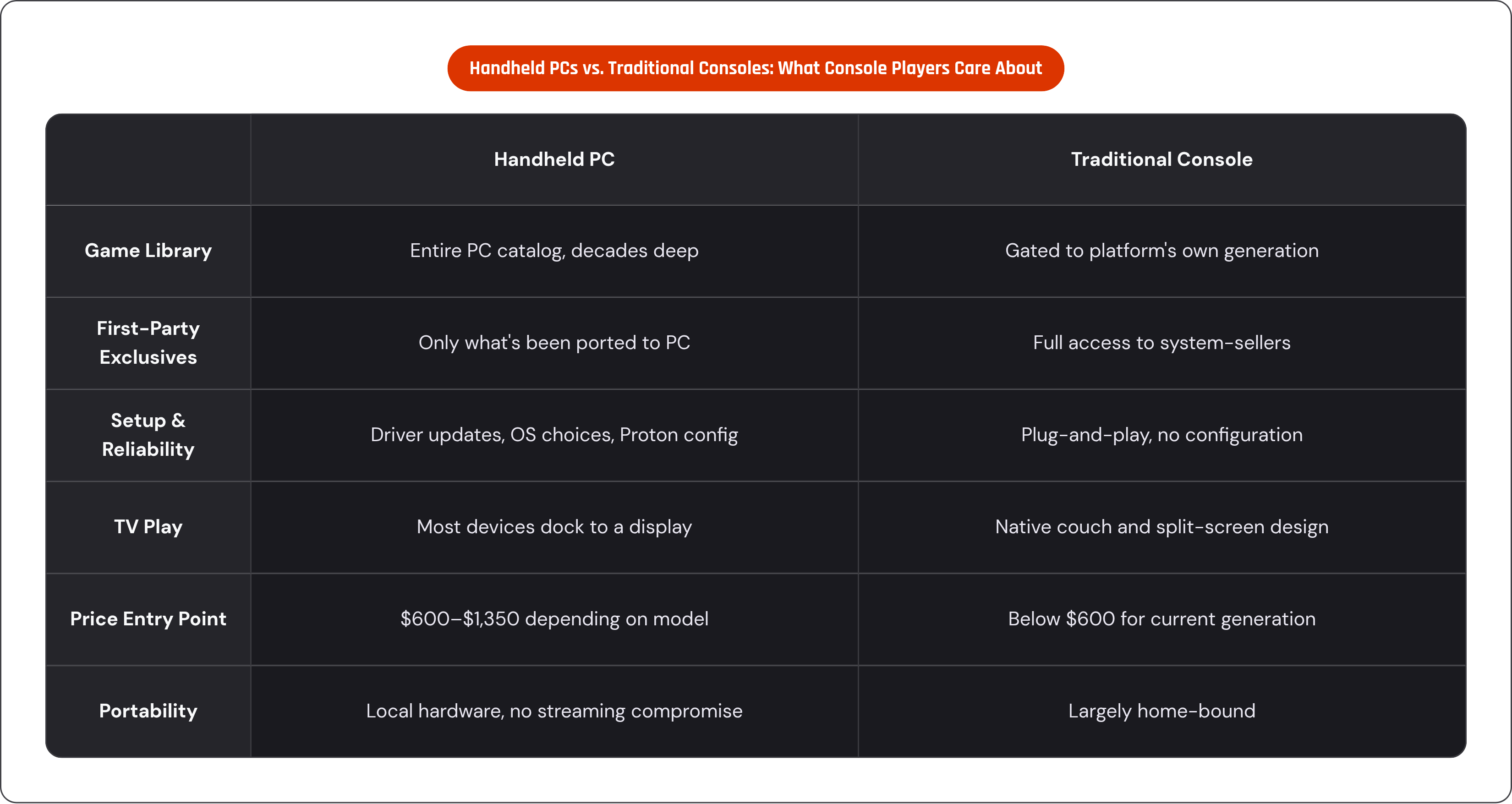
Let's skip the spec sheet comparison and talk about what console players actually care about: picking the thing up and playing, access to games they want, playing on the couch and the TV, multiplayer that doesn't fall over, and getting fair value for the money.
Handheld PCs win on a few of these clearly. Library depth is the big one; you're not gated to a single generation's catalog, you get years of PC releases going back decades. Portability doesn't come at the cost of the actual game, either. This isn't a streaming compromise where you're borrowing someone else's server; it's real local hardware running the real game, in your hands. Most of these devices also dock to a TV or monitor, so you're not locked into handheld mode if you'd rather sprawl out on the couch. And cloud gaming and remote play, which we'll dig into next, sit on top of all this as an added option rather than a replacement for local play.
Consoles still hold ground where it counts, too. First-party exclusives are the obvious one; PlayStation and Xbox system-sellers don't automatically show up on PC, and some never will. Plug-and-play reliability matters more than people give it credit for: a console doesn't ask you to configure Proton, manage a graphics driver, or pick between two operating systems before you can play. Price ceiling is another real advantage, since a current-generation console still costs less than the $999 to $1,349 range the top handheld PCs occupy. And the whole culture of couch co-op and split-screen built around a shared TV screen is still a console strength that handheld PCs, by nature of being handheld, don't replicate the same way.
So what's the honest takeaway? These aren't substitutes for each other. A handheld PC complements a console library far more often than it replaces one, unless you're already a PC-first gamer looking to take that library on the road. If that's you, if you've already got a sizable Steam library and you're tired of being chained to a desk to play it, a handheld PC solves a problem you actually have. If you're a console player whose whole world is first-party exclusives and couch co-op, you're solving a problem you don't have yet.
Cloud gaming and remote play as a handheld PC feature, not a workaround
Cloud gaming on a handheld PC isn't a fallback option you reach for when local hardware falls short; with a solid connection, it's a legitimate front-door way to reach both your console and PC libraries at once.
Several services plug into this directly. Xbox Cloud Gaming comes built into the ROG Xbox Ally through Game Pass, streaming Xbox and PC Game Pass titles without needing local horsepower to run them. Nvidia GeForce Now streams PC games you already own off Nvidia's own servers, again with no rendering happening on the handheld itself. PS Remote Play streams your PlayStation library from a home console straight to the device, so a game that will never get a native PC port is still reachable. And Steam Link streams from a home PC running Steam over to the handheld, effectively turning your desktop into a private remote server you're accessing from the couch, the backyard, or a hotel room.
What does this actually solve? Games too demanding for the handheld's local GPU can be streamed instead at higher settings than the hardware could manage on its own. PlayStation exclusives that will likely never run natively on PC become playable anyway, just streamed. And the Xbox Game Pass library becomes reachable even on a SteamOS device through browser-based cloud streaming, sidestepping the whole Windows-versus-SteamOS compatibility question entirely for that slice of games.
The catch, and it's a real one: cloud gaming needs a strong Wi-Fi or 5G connection to feel good, where local play just doesn't care. That's actually where handheld PCs have a structural edge over a phone paired with a controller for cloud-only setups, since you can fall back to real local hardware the moment the connection gets shaky. Which raises the obvious next question: if all of these streaming services already work on a phone too, what exactly is the handheld PC buying you that a phone and a good controller clip can't?