Smartphone Gaming Controller vs Dedicated Handheld Controls
Phone controllers and handhelds each win in different ways.
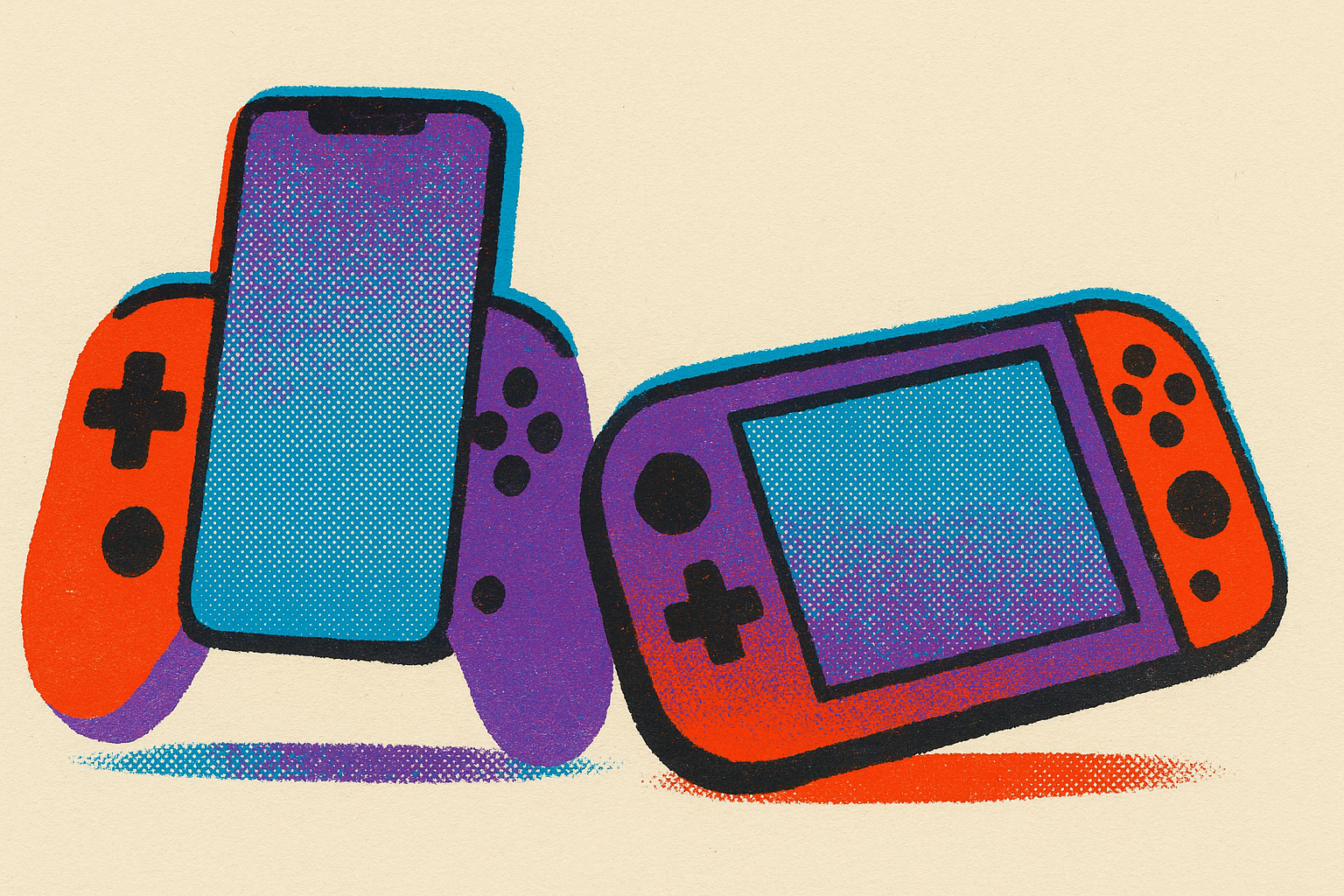
Mobile gaming is now the biggest gaming platform globally, and that's forcing a question that used to sound absurd: can a phone with a controller clipped onto it actually compete with a device built from the ground up to play games? I've spent way too many hours testing both setups on the same commute, the same flights, the same couch. Neither one wins outright, and I'll try to convince you that's the actually interesting part of the story. This piece walks through where each setup earns its keep and where it falls flat, so you can figure out which one fits how you actually play.
The numbers are hard to ignore. The ESA's 2024 study found 78% of U.S. players game on mobile, compared to 47% on console and 43% on PC. Newzoo's 2025 forecast puts total mobile gaming revenue at roughly $103.0 billion, more than console ($45.9 billion) and PC ($39.9 billion) combined. And 2025 made the picture messier in a good way: new gaming handhelds from multiple manufacturers entered the market, Nintendo launched the Switch 2, and cloud gaming services continued to mature rapidly. Two mature approaches, same problem, genuinely different answers.
Quick definitions, then we move. A smartphone plus controller is the phone already in your pocket, fitted with a clip-on gamepad or cradle-style grip. A dedicated handheld is its own thing: its own processor, its own screen, its own control layout, built with one job in mind. Where each one earns its keep, and where it doesn't, is the rest of this piece.
What each setup is actually betting on
A phone controller bets on versatility. The phone's already in your pocket, already online, already more powerful than most people give it credit for. The controller just gives that hardware a real way to play games. You're unlocking a device you already own instead of buying a new one.
A dedicated handheld bets on focus. One device, one job, always charged, built around the act of playing. No notification popping up mid-boss-fight, because the thing physically cannot do anything else. That focus is the entire pitch, and it's a good one.
Phone-plus-controller players put up with some friction (clipping a controller on, watching the battery drop, silencing texts) in exchange for a huge library, cloud streaming, and no extra device to pack. Dedicated handheld players trade that flexibility for immersion and instant readiness. Neither trade is smarter on paper. They serve different players, different moments, different genres, and the rest of this piece runs through four practical axes: library, control quality, portability, and cost.
Game library: where each setup wins and loses
Dedicated handhelds win on curation. Switch 2 titles are built specifically for that hardware, full stop. The Steam Deck opens the door to a vast PC game catalog, though compatibility with individual titles can vary. Android-based handhelds tap the Play Store: a wider net, but a rougher floor underneath it.
The phone-plus-controller setup wins on breadth, and differently depending on where you look. iOS gets you the App Store and Apple Arcade, with a growing number of titles supporting controller input. Android gets you the full Play Store. Then there's the part that actually changes the math: Xbox Cloud Gaming through Game Pass Ultimate, GeForce NOW, PS Remote Play, and Steam Link. Two of those stream from the cloud; the other two stream from hardware you already own. Combined, they put something close to the entire console and PC catalog on your phone screen.
That cloud angle is the single biggest argument in the phone setup's favor. With a solid connection, a controller and a phone can run AAA games no mobile-native handheld will ever run natively, no asterisks needed. Dedicated handhelds answer back with reliability that cloud can't touch: a Switch 2 cartridge or a locally downloaded library works with no internet connection required. A cloud stream can't make that same promise, not without physics changing.
Genre matters more than people admit here. Strategy games, narrative adventures, casual puzzle titles tend to run fine on touchscreens, whether that's a mobile-native handheld or a bare phone screen. Shooters, action-RPGs, and competitive multiplayer lean hard toward the phone-plus-controller setup, but only when cloud streaming is actually available and the connection holds. The library gap that used to favor dedicated handhelds is shrinking fast as cloud services mature. Anyone stuck without a strong, stable connection still feels that gap, and it does more work than it should have to.
How control quality actually differs between the two setups
The old complaint about phone controllers wrote itself: clip-on rigs added bulk, thumbsticks felt cheap and mushy, and the whole rig was awkward to carry around. Fair complaint, for a while. It doesn't hold up nearly as well anymore.
Controller engineering actually moved. Magnetic Hall effect sensors, which address the stick drift issues associated with older potentiometer-based thumbsticks, have appeared in a growing number of phone controller designs. Newer TMR (Tunnel Magnetoresistance) designs go a step further, cutting drift out almost entirely while improving sensitivity over Hall effect sensors. Haptics have come a long way too, with premium clip-on controllers offering tactile feedback features that many budget dedicated handhelds skip entirely.
Dedicated handhelds keep some real advantages too. A proper D-pad and full-sized analog sticks, molded into one chassis, sidestep the clamping and alignment problems that haunt clip-on designs. Triggers and bumpers on a handheld are built for that device from day one, not stretched to fit whatever phone you happen to be carrying that week. The Nintendo Switch 2 Pro Controller, priced at $84.99, is a good example of what a purpose-built pad feels like once nobody's compromising for portability.
Ergonomics is where phone controllers carry the most real risk, and it deserves more attention than it usually gets. Poorly designed grips push your wrists into extension over time, something reviewers have flagged specifically about mobile-first controller shapes. Well-built cradle controllers push back with wider handles, textured rubber, and recessed grips designed to accommodate phones with cases. Weight cuts both ways: controllers under 140 grams — a common threshold for portable designs — travel well, but heavier units with bigger grips can feel more substantial during long sessions. Latency's worth a mention too. For competitive play, a wired USB-C connection on a phone controller can offer lower latency than Bluetooth, a potential edge in anything twitchy like shooters or fighting games.
So where does that leave things? The gap between a well-engineered phone controller and a dedicated handheld is a lot narrower than it once was. Dedicated hardware still wins on physical cohesion, that sense the controller and the device were built together as one unit from the start.
Portability in practice: what "portable" actually means for each setup
Both setups call themselves portable. They mean different things by it, and that difference matters more than either marketing pitch admits.
The phone's always with you regardless of whether you're gaming; the controller's the optional extra you decide to toss in a bag or leave on the counter. That's the phone setup's real advantage: zero additional device, as long as the controller stays in your backpack most days, and the phone still handles everything else (maps, texts, music) while it's not being used for games. Friction shows up elsewhere. A clip-on controller adds real bulk once attached, and it stops being pocket-friendly the moment you clamp it on. Demanding games chew through battery fast, and nobody enjoys watching their charge disappear before a session even properly starts. Calls and texts interrupt play in a way a single-purpose device never will.
The dedicated handheld offers a different set of tradeoffs. It's always ready: no clipping, no Bluetooth pairing, no fumbling around in a bag. It doesn't touch your phone's battery, so you show up to a trip with both devices fully charged and neither one compromised. And because gaming is the only thing the device does, plenty of players find that focus genuinely more immersive, free of the low hum of distraction a phone always carries around with it.
Worth saying out loud: the handheld has a hidden cost, since it's a second device you now have to remember, charge, and physically carry, on top of a smartphone that's already sitting in your pocket doing the job. As a rough rule, for daily commutes or grabbing fifteen minutes of play between errands, the phone-plus-controller setup wins on sheer lack of friction. For a dedicated gaming trip, or a long session where you actually want to disappear into something, the handheld's singular focus starts to earn its keep.
Where cloud gaming changes the calculation entirely
Cloud gaming is the wild card that reshuffles most of this comparison. Cloud streaming services have matured to the point where a phone and a decent controller can access AAA console and PC titles in ways that were not practical a few years ago.
That's the strongest card the phone setup has to play. It's the only portable form factor that reaches into those full streaming libraries without a PC or console sitting nearby doing the heavy lifting. Dedicated handhelds like the Switch 2 carry their own excellent, curated libraries, but they're largely fenced off from Xbox, PlayStation, and Steam catalogs unless you're running an Android-based handheld or leaning on a separate cloud app.
The catch is obvious: a strong, stable connection is non-negotiable for any of this to work. Players stuck with spotty Wi-Fi or unreliable cellular coverage will find a dedicated handheld with a downloaded library far more dependable, no workarounds available.
So who actually benefits here? Someone already paying for Game Pass Ultimate, PS Plus, or GeForce NOW. Someone who plays mostly at home on solid Wi-Fi, or commutes somewhere with dependable 5G. Someone who wants access to new AAA releases without buying a console outright. For that player, the phone-plus-controller setup starts functioning, for practical purposes, like a console that happens to fit in a jacket pocket.
Cost and what each setup actually requires you to spend
Comparing sticker prices here can be misleading. The phone setup looks nearly free if you already own a decent smartphone. The dedicated handheld looks self-contained, but that self-containment carries its own ongoing bill.
Break down the phone-plus-controller cost and you get three pieces: the phone itself, a sunk cost for most buyers already; a cloud subscription if you're using Xbox Cloud Gaming or GeForce NOW, a recurring monthly charge; and whatever you spend on native mobile titles, many of which are free-to-play with in-app purchases stacked on top. The dedicated handheld's cost structure looks different: the device itself, ranging from budget Android handhelds up to a Switch 2 at launch pricing; games at full retail pricing for Switch 2 titles, though Steam Deck owners can draw on a broad PC game catalog with varied pricing; and extras like cases, a pro controller at $84.99, or extra storage that adds up faster than people expect.
Both sides hide costs. If gaming pushes someone toward upgrading their phone more often just to keep up with performance demands, that "free phone" assumption quietly falls apart. A dedicated handheld carries its own hidden costs too: its own case, its own charging cable, its own eventual replacement cycle, with a game library that keeps compounding in cost over the years you own it.
For anyone already paying for a cloud subscription, the phone-plus-controller setup hits its value ceiling fast. One controller purchase, and an entire streaming catalog opens up. A solid mid-range phone controller often delivers noticeably better value than an entry-level dedicated handheld stuck with a thin or expensive game library.
Which setup fits which kind of player
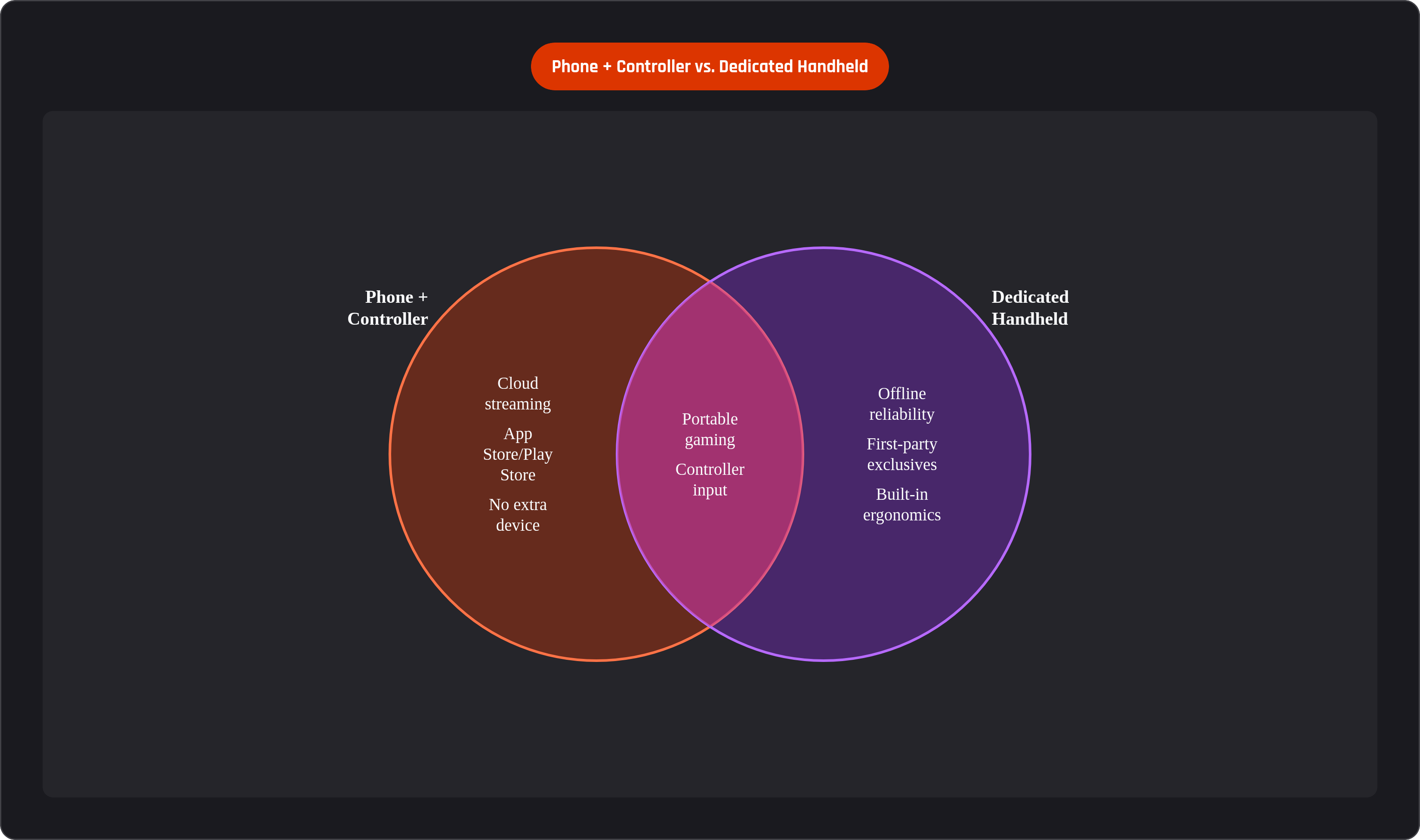
Here's my honest read: if you already own a decent phone and you're not the type who buys a second gadget just because it exists, the phone-plus-controller setup wins for you, and it isn't close. That's my own bias talking, built from my own habits, not some universal law. So let's break down where each one actually lands for different kinds of players.
The phone-plus-controller setup fits better if you already own a modern smartphone and have zero interest in carrying anything extra, if you're subscribed to Xbox Cloud Gaming, GeForce NOW, or PS Remote Play and want console-quality games without buying a console, if your sessions run an hour or less where fast setup and teardown actually matters, or if you bounce between genres and want the App Store, Play Store, and cloud catalog all living in one place.
The dedicated handheld fits better if you want distraction-free sessions where the device has exactly one job, if first-party libraries (Switch 2 exclusives being the obvious example) actually matter to how you spend your time, if you game offline often, on flights or in dead zones where connectivity is a coin flip, or if you just want a controller and screen designed together from day one, no setup friction standing between you and playing.
Plenty of players don't pick one. They use a phone controller for cloud gaming at home and during commutes, then reach for a dedicated handheld on trips or for exclusives they can't get anywhere else. That's just using each device for what it's actually good at. The phone in your pocket is already a capable gaming machine, whether you've noticed or not; the real question is whether a controller turns the phone you're already carrying into the right tool for how you, specifically, want to play.