Best Portable Game for Every Play Style
Find your ideal portable game by matching your play style to the right format and hardware.
Mobile gaming pulls in roughly $103 billion a year now, about 55% of global gaming revenue, ahead of console at 24% and PC at 21%, per Newzoo's 2025 numbers. Put another way: 3 billion of the world's 3.6 billion gamers play on mobile. Studios build Unreal Engine 5 open-world titles, full console ports, and cloud-streamed blockbusters for phones now, so the old idea that "portable gaming" meant a lesser version of the real thing has basically flipped on its head. Same games, running the same way, wherever you happen to be standing when you open the app.
So here's the question I keep coming back to: if the hardware ceiling has climbed this high, what's still ruining your commute-gaming session on the bus? Nine times out of ten it's a mismatch between the game and how you actually play. Untangling that mismatch is the whole point of what follows.
How play styles map to portable formats before a single game is named
Five play styles do most of the work here, and they'll keep showing up through the rest of this piece. Competitive action players need low input lag and precise controls, whether that's a three-minute Brawl Stars match or a forty-minute ranked grind. Narrative explorers care about story, pacing, and atmosphere, and their sessions swing wildly depending on the game. Strategy and builder types want depth over reflexes and don't mind a busy screen or a long sit. Casual players work in ten to twenty minute windows and want to pick up and put down without friction. Retro players already know what they want: familiar mechanics, low friction, and roughly zero interest in anything billed as "new and improved."
Format matters as much as genre, maybe more. Native mobile games are always there, no setup, touch or controller, take your pick. Cloud services (Xbox Game Pass Ultimate, GeForce Now, PS Plus Premium) hand you console and PC libraries without owning the actual hardware. Remote play, through Steam Link, Xbox Remote Play, or PS Remote Play, streams from a machine you already own, and it usually beats pure cloud streaming on latency, assuming your home Wi-Fi isn't sabotaging you.
Physical controls matter for three of these five play styles in particular. Competitive, narrative, and strategy players get something real out of a controller, while casual and retro players can get by on touch but improve meaningfully with one too, especially now that average session lengths have stretched long enough to expose how uncomfortable a touchscreen gets after twenty minutes of thumb-cramping. Hardware shows up in every recommendation below, so let's name it now: clip a phone into a Backbone One or Backbone Pro and it turns into something closer to a dedicated handheld, one that runs native games, cloud streams, and remote play without you having to carry a second device around.
Games for competitive action players who want wins, not workarounds
Touch controls cost competitive players matches. Full stop. The lag and the lack of precision show up exactly when you need a clean flick shot or a split-second dodge, and ranked ladders don't hand out sympathy points for a smudged screen.
Native mobile has answered this better than you'd expect, honestly. PUBG Mobile runs a full battle royale with a mature ranked scene and controller support that feels built in, not bolted on as an afterthought. Call of Duty: Mobile keeps matchmaking fast and the gunplay familiar, and its controller compatibility has been tested across enough phones by now that it's a known quantity. Brawl Stars might be the sleeper pick here: top-down, short match windows, punchy enough to play standing on a train platform, but with enough depth underneath to reward a real ranked grind if you stick with it.
Cloud gaming opens up a different tier entirely. Xbox Game Pass Ultimate, $19.99 a month, streams Halo Infinite multiplayer and Fortnite to mobile at up to 1080p, so the games you already play on console just travel with you now. GeForce Now Ultimate, also $19.99 a month, plugs into your existing Steam or Epic library, and its RTX 5080 Blackwell servers push up to 4K at 120 frames per second, about 30% more performance than the last server generation gave you. That's not a small bump if frame rate is the thing standing between you and staying alive in a fight.
There are real limits here, and I'd rather say them plainly than pretend they don't exist. Input latency on cloud streams is still noticeable to high-sensitivity players, a complaint that keeps popping up in ResetEra threads. GeForce Now handles it better than most, and remote play from your own console still wins on latency when your home network can carry the load. Hall Effect sensors and sub-1ms mechanical switches, standard on 2026 controllers, matter more here than anywhere else on this list. Skip them and you'll feel it in the one fast-reaction moment that decides the match. A clip-in controller at least means you keep your phone's actual screen while gaining console-grade buttons, so you're not trading a good display for good input.
Games for narrative explorers who need a world to sink into
Story-driven games used to live on consoles almost exclusively, and the mobile ports that existed were stripped down or clumsy on touch. Everyone just quietly accepted that as the tax you paid for playing on the go.
That's changed, mostly. Genshin Impact delivers a sprawling open-world RPG with full voice acting and console-quality visuals in its native cross-platform release, no asterisk needed. Titles like Pascal's Wager and Oceanhorn 2 were built as deep single-player adventures for mobile from the ground up. Apple Arcade works almost like a curation layer here: no ads, no in-app purchases, just full narrative experiences like Sayonara Wild Hearts and Creaks that fit neatly into a commute.
Cloud streaming is where things get genuinely new for this group. PS Plus Premium, $19.99 a month, is the only service carrying Sony's first-party catalog: God of War Ragnarök, Spider-Man 2, Horizon Forbidden West, now playable on the phone you're holding in bed at midnight. Steam Link, free, streaming from your own PC, opens up the back catalog of PC narrative games, Disco Elysium, Hades, Baldur's Gate 3, at zero subscription cost, as long as your home machine stays powered on.
Session pattern matters more for this group than for almost anyone else on this list. Narrative players tend to settle into long, uninterrupted stretches, so comfort becomes the real limiting factor before battery life or library size ever do. This is the group where a controller does the most invisible work: it eases the friction of a touch UI and drops you straight into the world, which is really the whole point of playing these games in the first place.
Games for strategy and builder players who want depth without a desk
Strategy has always struggled on handhelds. Small screens and fiddly touch inputs tend to punish a genre built around dense information and precise clicks. Mobile-native design solved that problem differently than PC ever did, and the results hold up better than you'd guess.
Clash Royale built its entire loop around one-handed play and real-time decisions, a genuinely different design challenge than just shrinking a PC strategy game onto a smaller screen. Bad North keeps things minimalist: real-time tactics with a tight risk-reward structure that looks and plays beautifully small. Civilization VI's mobile port carries the full 4X experience to iOS and Android with touch controls that were clearly built with care, and controller support sharpens it further still. Into the Breach might be the cleanest fit of the bunch: turn-based, each decision self-contained, naturally pauseable, close to ideal for anyone playing on a commute.
Cloud and remote play stretch this further. Xbox Game Pass Ultimate includes genuinely deep strategy titles, Crusader Kings III, Age of Empires IV, now streamable to mobile, though the dense UI benefits from a controller with a touchpad or a bigger, tablet-sized screen. GeForce Now gives you your own Steam strategy library without rebuying anything, and it works especially well for turn-based games, where frame rate matters far less than it does in a shooter.
There's a hidden advantage here that most casual conversations about portable gaming skip right past. Turn-based and asynchronous strategy games tolerate interruption unusually well. A ten-minute train ride can be a meaningful move in a Civilization game in a way it just can't be in a fast-twitch shooter; that tolerance for getting interrupted might be strategy's best-kept portable secret.
Games for casual players who have 15 minutes and want to actually enjoy them
The casual mobile audience is the center of the market, not a side crowd. 44% of women gamers play exclusively on mobile, compared to 27% of men, and Gen Alpha leads mobile penetration at 94%, with Gen Z close behind at 92%. That's a genuinely enormous group, and the design brief for them is specific: a complete, satisfying experience in under 20 minutes, no mandatory setup, no loading friction, no penalty for putting the phone down halfway through.
Alto's Odyssey nails this with an endless runner that's more meditative than competitive, tactile and pretty with zero commitment asked of you. Monument Valley 1 and 2 are puzzle games so carefully designed that five minutes feels satisfying and complete, no grind attached. Pokémon GO turns actual physical movement into the session structure itself, so there's no sitting down required at all. Stardew Valley's mobile version is the odd one out: it starts as a casual, low-stakes farm sim and quietly expands into something much deeper at whatever pace the player sets, making it one of the rare games that works for both casual and builder audiences at once.
Touch controls earn their keep here in a way that's rare on this list. The best casual games are built for thumbs from day one, so a controller is optional, and sometimes it even adds friction where none needed to exist. On the cloud side, Amazon Luna (free with Prime, or $9.99 a month for Luna+) lowers the barrier to entry, which fits this crowd's lower-stakes relationship with the whole hobby.
Games for retro players who know exactly what kind of fun they're looking for
Retro players know precisely what they want, which makes this group the easiest to write for and the hardest to surprise. Familiar mechanics, proven design, low-friction access: that's the whole ask. Novelty was never the point, so pitching it to them would be selling something they didn't come to buy.
The App Store and Google Play both carry official ports and remasters, Final Fantasy titles, Chrono Trigger, the Room series, that are complete, well-maintained, and often meaningfully improved for touch. Apple Arcade's back catalog adds curated classics on top, without ads or upsells layered in.
Cloud streaming adds a legal, official path to older console libraries too. Xbox Game Pass Ultimate includes backward-compatible Xbox 360 and original Xbox titles streamable straight to mobile, retro gaming without a dusty console sitting under the TV. PS Plus Premium's PlayStation catalog covers PS1, PS2, and PSP classics, though those are downloadable rather than streamed; cloud streaming on that service applies specifically to PS3 titles, worth knowing before you go looking for one and stumble onto the other.
Dedicated retro hardware exists too, and it deserves a mention here. Devices like the Miyoo Mini Plus are purpose-built for emulation: excellent controls, a genuinely nice little screen, flawless performance on anything up to PS1, and Onion OS adds a game switcher and box art scraper on top. A phone with a good controller covers most of the same ground through official channels, minus the second device rattling around in your bag. Controllers matter more here than the spec sheet suggests, too: the tactile click of a physical button is part of what retro players are actually chasing, and touch input just doesn't scratch that itch, no matter how sharp the screen looks. A good clip-in phone controller gets close to recreating the muscle memory of an original PlayStation controller or a Game Boy, which, for this crowd, is basically the entire point.
How to choose your setup once you know your play style
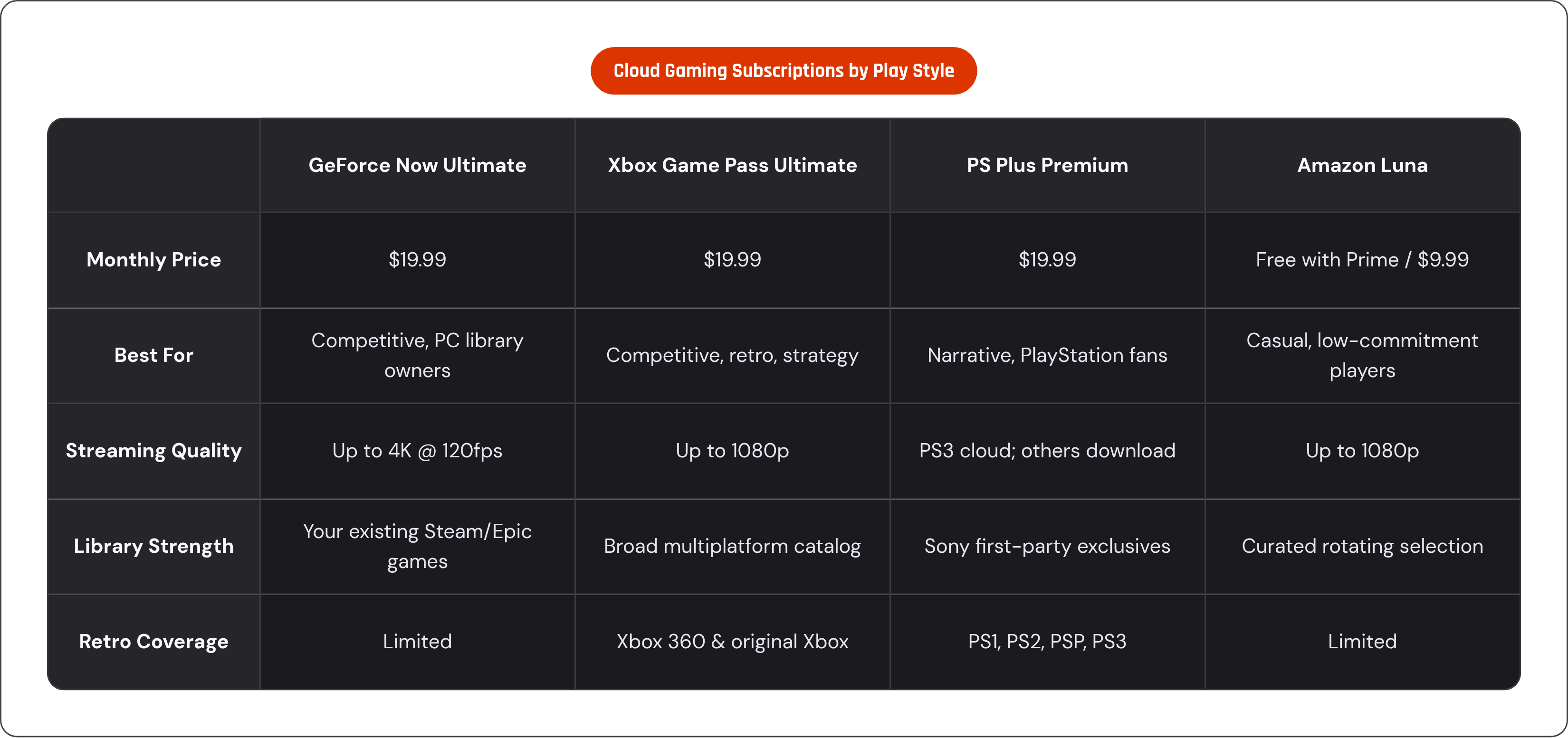
Phone plus controller, dedicated handheld, cloud subscription, or remote play: four real options, each with a genuine best-fit user. Anyone telling you one option wins for every player is glossing over how differently people actually play, and probably selling you something.
Phone plus controller covers the widest ground by a fair margin. It plays native mobile titles, cloud streams from Xbox, GeForce Now, PS Plus, and Luna, and handles remote play through Steam Link, Xbox Remote Play, or PS Remote Play, all from the one device already in your pocket. Clip-in phone controllers, available in wired and wireless options and compatible across both iOS and Android, deliver console-grade input without adding a second device's weight to your bag. No separate library to buy into either; your existing subscriptions and purchases just travel with you.
A dedicated handheld makes more sense in a few specific cases. Nintendo Switch 2 is the pick if you want Nintendo's exclusive lineup and a tightly curated first-party catalog; CNN Underscored named it the best overall handheld in 2025. Steam Deck suits players who care about modding, indie depth, and owning their PC library locally, and the OLED models improved on that further last year. Legion Go S fits players who want Windows flexibility, cloud access, and a large 120Hz screen, and it outpaces the Steam Deck specifically in CPU-bound scenarios.
Matching cloud subscriptions to play style is fairly direct once you know your own habits. Competitive players with an existing PC library should look at GeForce Now Ultimate at $19.99 a month; those chasing breadth of content do better with Xbox Game Pass Ultimate at the same price. Narrative explorers who already own a PlayStation get the most out of PS Plus Premium, while casual players already paying for Prime get a nearly frictionless entry point through Amazon Luna's free tier or the $9.99 Luna+ upgrade. Retro players chasing official back catalogs land on either PS Plus Premium or Xbox Game Pass Ultimate, depending on which childhood console they're trying to revisit.
One thing holds steady across all five play styles: physical controls make the experience better. Sometimes by a hair, sometimes by a lot, but it doesn't run the other way. The phone stopped being the bottleneck a while back; what's left, and what this whole piece has really been about, is matching the game and the setup to how you actually like to play. Figuring that out beats asking whether your phone can run the thing at all, which honestly was never the hard question to begin with.