Phone Gaming Setup Total Cost vs Handheld Console Cost
Phone gaming with an existing device costs far less than a dedicated handheld console.
I dug into pricing pages, retailer listings, and subscription tiers because I kept seeing the phone-versus-handheld argument thrown around in comment sections with zero math behind it. Turns out the casual claim mostly holds up, but the gap is uneven, and a couple of the caveats surprised me enough that I went back and double-checked the numbers twice.
What counts as a complete phone gaming setup, and what counts as a complete handheld console setup
A phone gaming setup needs three things: a phone, a controller, and games, though cooling clips and mounting brackets are nice extras rather than requirements. A handheld console setup needs the console itself, a starter library of games (a Switch 2 with zero games installed is a very expensive paperweight), and whatever case or strap you want for hauling it around.
Here's where most people's math falls apart before it starts: a phone does far more than play games, and Nintendo's Switch 2 does basically one job, playing Nintendo games and not much else. A Steam Deck stretches a little further into general PC territory, but it's still a gaming device first and a computer second. Your phone, meanwhile, handles calls, texts, banking, navigation, and about forty other daily errands before it ever opens a game. So if you already own a smartphone, the real cost of getting into phone gaming is the controller, plus maybe a subscription if you want cloud access.
Nobody talks about game library cost when they pitch a console, and that's the part I want to flag early: a console doesn't stop costing you money once you've paid for the console. Cloud gaming tilts this even further toward the phone, since one monthly fee can unlock hundreds of titles instead of making you buy each one separately.
Current prices for Nintendo Switch 2 and Steam Deck OLED, before a single game is bought
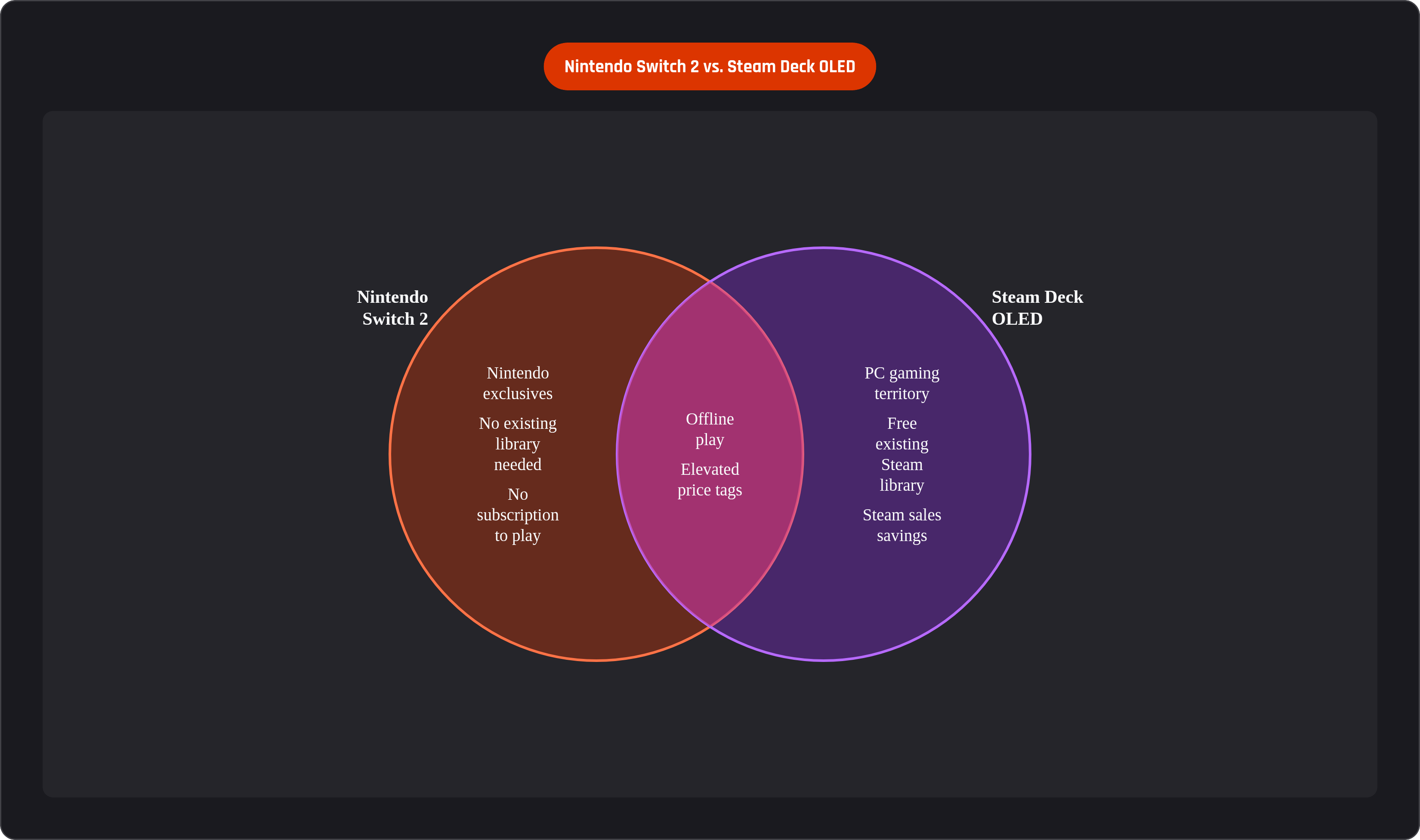
Nintendo Switch 2 launched at a significant premium, and Nintendo has signaled further price increases ahead. It's a closed platform by design: Mario Kart World and the rest of Nintendo's first-party lineup are the reason most people buy in. Those games carry premium price tags, so a starter library of even a few titles adds a meaningful sum before you've cleared the tutorial on most of them. You don't need a subscription to play what you've bought, but Nintendo Switch Online charges recurring fees for multiplayer and cloud saves.
Steam Deck OLED with 512GB storage has seen its price rise substantially from its original launch price, a significant jump that makes it a real premium outlay. That's a real premium, and it comes with a real perk attached, too: PC gamers who already own a Steam library get to bring thousands of owned titles over for free. If you don't have an existing library, you're paying for the hardware on its own, though Steam sales soften that over time.
Both devices carry elevated price tags right now, so don't expect handheld prices to drop soon. Add it up: a ready-to-play Switch 2 clears well above its base price with even a modest game library, and a ready-to-play Steam Deck OLED demands a substantial hardware investment before you've bought a single game.
What a phone gaming setup actually costs, broken into three realistic tiers
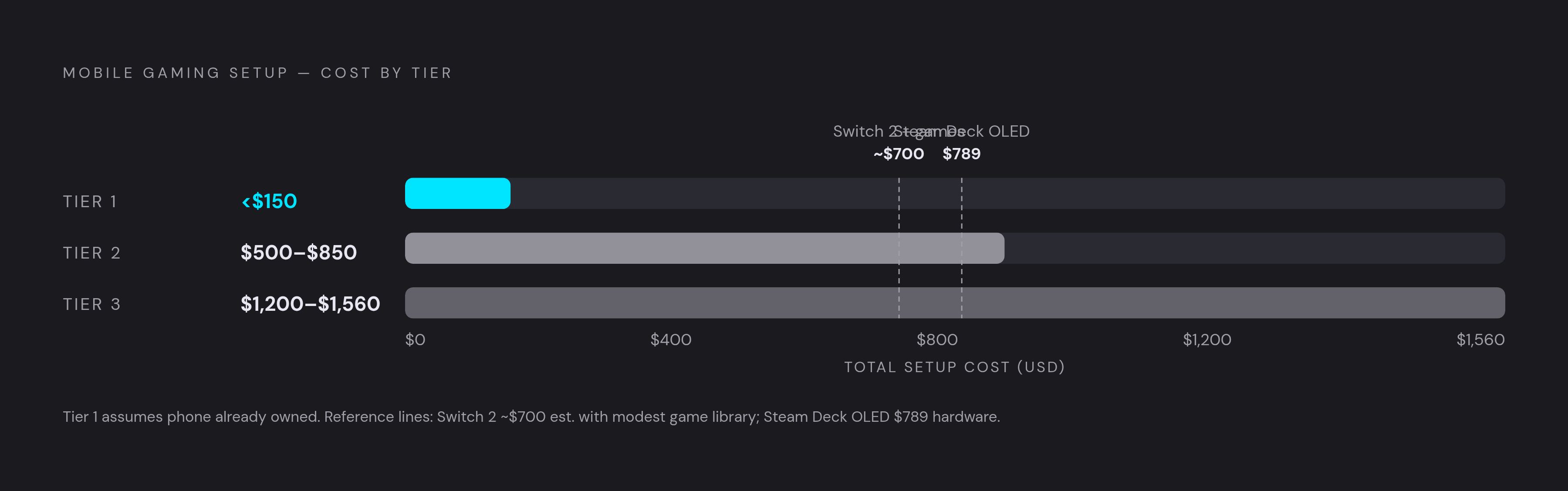
Three tiers, three real buyer situations, running from the cheapest case to the most demanding one.
Tier 1, the person who already owns a phone, which is most of you reading this: phone cost is $0, a budget controller runs $50 to $80, and stepping up to $100 to $150 buys you hall-effect sticks with lower latency. Add a clip or mount for about $15 if the controller is Bluetooth, and toss in a small cooling fan for a few extra dollars (Peltier-based coolers cost more but last longer). Total: well under $150, and possibly under $100 if you don't care much about controller quality.
Tier 2, buying a new mid-range phone plus a controller: a capable Android phone running a current Snapdragon or Dimensity chip runs $400 to $700 and handles nearly every mobile title or cloud-streamed game without stuttering. Add a $100 to $150 controller. Total lands around $500 to $850, roughly matching or undercutting a Switch 2 plus a couple of games.
Tier 3, a flagship gaming phone plus a premium controller: phones like the iPhone 16 Pro, Galaxy S25 Ultra, or ASUS ROG Phone run $999 to $1,299, and a premium controller with hall-effect or TMR magnetic sticks, remappable rear buttons, and pass-through charging adds another $150 to $170. Total: $1,200 to $1,560, comparable to or a bit above a Steam Deck OLED. The phone still does everything a phone does when you're not gaming, which is worth factoring in.
Most people land in Tier 1, and at that tier, no dedicated handheld comes close on price.
The controller is the most consequential purchase decision in the phone gaming setup
If one decision in this whole comparison deserves real thought, it's the controller. The market moved fast here: you can go as cheap as a Bluetooth pad and a clip, or as integrated as a clamp controller that turns the phone itself into something that handles like a dedicated handheld.
Two sensor generations exist right now, and the gap between them matters more than the spec sheet suggests. Older potentiometer sticks work by physical contact between a wiper and a resistive track, and that contact wears down with use, which is exactly how stick drift shows up after enough hours. Magnetic sensors, whether hall-effect or TMR, skip the physical contact entirely, so the wear mechanism that causes drift doesn't exist in the first place. In practical terms, that's the gap between a controller that still works in three years and one that quietly gets worse every month.
Latency matters too, and it depends on connection type. Wired USB-C passthrough runs a few milliseconds of delay, while Bluetooth runs a bit higher. For casual play, neither matters, but for competitive shooters or fighting games, those extra milliseconds are exactly where missed inputs come from.
Nobody talks about weight, either: a phone locked into a loaded clamp controller weighs roughly what a Switch 2 weighs in handheld mode. That's a real fact worth sitting on for a second, because it means you're getting something in the same physical ballpark rather than a lighter, worse-feeling device. And Apple's move to USB-C across the iPhone 15, 16, and 17 lineup killed the old Lightning-versus-USB-C mess, so one clamp controller now fits nearly any current phone without a separate adapter.
If your budget has any give in it, put it toward magnetic sticks and wired passthrough. That upgrade pays off over years of use, well beyond whatever looks better on a spec sheet for five minutes.
Game library costs: where the phone side quietly wins by a large margin
Console libraries are front-loaded and priced per title. Switch 2 first-party games at full price add up fast enough that even a frugal buyer needs several titles before the console purchase feels justified rather than premature.
Phone gaming spreads that cost out differently, starting at the bottom with free-to-play. There's a genuinely enormous catalog of games that cost nothing upfront; quality swings all over the place across that catalog, but the best of it is deep enough to keep someone busy for hundreds of hours without spending a cent. Premium mobile titles sit well under console pricing across the board, and Apple Arcade or Google Play Pass bundle broad catalogs into one small monthly fee.
Then cloud gaming changes the math outright. Xbox Game Pass Ultimate, Nvidia GeForce Now, and PS Remote Play all charge one monthly rate for hundreds of console and PC titles streamed to a phone, no per-game purchase needed. GeForce Now goes further for PC owners specifically: it streams games you already bought on Steam, so an existing library follows you to the phone instead of getting repurchased from scratch.
That flips the usual math on its head. Instead of $60 to $70 per console title, you're paying one flat rate for a rotating library of hundreds of games, and if you're already paying for Game Pass on a console or PC, moving those same sessions to a phone with a controller costs exactly nothing extra in software.
The scale backs this up on its own, no argument needed: mobile gaming generated $103 billion in revenue in 2025 across roughly 3 billion players worldwide. A library that deep doesn't happen by accident; it happens because the audience and the money behind it are both massive.
The one scenario where a dedicated handheld genuinely earns its premium
None of this makes a Switch 2 or Steam Deck a bad purchase. It just means the premium needs a real reason attached to it, and a few reasons genuinely hold up.
Platform exclusives are the clearest one. Nintendo's first-party lineup, Mario, Zelda, Metroid, doesn't exist on mobile and never will show up on a cloud service. If those specific games are why you're buying a device, the Switch 2 is the only thing on this list that plays them, full stop.
The Steam Deck earns its premium a different way. If you already own a large Steam library, the Deck lets you carry that library around with zero additional software spend. The $789 hardware is the only new money on the table, since the games are already yours.
Offline reliability counts, too, and it's easy to underrate until you need it. Dedicated handhelds run games locally with no connection required, while cloud gaming on a phone needs a stable signal just to boot up. In an area with patchy mobile data, that's the whole difference between playing and staring at a loading screen.
And some people just want a device that does one thing, with no notifications interrupting a boss fight, no app switching, no distraction baked into the hardware itself. A dedicated handheld delivers that by design, and for some players, that single-purpose focus is worth the extra money on its own.
How to decide which setup makes financial sense for the way you actually play
Start with the obvious question: do you already own a capable smartphone? If yes, your entry cost into phone gaming is just a controller, and the comparison is basically settled before it begins. If no, remember a new mid-range phone is something you'll use for dozens of things beyond gaming, so the gaming cost is only a slice of what you're actually paying for.
Second question: are the games you actually want available on mobile or through a cloud service? If yes, or if Xbox, GeForce Now, PS Remote Play, or Steam Link cover what you're after, a phone setup does the job. If your honest answer is "I specifically want Nintendo's exclusives," then budget for the Switch 2 and go in knowing exactly what you're paying for; nothing else plays those games.
Third question, and this is the one people underestimate most: how much do you actually spend on games in a typical year? Heavy console spenders should run the math on switching to a cloud subscription instead, because the monthly fee often pays for itself faster than expected once you stack it against buying titles individually at $60 to $70 each.
On controller choice specifically: if you already own a phone and play casually to mid-core, a budget controller with hall-effect sticks gets you most of the experience for the least money. If you're buying a new phone anyway, pair a mid-range device with a mid-range controller and a cloud subscription, and the total still lands below a Switch 2 plus even a modest game library.
Smartphones are already in the hands of a vast share of the global population. Once you run the actual numbers instead of guessing at them, the cheaper road into good gaming has less to do with a purchase decision and more to do with what's already sitting in your pocket, doing nothing, waiting for a controller to show up.