What an Android Handheld Console Does That a Phone Can't
Purpose-built chips, cooling and controls explain when a handheld beats a phone.
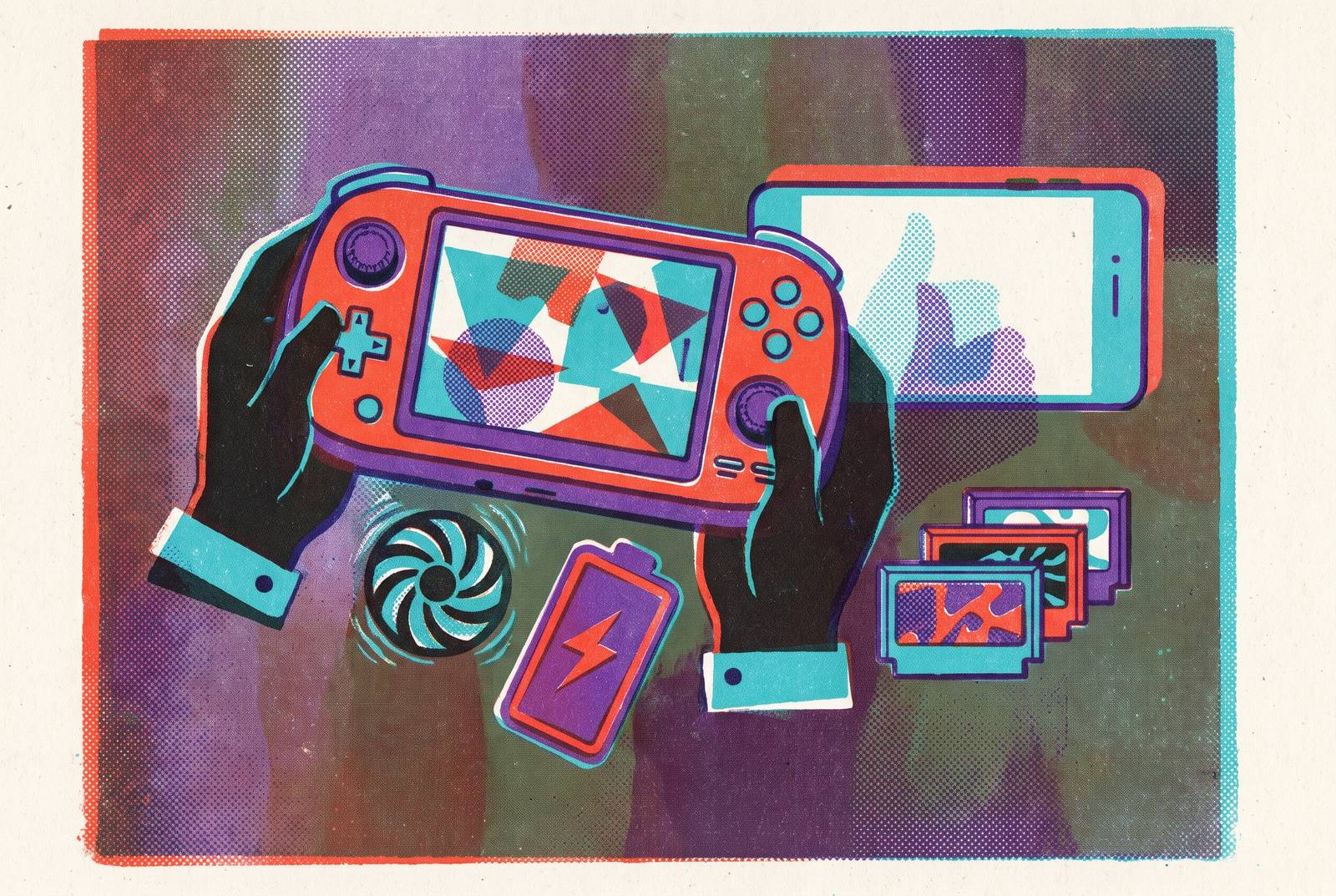
An Android handheld console does not win by being a phone with more buttons. Its advantage is that the chip, cooling, controls and chassis are designed for the same job, namely sustained play. That makes a dedicated device valuable for demanding local games and emulation, but less essential for cloud gaming. The buying decision turns on which part of that design your games actually need.
What an Android handheld console actually is, and why it exists as a separate category
An Android handheld console is a purpose-built gaming device running Android, with access to Google Play, cloud gaming apps and emulators. Its shape is closer to a Nintendo Switch than a smartphone. Dual analog sticks, shoulder buttons and a D-pad are part of the chassis. The operating system is familiar, but the hardware is built with different priorities.
Even the screen reflects those priorities. A 4:3 panel suits retro games without letterboxing, while a 16:9 panel fits widescreen games such as PSP titles. The category also covers different budgets and uses, from the MANGMI AIR X at $89.99 to the Retroid Pocket 6 at roughly $200–$250 and the premium AYANEO Pocket S2 Pro at roughly $600. Devices such as the Logitech G Cloud are built for cloud gaming instead. These are not all chasing the same performance target, but they share a starting point that phones do not, with gaming determining the form rather than adapting to it.
Why gaming-specific silicon changes what a handheld can sustain, not just peak
Phone processors are designed to move between bursts of activity and low-power states. Processing a photo or rendering a webpage demands a brief surge, after which the chip can retreat. A demanding game asks for something different. It needs steady performance throughout a session as heat builds.
Qualcomm’s Snapdragon G-series gives gaming handhelds a processor family built around that distinction. In flagship devices such as the Pocket S2 Pro, the emphasis shifts toward sustained GPU performance rather than the conservative power profiles required by phones. Some Android handhelds still use chips other than gaming-specific silicon. It means the category now has chips designed for its workload, rather than relying entirely on processors borrowed from another kind of device.
The AYANEO Pocket ACE provides a concrete example. Its gaming-handheld chip is distinct from a phone processor of the same generation, with sustained gaming performance as a design goal. The device achieves close to 15 hours of game time on retro systems, though that figure should not be read as a promise for demanding emulation.
But what about an extremely powerful flagship phone? Peak speed is not the disputed point. A phone can have plenty of processing power and still lower its clock speeds when it works hard for a long time. The useful comparison is therefore the performance each device can maintain.
How active thermal management lets a handheld hold that performance where a phone cannot
Even a chip built for gaming needs somewhere to send its heat. Without a good enough thermal system, heat limits what it can do, just as it does with any other processor. Cooling completes the argument about sustained performance. It explains why a thicker handheld can do something a thin phone cannot get just by changing a software setting.
A phone’s passive cooling is a deliberate compromise for thinness and pocketability. Heat must travel through a flat chassis, with no active exhaust path, and some of it reaches the user’s hands. When that system cannot keep up with a sustained gaming load, the operating system down-clocks the processor, potentially within minutes. That response keeps the device safe, so the player should leave it in place.
Dedicated handhelds have room for active cooling and exhaust ports directed away from the grips. Their extra bulk serves a purpose. It allows the thermal system to remove heat while keeping palm temperature manageable during long sessions. Hybrid designs occupy an awkward middle ground, becoming thicker than ordinary phones while still accommodating only small fans or substantial passive cooling.
An external phone cooler can help address heat, but it changes the proposition. The phone now needs another accessory, so there is more gear to have on hand for play. That trade-off becomes especially visible with demanding emulators, where a brief period of high performance is less useful than a steady session.
Why physical controls built into the device are fundamentally different from controls clipped onto it
Heat determines how steadily a game runs, while input determines how well the player can act within it. Touchscreens provide no physical confirmation that a finger has found the right control. They also put virtual buttons over the game itself. In action games, fighting games and other titles that need several inputs at once, the player has to keep track of both the action and an invisible boundary between buttons.
A phone-mounted controller solves much of that problem. It supplies tactile controls and clears fingers away from the display, making many controller-supported games comfortable to play. Connection type also counts. Bluetooth adds a wireless hop, but a direct USB-C connection removes most of the input lag from that hop. Built-in controls do not always beat every accessory on latency alone.
Supported games work with the handheld’s controls, and on-screen inputs can often be mapped to buttons without switching between apps. Hardware choices can also go beyond simply supplying sticks and triggers. The AIR X includes Hall effect sticks, which use magnetic sensors rather than wearing potentiometers and resist drift, at an unusually low price for that feature.
Other designs extend that idea into customization. The MANGMI Pocket Max has modular magnetic buttons, allowing its D-pad and action buttons to be swapped for clickier, more sensitive micro-switch versions. A clip-on addresses the phone’s lack of buttons, while an integrated handheld can make the entire chassis and interface serve them.
What emulation requires that a phone with a controller still cannot fully provide
Demanding PS2 or GameCube titles need steady GPU performance to run at full speed, so the processor and cooling system must work together. Precise physical controls are needed at the same time. Adding a controller to a phone fixes input, but does not change the thermal conditions under which the game runs.
These requirements need to be balanced. A phone can run emulators, and resource demands vary across emulated systems. The distinction becomes clearer as the workload grows and the session lengthens. A dedicated handheld is designed to combine sustained processing with cooling and controls, rather than solving one requirement while leaving the others to a general-purpose device.
The display adds another consideration beyond speed. The upcoming AYANEO Pocket S Mini has a 4:3 panel that fits retro console games without black bars, while a 16:9 screen fits the PSP’s native widescreen presentation. Neither shape is universally better. The useful choice depends on the library the player intends to use.
Reddit’s r/retroid community provides guides, ROM organization tips and emulator configurations built around Retroid handhelds. That support makes the device less of an isolated configuration project.
How cloud gaming reshapes the comparison — and why it doesn't eliminate the handheld's edge
Cloud gaming changes the workload by moving the game to remote servers. The local device handles display and input. Does that remove the reason to buy dedicated hardware? It weakens the chip argument substantially, but leaves several other differences intact.
The quality of a cloud session depends on input latency, control comfort, screen size and quality, battery life and the network connection. A powerful local processor cannot make up for shortcomings in those areas. WiFi 6E or WiFi 7 can handle streaming better than older standards, while comfortable grips become more valuable as sessions lengthen. A dedicated device also keeps gaming from consuming the battery needed for the phone’s other jobs.
Xbox Cloud Gaming streams hundreds of Game Pass titles through Game Pass Ultimate, while GeForce Now streams games from the player’s existing Steam, Epic and some other libraries. PS Remote Play instead streams a home PS5 over the internet at no extra cost, requiring the console to be on or in Rest Mode with network access enabled. These distinctions affect which games are available, but not the basic division of work between the remote system and the screen in the player’s hands.
For this use, a good phone controller is a genuine alternative to a dedicated handheld. With strong WiFi, it closes most of the hardware gap. Streaming still depends on a connection, so it needs reliable WiFi or strong 5G. A handheld with a local library can keep working on a flight or through a commute’s dead zones, where a cloud-only setup cannot.
Why the hybrid phone-console that tries to do both keeps failing
The intuitive response is to combine both devices. Why not build a phone with gaming controls, active cooling and a comfortable grip, then leave the second device at home? The difficulty is that each addition helps one role while burdening the other. A grip that supports the palms during play does not help a device slide into a pocket.
As an everyday phone, the resulting hybrid becomes heavier, thicker and more awkward to carry. Reducing that bulk, however, compromises the space available for cooling and palm support. The requirements pull in opposite directions. This is not simply a missing feature waiting for an engineer to add it without consequence.
Software creates a parallel conflict. A phone interface is built for vertical use with one-handed touch gestures, while a gaming frontend is built for horizontal use with controller-first navigation. Calls and notifications can interrupt play, and background sync tasks can introduce micro-stutter in latency-sensitive rendering.
Snap-on controls and external cooling offer another route by producing a phone with accessories. The distinction explains why separating the jobs can be more practical than forcing them into one chassis. A phone covers short sessions and connected play, a dedicated handheld serves extended local gaming, and a controller bridges the input gap when a second device is unnecessary.
When a dedicated Android handheld is genuinely worth it, and when a phone with the right controller already closes the distance
Buy for session length, game type and connectivity. A dedicated handheld makes more sense when play lasts 30 or more minutes at a stretch, several times a week. Its grips, cooling and separate battery have time to earn their place. The case strengthens when demanding emulation, controller-required games or a library that works offline is central to the purchase.
The appropriate hardware tier still depends on the games. The AIR X provides an entry point for PSP and below, while the Pocket 6 occupies the mid-range territory for PS2 and GameCube. The Pocket S2 Pro addresses buyers seeking flagship all-in-one performance. Even a cheap handheld needs to suit the emulators it will run, and a player who just wants to replace touch controls can do that without a premium model.
A phone remains a sensible choice for short, opportunistic sessions and mobile-native games suited to touch, including Balatro, Stardew Valley and Vampire Survivors. It is already in the pocket. Cloud gaming and remote play also favor keeping an existing phone when the connection is reliable, because local rendering power is not the central requirement. That choice avoids managing another device, its charge and its storage.
For players who use both, the division need not mean packing both every day. The phone can cover brief sessions and cloud gaming at home, while the handheld is reserved for planned play and travel. For those whose main obstacle is the touchscreen, Backbone makes a controller for iPhone and Android that supports native, cloud and remote-play games. It is a credible middle path for getting physical controls on an existing phone without buying a separate console.