Game Library Size Phone Gaming vs Dedicated Handhelds
Mobile phones have 25 times more games, but Nintendo Switch's smaller library skews toward quality.
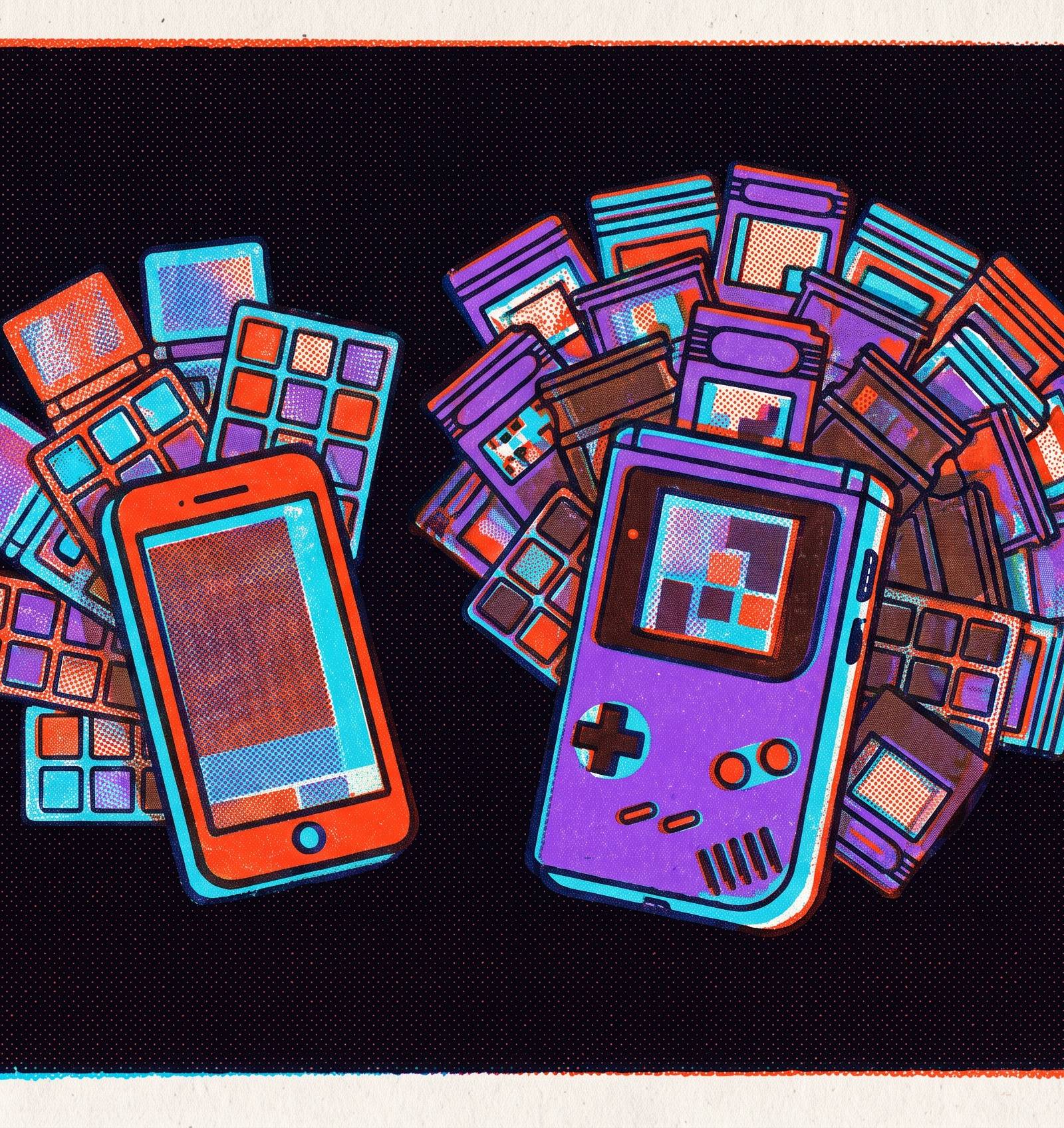
Google Play carries about 298,000 games, and the App Store has roughly 246,000. The Nintendo Switch eShop sits at just over 11,100. Line those numbers up and the argument looks settled before it starts: mobile wins by a landslide. But a library count tells you almost nothing about what's actually good to play, and that gap between "games that exist" and "games worth your time" is basically the whole story here.
How mobile's library concentrates at the top, and what that leaves in the middle
Here's the number that should bother you: in 2025, the top 1% of publishers pulled in 92.5% of all in-app purchase revenue and 79.8% of total downloads. The other 99%, the hundreds of thousands of people who put a game on the App Store or Google Play, are splitting what's left. What's left isn't much.
That's just what happens when 97% of Android apps are free and paid for through ads and in-app purchases. A free game funded by ads needs volume. It needs you opening it fourteen times a day, watching a video for an extra life, maybe getting talked into a $4.99 bundle at 11pm when you're tired and on a losing streak. A $40 cartridge asks for something different: that you finish it, and that you tell your friend about it.
So the App Store chart you scroll through is built for installs and monetization, and casual titles, hyper-casual titles, and battle royale games sit at the top because those genres turn attention into money better than anything else does. Somewhere below that layer, buried in the hundreds of thousands, there are weird, small, genuinely good games made by people who cared about making something good. Finding them is the hard part, since the storefront rewards volume over discovery, and that friction is a recurring complaint among users trying to surface quality titles.
Does a dedicated handheld dodge this by simply having fewer games? Worth checking.
What Nintendo Switch's 11,100-title library actually represents
Eleven thousand games looks small next to 298,000 until you remember the Nintendo DS topped out around 3,500 releases across its entire lifespan. The Switch has more than tripled that.
Some of that growth is just distribution. Digital-first releases on the eShop dropped the barrier to entry for small developers in a way cartridge manufacturing never allowed. Money shapes what gets made, too: a paid game, even a modestly priced one from a two-person studio, needs players to finish it and recommend it to someone else. There's no ad drip-feed keeping the lights on if the game is bad, and that difference in how the money moves changes what survives long enough to matter.
The genre spread reflects it: open-world RPGs, action-platformers, puzzle games, sports titles, a steady stream of AAA ports. Nintendo's own franchises, Zelda, Mario, Metroid, anchor things the way you'd expect. But the stronger case for the platform is the third-party and indie work sitting next to them: Hollow Knight, Stardew Valley, Dead Cells, games made by small teams that found an audience because they weren't drowning in a hundred thousand competitors on day one.
Access is the tradeoff. The catalog moves at Nintendo's release schedule and Nintendo's prices, with no backward compatibility for most older Nintendo hardware. The result is a curated catalog running on Nintendo's clock, not yours.
Where PC handhelds like the Steam Deck land in this comparison
Steam's total catalog runs around 120,000 games, with more than 20,000 new titles added every year, so it sits somewhere between mobile's flood and the Switch's curated pool. But the raw Steam number isn't really the figure that matters for a handheld conversation. What matters, is that over 25,000 titles are now tagged Playable or Verified specifically for Steam Deck.
That Verified badge is doing the actual work. It's a trusted shortlist carved out of a store that's otherwise enormous and noisy, solving something close to mobile's discovery problem through a completely different mechanism. Verified doesn't mean the game is great; it means the controls map correctly, performance hits a reasonable bar, text is readable on a small screen, and nothing crashes in a way that ruins your run.
PC handhelds also run Xbox Game Pass and similar services natively, which makes them hybrid devices in a way the Switch was never built to be. That's a real point in their favor. Battery life is the real cost, though: PC handhelds are widely noted for limited battery endurance under a gaming load, while phones typically last considerably longer on a single charge. Put those numbers side by side and the tradeoff stops being abstract. PC handhelds have a high ceiling and a short leash.
How cloud gaming changes the library math for phone players
Here's the wrinkle that breaks the whole "mobile versus handheld" framing: a phone with a decent connection and a cloud gaming subscription reaches straight into console and PC catalogs. Which means that store count was never actually the ceiling on what a phone can play.
Two models exist here, and they're not the same thing. Bring-your-own-library services like GeForce Now streams games you already bought on Steam, Epic, or Xbox; your library is whatever you paid for, just running on someone else's hardware in a data center somewhere. Subscription-catalog services like Xbox Cloud Gaming, PlayStation Plus Premium, and Amazon Luna instead hand you a curated, rotating catalog for a flat monthly fee.
PS Remote Play sits off in its own lane: streaming from a PS5 you already own, over your own home network, free, no subscription attached, handing you your full PS5 library on your phone screen. Steam Link does the same trick locally for a PC Steam library.
On performance, Xbox Cloud Gaming runs 40 to 65ms of latency on 5G, capped at 1080p and 60fps. That's genuinely playable for most genres and noticeable the second you touch anything competitive, where a tenth of a second is the difference between landing a shot and watching the killcam. The caveats are real, not cosmetic: quality falls apart on a weak connection, subscription libraries can lose a title mid-playthrough if a licensing deal expires, and there's no offline access for anything cloud-only. A dedicated handheld runs its native library locally: zero latency, guaranteed offline, no subscription needed for anything already bought. Cloud gaming stretches a phone's reach dramatically, and along with that reach comes a pile of dependencies that a Switch or Steam Deck simply doesn't carry.
The genres and play styles where each platform's library actually shines
Mobile owns categories that don't really exist anywhere else. Auto-runners, idle games, match-3 puzzlers, hyper-casual time-killers; none of these have a natural handheld equivalent, because they were built around a thumb on glass, not a joystick in a hand. Session length matters too: a game built for a 2 to 5 minute burst fits how people actually use their phones, which is to say, in a pharmacy line or during a commercial break. Strategy and MOBA genres have carved out real ground on mobile as well. Casual titles dominate the top of the charts, while battle royale and MOBA games anchor the competitive side.
Dedicated handhelds lean toward open-world RPGs, action-platformers, and narrative-driven games, the stuff that rewards 30 to 60 minutes of uninterrupted attention instead of a quick hit between subway stops. Local play with zero network dependency comes standard, and the physical controls, analog sticks, shoulder triggers, bumpers, do things a flat sheet of glass can't do no matter how good the software gets.
Which raises the real question buried under all of this: is a phone's weak showing in console-style genres actually about how many of those games exist on mobile, or is it that touch controls make a lot of them worse no matter how many are technically available? That's a controller question, not a library question, and it's also the next section.
Why a physical controller changes how much of a phone's library is actually playable
Library access and library playability aren't the same thing, and mobile gaming has spent years quietly treating them like they are. A phone can technically run a console-style action game, sure. Whether you'd actually want to play it with your thumb smudging the exact spot on the screen where the action is happening is a separate question, and usually the answer is no.
A clip-on controller fixes that. It turns the phone into something close to a dedicated handheld: same form factor, same enormous library, same portability, minus the battery anxiety that follows PC handhelds around. What separates a good one from junk comes down to a short, specific list. Hall effect or TMR magnetic thumbsticks have replaced the old potentiometer sticks that used to drift over time, the kind of wear that eventually makes your character walk sideways for no reason you did anything to cause. Latency matters, and a wired passthrough connection sits on a different floor entirely than Bluetooth. Ergonomics, grip depth, trigger travel, how a button feels on press two thousand, separate a controller you'll use for six hours from one you'll toss in a drawer after twenty minutes. Battery passthrough, letting the controller charge your phone while you play, quietly erases one of the only real disadvantages phones ever had against dedicated hardware.
The move toward a common connector standard across modern smartphones has largely resolved the old compatibility split that used to force people into buying separate controllers depending on which phone they owned, and one controller design now works across nearly every modern device. Put a good controller on a modern phone and you've unlocked mobile's entire native library plus everything cloud gaming reaches beyond it, a combination no single dedicated handheld matches on pure breadth.
How to actually choose based on how you game
This was never really a contest about which platform has the bigger number on the box. It's about which library fits your genres, your patience for short sessions versus long ones, how stable your connection is, and how much friction you can stand before a planned gaming session turns into a search for a charger under the couch cushions.
A dedicated handheld, Switch or Steam Deck, makes sense if you want offline-first play on a catalog someone else already curated, if your taste runs toward long-session RPGs and narrative-heavy action-adventure, and if you don't mind carrying a second device and, in the Steam Deck's case, planning your evening around a battery that taps out in under two hours.
Your phone makes sense if you already carry it everywhere and have zero interest in a second gadget, if your taste leans casual or touch-native or fits into short bursts, and if your connection is solid enough that cloud gaming can stretch your library into console and PC territory without falling apart. Clip a controller onto that phone and it starts covering nearly everything a dedicated handheld does, plus more.
For most people without a specific reason to want a dedicated device's native catalog, a phone with a decent controller and a cloud subscription is a genuinely competitive setup now, better battery life and more portable besides. The bigger number was never the point. Your actual life, your commute, your couch, your patience for a screen that dies at hour two, was always going to decide this before the spec sheet got a vote.