GeForce Now Games List and Library Scope
GeForce Now's 4,500-game count masks two different delivery systems built into one service.

GeForce Now now supports more than 4,500 games, which puts it in the same conversation as any storefront on the market, cloud or otherwise. The size is worth noting, but the structure underneath it deserves more attention, because NVIDIA runs two fundamentally different systems under one subscription and calling both of them "the library" hides more than it reveals.
Where the 4,500-game figure comes from, and what it actually counts
NVIDIA's official count, as of mid-2026, sits above 4,500 titles. That's the number on the marketing page, and it's accurate as far as it goes. But it's a sum, not a single catalogue: it's Ready-to-Play titles (the games NVIDIA has configured, tested, and hosts on its own servers) added to Install-to-Play titles (Steam games that stream through a temporary cloud session). Two different delivery mechanisms, one headline figure.
Where'd the jump come from? Per Tweaktown's reporting, the library sat at roughly 2,300 games before Install-to-Play launched, and very quickly climbed past 4,500 once the feature went live. This was a structural change in how the service sources content, and it happened fast enough that "2,300 games" and "4,500 games" describe almost two different products wearing the same name.
Third-party tracker Cloudbase.gg, which updates daily, currently lists 5,475 games, suggesting the real number keeps drifting upward past whatever NVIDIA's official page says at any given moment. Both figures are accurate, depending on when you check and who's counting. The library isn't printed once and shelved; it's a live document, and publishers can add or pull titles whenever they want.
Worth saying plainly what 4,500 doesn't mean. It doesn't mean every game in a player's personal Steam library, doesn't mean every game ever released for PC, and doesn't mean any of it is guaranteed to stay put. A publisher can opt a game into Install-to-Play and opt it back out later, with no guarantee of advance notice. The ceiling isn't technical, it's contractual, and that distinction matters more than the number itself.
Which storefronts connect to GeForce Now and what that means for your existing game purchases
Here's the part that actually changes how someone should think about subscribing: GeForce Now streams games a player already owns, from storefronts they've linked to their NVIDIA account, rather than selling games directly. Steam, Epic Games Store, Ubisoft Connect, and a handful of others all connect in, with Steam contributing by far the largest share once Install-to-Play entered the picture.
Xbox Game Pass integration deserves a specific mention here. Per TechUseful, the number of supported titles pulled from that ecosystem grew 240% since 2024, which is a genuinely large shift in how willing Microsoft has been to let its catalogue stream through a competing cloud platform. A few years ago that kind of cross-platform cooperation would've seemed unlikely; now it's just another line item in the weekly additions.
The breadth shows up in specifics. 2025 and 2026 brought Black Myth: Wukong, Baldur's Gate 3, Cyberpunk 2077, Forza Horizon 5, Halo Infinite, Marvel Rivals, Assassin's Creed Shadows, and DUNE: Awakening onto the service, alongside day-one arrivals like Grounded 2 (Steam and PC Game Pass) and Mafia: The Old Country. That's a genuinely wide spread of genres and publishers, and it's the strongest evidence that the "4,500 games" figure isn't padded with filler nobody wants to play.
But the friction point is real, and it trips people up constantly: linking a Steam account to GeForce Now doesn't grant access to everything on Steam. It grants access to whatever's been opted into Install-to-Play, and only if the player already owns it in that store. A game owned on a storefront GeForce Now doesn't support yet won't stream, full stop, no matter how large the headline number gets.
How new games are added each week and how to track what's coming
NVIDIA runs this on a weekly rhythm called GFN Thursday: new titles get announced and added every week, with a preview list published earlier in the month so subscribers know roughly what's coming. November 2025 is a decent snapshot of the variety on any given week: Call of Duty: Black Ops 7, Anno 117: Pax Romana, Virtua Fighter 5 R.E.V.O. World Stage, and Surviving Mars: Relaunched all landed in the same stretch, spanning shooter, city-builder, fighting game, and colony-sim genres without much overlap between them.
Day-one releases are becoming routine rather than exceptional. Grounded 2 and Mafia: The Old Country both hit GeForce Now the same day they released on PC, which wasn't the norm even two or three years back. That timing shift matters more than it sounds; day-one availability puts the service on equal footing with traditional PC releases rather than lagging behind them.
Install-to-Play additions don't follow the same clock, though. Because those depend on individual publishers opting games in through Steamworks, they arrive on a rolling, unpredictable basis rather than tied to the Thursday announcement cycle. That makes Install-to-Play the more interesting category to watch, precisely because nobody's telegraphing what's coming.
For actually tracking any of this, three sources do the job: NVIDIA's official Games page, the monthly GFN Thursday blog roundups, and Cloudbase.gg for a running, daily-updated count. None of them, though, will reliably tell you when something's about to disappear. Additions get a press cycle. Removals mostly don't.
How to check if a specific game is available before subscribing
The direct answer lives at nvidia.com/en-us/geforce-now/games/, NVIDIA's official searchable database. Type in a title, and it'll show current status (Ready-to-Play or Install-to-Play), which subscription tier is required, and which storefront the game needs to be purchased or owned on. It's the authoritative source, and it should be the first stop, not the last.
Cloudbase.gg works as a secondary check, and it's genuinely useful for one reason: because it updates daily and independently, it sometimes reflects a new addition before NVIDIA's own page catches up. Two sources, checked against each other, beat trusting either one blindly.
The smarter workflow, before paying for anything, is to run an inventory check first. Pull up an existing Steam or Epic library, then search each title (or at least the ones that matter) against the GeForce Now catalogue. Given that the entire model is built around streaming games already owned, this is really the only way to know in advance whether a subscription pays for itself.
The free tier doubles as a built-in trial for exactly this purpose. One-hour sessions, Ready-to-Play access only, but that's enough time to test whether a specific game streams cleanly on a given internet connection before committing to a monthly charge. And for games tied to publishers with a history of pulling titles from cloud platforms on short notice, a quick manual check beats assuming last month's availability still holds. The library's structure practically demands double-checking rather than remembering.
What the subscription tiers actually unlock in terms of library access
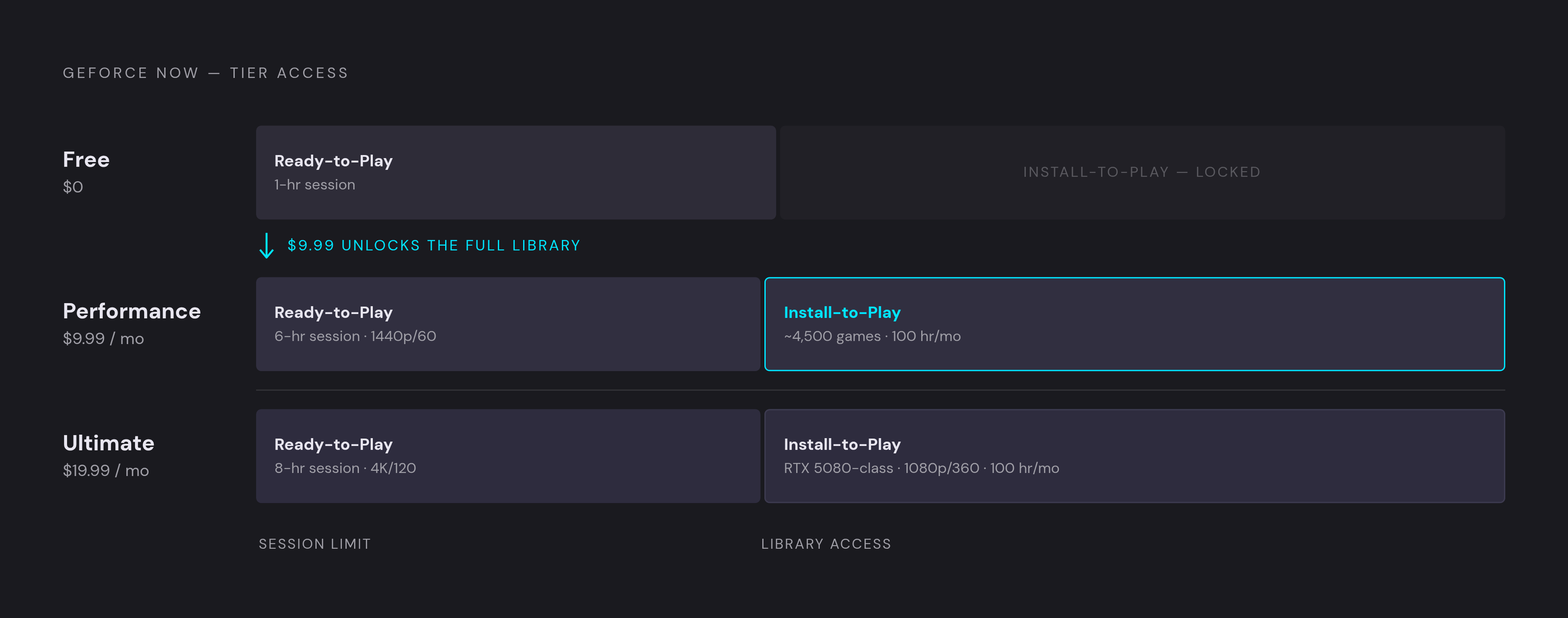
Three tiers, and each one changes not just performance but actual access. Free gets Ready-to-Play titles only, one-hour sessions; it's a real sample of the service, offering a genuine but limited slice of the full thing.
Performance, at $9.99 a month, extends sessions to six hours, renders up to 1440p at 60fps, and, critically, unlocks Install-to-Play eligibility. That's the tier where the 4,500-game figure actually starts to become relevant to a subscriber, since Free never touches the Steam-sourced half of the catalogue at all.
Ultimate, at $19.99 a month, pushes sessions to eight hours and runs on RTX 5080-class hardware, rendering up to 4K at 120fps or 1080p at a startling 360fps. This is the full-library, full-performance tier, and it's the one the Blackwell upgrade (more on that shortly) was built around.
One wrinkle landing January 1, 2026: both Performance and Ultimate subscribers get a 100-hour monthly cap on streaming time. Go over it, and additional hours come in 15-hour blocks: a few dollars on Performance, somewhat more on Ultimate, with up to 15 unused hours carrying over into the next month. NVIDIA frames this as a way to keep queue times short and quality consistent for paying members, which is a reasonable trade given how cloud infrastructure gets strained during peak hours.
Realistically, though, most subscribers won't approach that ceiling. A hundred hours is over three hours a day, every day, for a month straight. For anyone gaming in normal evening or weekend chunks, the cap is background noise, not a constraint. It's a heavy-user problem, and heavy users, by definition, know who they are.
One more detail worth flagging: Install-to-Play access comes with both paid tiers, but the 100 GB of temporary session storage disappears when the session ends. Persisting installed games between sessions requires a separate cloud storage plan, purchased on top of the base subscription. Skip it, and every Install-to-Play session starts from a blank slate.
What the Blackwell upgrade means for the games already in the library
NVIDIA announced at Gamescom 2025, on August 18, that Ultimate members would migrate to RTX 5080-class servers built on the Blackwell architecture, starting September 10, 2025, at no change to the $19.99 price. That last part is worth sitting with for a second: same subscription cost, materially better hardware underneath it.
The headline numbers are steep. Streaming up to 5K resolution at 120 frames per second, or up to 360fps at 1080p where the hardware allows it. Sub-30-millisecond network latency as the target, AV1 encoding running up to 100Mbps, plus YUV color and 10-bit HDR support layered on top. The lineup of games stays the same; what changes is how good those games look and feel once they're streaming.
DLSS 4 with Multi Frame Generation is the piece doing the heaviest lifting here. It generates up to three additional frames for every traditionally rendered one, which multiplies effective frame rates by up to 8X over brute-force rendering alone. By May 2026, that technology covered nearly the entire Ready-to-Play library for Ultimate subscribers, a genuinely fast rollout considering DLSS 4 launched supporting 75 titles at Gamescom 2025 and grew past 175 in less than eight months.
That's the real story buried in this section: the games themselves haven't changed one bit. A five-year-old Ready-to-Play title benefits from the exact same hardware upgrade as something that released last month, which is a strange and pretty good deal for anyone who already owned that old game and never expected it to look better. NVIDIA's also positioning this around two distinct use cases, Cinematic Quality Streaming for visual fidelity and a lower-latency competitive mode for people who'd rather shave milliseconds than chase pixels. Not everyone wants the same thing out of the same library, and the Blackwell rollout at least acknowledges that split rather than pretending one setting fits all.
Playing the GeForce Now library on mobile and what makes a controller the difference
iOS and Android are both natively supported, meaning the entire library, tier and connection permitting, is technically playable on a smartphone. Technically is doing some work in that sentence, though.
Bandwidth requirements scale with tier: Ultimate recommends 35 Mbps for 4K at 120fps, Performance needs 15 Mbps for 1080p at 60fps, and anything latency-sensitive wants under 50ms ping. That's the first hurdle, and it's a real one; a decent home Wi-Fi connection clears it easily, a crowded coffee shop network often doesn't.
But bandwidth solved is only half the equation. A 4,500-game library on a phone runs into a harder limit: half those games need precise analog stick input and all you've got is a pane of glass. Touch controls handle casual, tap-friendly titles fine. They fall apart fast against the action-RPGs, shooters, and strategy games that make up a large chunk of what's actually popular on the service, games designed from the ground up around a controller or a keyboard and mouse, not a thumb smudging across a screen.
With over 35 million registered users as of early 2025, a meaningful share of that base is almost certainly playing on a phone at some point, which makes the controller question far from a niche concern. The library itself is arguably the strongest case that a smartphone, paired with the right controller, is already a legitimate gaming device: 4,500-plus games, RTX-class rendering behind the scenes, and no television required anywhere in the chain. Whether a given player actually has that controller in their pocket, though, is the one variable the service can't stream to them directly.