Best Handheld Console for RPG Players
Switch 2 dominates if you live for Nintendo and Japanese RPGs.
Stuff.tv called the Switch 2 the best handheld gaming console you can buy, and pointed to the screen, the design, and the size of the library backing that up. For RPG players specifically, the case gets even easier: this is the only place to play Nintendo's flagship RPG franchises the way they were built to run, and Square Enix, Atlus, and Bandai Namco all kept up their support from the original Switch without missing a beat.
The Switch 2 mostly lives in its own world, as Yahoo Tech pointed out, and that's worth sitting with for a second. If your RPG taste runs toward Western open-world games or PC-native CRPGs, you won't find much of either here. There are friction points even inside its own lane, too. The 256GB of storage fills up fast once you start installing modern RPGs that routinely run 30, 40, 50 gigabytes each, and expanding that means buying a microSD Express card, which isn't cheap and isn't optional for long. Battery life runs 2 to 6.5 hours depending on what you're playing, which is workable but thin for a long dungeon crawl. The Joy-Cons got roomier than the originals, though they still won't feel great six hours in.
At $450 or $500 depending on configuration, it costs less than most handheld PCs. This isn't an impulse buy, though. If you follow Nintendo's RPG output closely or you've never met a JRPG you didn't finish, this is the obvious pick. If your library lives on PC or PlayStation, keep looking.
Steam Deck OLED, the widest RPG library you can hold in one hand
The Steam Deck's RPG library is really just the Steam catalog, and the Steam catalog happens to contain most of the genre. Elden Ring, Final Fantasy VII Rebirth, Kingdom Come: Deliverance II, nearly every CRPG and Western RPG and PC port of a JRPG that's shipped in the last decade. All of it, on one device, no exceptions carved out.
The OLED screen is a genuine upgrade for anyone playing visually dense RPGs, and the trackpads solve a problem thumbstick-only controls create for anything strategy-heavy. Baldur's Gate 3 and Pathfinder were designed around a mouse cursor, full stop, and a trackpad gets you a lot closer to that than any analog stick will. SteamOS also just runs cleaner for handheld use than Windows does. Stuff.tv has said as much, and it shows up constantly the moment you're actually using the thing day to day.
Here's the catch: price. Valve raised the Steam Deck OLED's starting cost by $240 in May 2026, blaming higher memory and storage costs, and that pushes the value math a fair distance from where it sat at launch. Not every game in your library carries Steam Deck Verified status, either, so performance still varies title to title even on Valve's own hardware. Even so, for a PC-native RPG player whose taste spans CRPGs, Western RPGs, and PC-first JRPGs, nothing else here comes close to the range on offer.
ASUS ROG Xbox Ally X, for players who want Game Pass and Steam under one roof
Quick clarification before anything else, because the name causes real confusion: this is a Windows 11 handheld PC with an Xbox-branded front end sitting on top. That front end pulls Steam, Epic, Xbox Game Pass, and other storefronts into a single interface, which cuts down on the launcher-hopping that comes standard with owning games across three different services.
For RPG players, Game Pass is the actual draw. Xbox Cloud Gaming came out of beta in 2026, and this year's additions relevant to RPG fans include The Outer Worlds 2, Octopath Traveler Zero, and Clair Obscur: Expedition 33. Xbox Play Anywhere titles also carry save data across devices, which matters a lot if you split time between the handheld and a console or PC at home. Day-one access to Microsoft-published RPGs without buying them a second time is the strongest argument for going this route.
The tradeoff against the Steam Deck is complexity. Windows 11 adds overhead SteamOS was built specifically to avoid, and the Ally X can't run every Xbox console game natively; some titles still stream even while the hardware sits right there in your hands. TheInspectAspect named it the strongest choice for buyers already committed to the Xbox ecosystem, and that's fair enough. It suits someone who wants their Game Pass subscription to travel without giving up Steam entirely.
PlayStation Portal, the option PS5 owners keep overlooking
At $199.99, the Portal is the cheapest dedicated handheld in this whole roundup. That price only makes sense if you already own a PS5 or subscribe to PS Plus Premium. Without either, it's much less useful.
With both, it does something genuinely useful. It streams at 1080p and 60fps with real DualSense controls split across either side of the screen, and after launch, Sony added cloud streaming for PS Plus Premium subscribers, so you don't even need a PS5 running at home to reach the back catalog anymore. Sony's first-party lineup also leans heavily narrative and single-player, which happens to line up with what most RPG players are already after.
The obvious catch is your home network. Streaming quality rises and falls with your Wi-Fi, so this isn't the device for a spotty connection or a household where three people are streaming video at once on the same router. Worth comparing PS Plus Premium against Xbox Game Pass directly here: fewer day-one launches, but a deeper back catalog, which suits someone working through Final Fantasy, Persona, or FromSoftware rather than chasing whatever shipped this Tuesday. For an existing PS5 owner, the value is hard to argue with. Anyone outside Sony's ecosystem should look elsewhere.
Cloud gaming as an RPG platform in its own right, not a fallback
Cloud gaming's reputation has shifted, and it's worth noting how far it's come from budget compromise to genuine option. Xbox Cloud Gaming left extended beta in 2026, GeForce NOW now carries more than a thousand games including over 100 major free-to-play titles, and PS Plus Premium runs its streaming through a console UI clean enough that you forget you're not playing locally half the time.
There's a money argument buried in here too. A monthly subscription can replace a hardware purchase costing several times that subscription in a single month, and Boston Consulting Group's 2026 video gaming industry report names streaming and subscription access as one of the clearer growth levers in the industry as hardware prices keep climbing. That's an industry-wide bet on where the spending goes next, not a niche opinion.
For RPG players specifically, cloud gaming solves two problems at once. Save data often lives server-side, so switching from your Steam Deck to your phone mid-playthrough costs you nothing, and a 100-hour RPG with a 50GB install never touches your device's storage, because it was never installed there in the first place. This setup also opens up current-gen RPGs on hardware that couldn't run them natively otherwise.
So which service, though? Match it to how you actually play. Xbox Game Pass Ultimate suits someone chasing day-one access to new releases, and it needs roughly 10Mbps for 720p at 60fps. PS Plus Premium fits the narrative single-player crowd working through Sony's catalog. GeForce NOW is the pick if you already own a PC RPG library on Steam or Epic and just want to stream what you've bought instead of adding a new storefront to track. Here's the honest catch, though: cloud gaming's ceiling is your network, not the server farm running the game behind it. Rural connections and shaky broadband still favor owning the hardware outright, no way around that.
Retro and emulation handhelds for classic RPG players
Plenty of RPG players are still working through Final Fantasy IV through VI, Chrono Trigger, Dragon Quest, Pokémon, Tactics Ogre: games that predate modern storefronts entirely and never got a proper native release on anything current.
Devices like the Retroid Pocket 6 and the Anbernic lineup exist for exactly this crowd, and they cost a fraction of what a Switch 2 or Steam Deck OLED runs. What they add that actually matters for RPGs is save states, which sound like a minor convenience right up until you remember a lot of classic RPGs were built around brutal, sparse save systems nobody has the patience for anymore. Fast forward compresses the grinding these games baked into their design from day one, and display filters make decades-old pixel art look sharp on a modern screen instead of a smeared, upscaled mess.
There's also a dual-screen category worth a mention here: devices like the AYN Thor put a second screen right there for browsing a guide or checking a map mid-session, which helps enormously in older RPGs that gave you next to no in-game navigation to speak of. One catch, and it's a real one: the emulation ecosystem requires you to source your own software, so there's more setup involved than buying a game off Steam or the eShop and hitting download. It's a niche pick for a well-defined audience, and it deserves to be named instead of skipped past.
A smartphone paired with a controller as a serious RPG platform
The mobile gaming controller market was estimated at several billion dollars in 2025 and is projected to grow at a strong compound annual rate through 2033. That's real demand, not a fluke.
Here's what a phone actually gives you: full access to Xbox Cloud Gaming, GeForce NOW, PS Remote Play, and Steam Link, all on a device you already carry everywhere anyway. Stack a growing catalog of mobile-native RPGs built for the format, not squeezed onto it, on top of that, and add a flagship phone's screen and battery specs, which now rival or beat several of the dedicated handhelds already covered above.
A controller matters here, though, more than people expect going in. Touch controls turn menu-heavy, precision-dependent RPGs into a chore fast, and clipping on a real controller closes that gap almost instantly. Clipping on a dedicated mobile gaming controller turns a phone into something close to a real handheld in your hands. Some of these controllers point to more than 50 research studies, over 50 patents, and many thousands of part iterations behind their designs, and whatever you make of that number-dropping, it points at real engineering hours spent on latency and hand fatigue over long sessions, the exact same problems every handheld in this piece is trying to solve from a different angle. Some controller companion apps also pull Xbox Cloud, PS Remote Play, and GeForce NOW into one place, echoing what the Ally X's front end does for PC storefronts.
The portability case closes the argument on its own, honestly. A phone plus a controller weighs less and takes up less space than any dedicated handheld on this list, and you're not lugging a second device that needs its own charger and its own software updates nagging you every other week. This setup suits cloud-first players, existing Game Pass or GeForce NOW subscribers who don't want new hardware, and mobile-native RPG fans who'd rather press real buttons than poke at glass.
Matching your RPG style to the platform that actually serves it
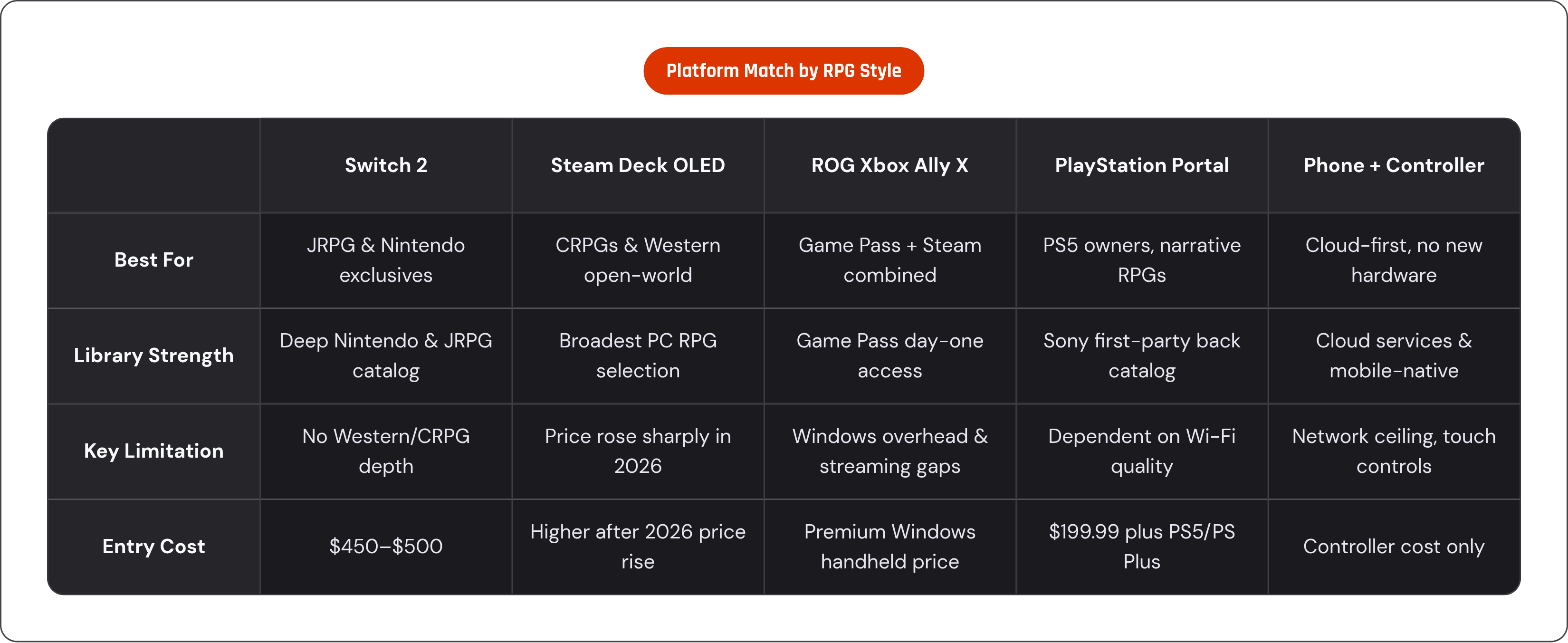
Which one's "best" depends on how you actually play, and if you've made it this far, you probably already suspect where you land. A JRPG devotee buying a Steam Deck just spent good money on a machine that can't run half their wishlist. A CRPG fan buying a Switch 2 is going to spend the first week wondering where all the tactical, mouse-driven strategy games went. Your taste is the real decision here; the device just needs to keep pace with it.
Run through it plainly, one more time. Nintendo exclusives and JRPGs point to the Switch 2. A PC library full of CRPGs and Western open-world games points to the Steam Deck OLED. Already deep into Xbox Game Pass? The ROG Xbox Ally X respects that without cutting off Steam. Own a PS5 and mostly play narrative single-player games? The Portal is $199.99 well spent. Don't want new hardware at all, and already pay for a cloud subscription anyway? Your phone and a decent controller will do more than you'd guess. And if your real love is Chrono Trigger or Tactics Ogre, no amount of modern horsepower matters half as much as save states and a decent emulation front end.
These are just different answers to different questions, none of them wrong on their own terms. Pick the device before you've figured out which question you're actually asking, and you risk ending up with hardware that doesn't match the games you actually want to play.