Handheld Gaming Console List by Category
Nintendo Switch 2 dominates hybrid gaming while PC handhelds race upward on a smaller base.
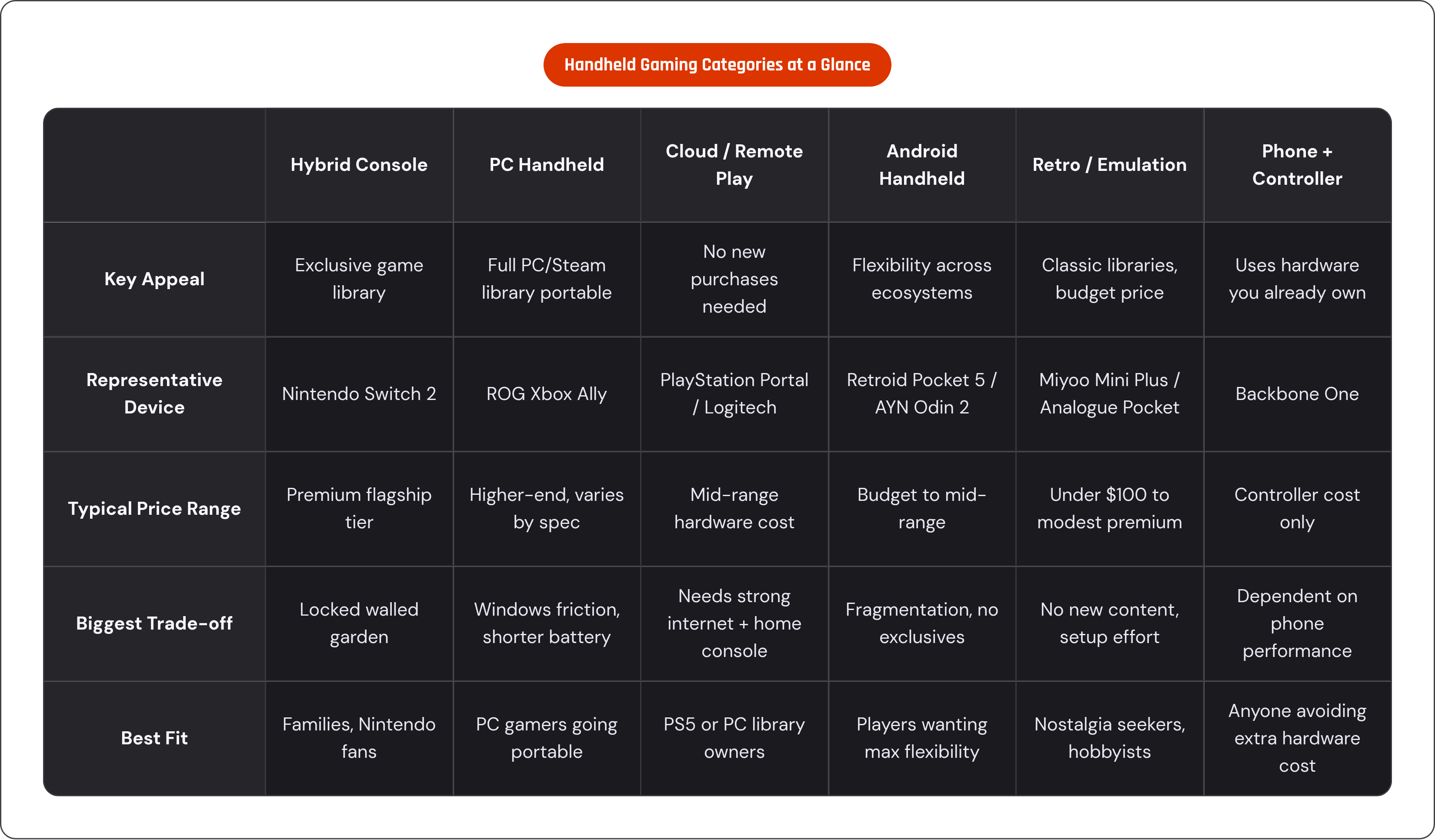
The handheld gaming market splits into at least six different segments, and lumping a $67 emulation box in with a $449.99 hybrid console and a phone clipped into a controller does a disservice to all three. Global spending is set to climb from roughly $9.4 billion in 2025 to $17.3 billion by 2033, a 7.8% annual growth rate, but that headline number hides how lopsided the growth actually is. Hybrid systems alone pulled in $8.2 billion in 2025, while PC handhelds are growing fastest off a much smaller base. So "what's the best handheld" isn't really answerable until you sort out something more basic: are you chasing exclusive games, hauling your Steam library around, streaming without buying anything new, or just trying to get more out of the phone already sitting in your pocket?
Mintel's US consumer research found battery life sits at the top of the list for more than half of gamers, portability comes in close behind, and cost is the single biggest reason people skip buying at all. Every category below deals with those three problems in its own way, and that's most of the story right there.
Hybrid console-handhelds: dedicated hardware with exclusive game libraries
A hybrid handheld plays portable and docks to a TV, one box doing two jobs without making you give up much on either end.
Nintendo Switch 2 owns this category so thoroughly that talking about the segment without it feels beside the point. It launched June 5, 2025 at a premium price point with redesigned Joy-Con 2 controllers and a real jump in raw performance over the original Switch. Donkey Kong Bananza, Pokémon Pokopia, and Hyrule Warriors: Age of Imprisonment carry the pitch on their own, since Nintendo won't license these games to anyone else.
Worth sitting with for a second: the original Switch sold past 150 million units, and Mintel found close to 40% of US gamers owned one, an installed base the size of a mid-sized country. It works like a built-in upgrade pipeline: millions of people who already trust the brand and just need a reason to buy the next box. That's a big part of why this category dwarfs everything else here.
No subscription, no internet needed for local play, games you can't get anywhere else — that's the whole appeal for a certain kind of player, and Nintendo built a walled garden around it.
Being locked into that garden is the tradeoff, though. The price sits above budget tier, and if raw horsepower is what you're after, a PC handheld beats a Switch 2 without much of a fight. This category fits the family living room, the person bouncing between couch and commute, and anyone for whom "it's a Nintendo exclusive" ends the conversation instead of starting one.
PC handhelds: full gaming libraries in a portable form factor
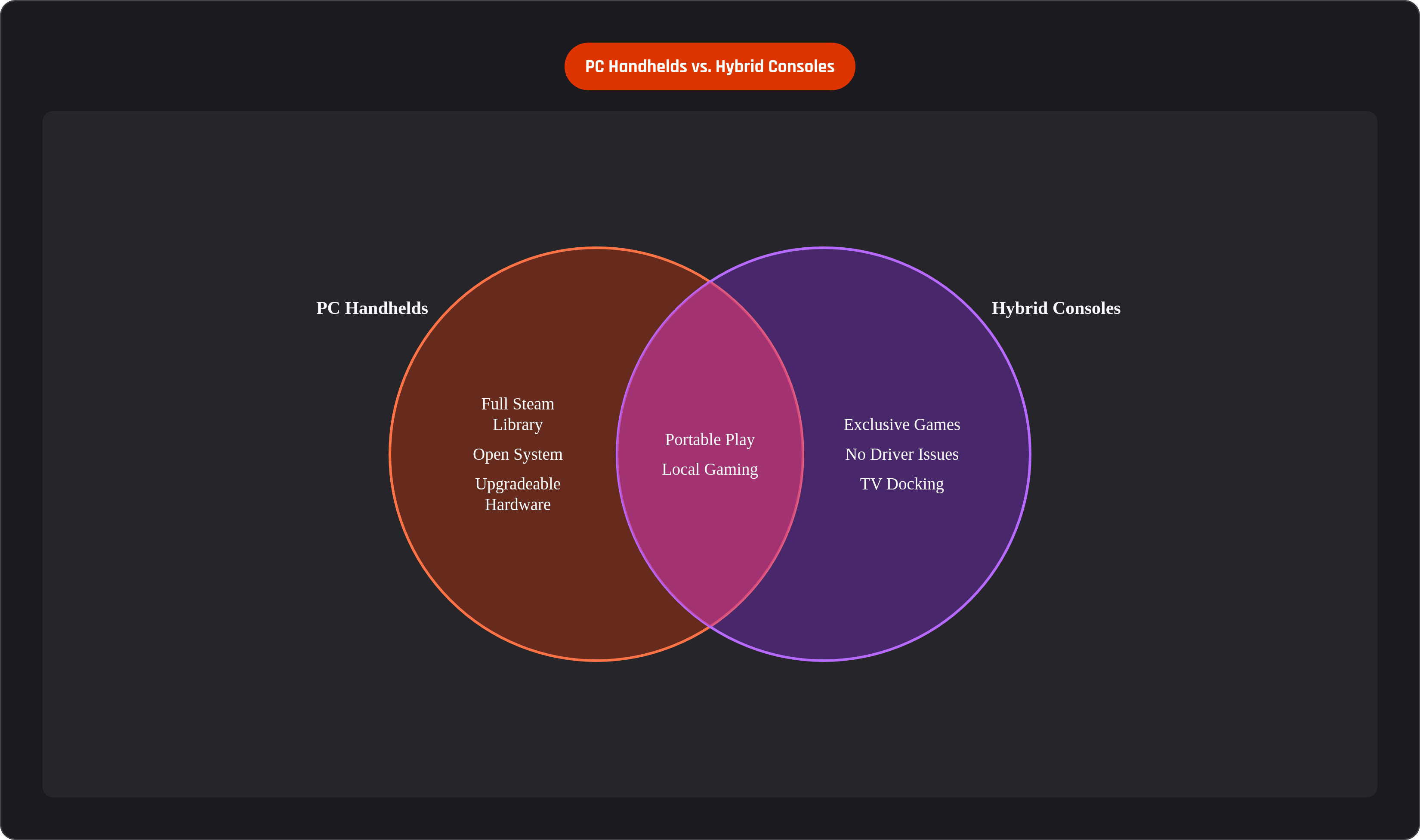
This category is really about your existing Steam or Xbox library, the one built up over a decade and a few thousand dollars, now running in your hands. No repurchasing, no new ecosystem to learn, just your games on smaller hardware.
Valve's Steam Deck proved the idea works. Cumulative sales passed 10 million units in 2024, running SteamOS with enough compatibility and modding support to grow a real community around it. That success is why ASUS, Lenovo, and Acer all decided it was time to show up too.
The device worth watching in 2025 is the ROG Xbox Ally and Ally X, a joint launch from Microsoft and ASUS that hit shelves October 16, 2025. Seven-inch FHD screen, anti-reflection coating, 120Hz refresh, FreeSync Premium, and a choice between two AMD chips: the Ryzen Z2 A for everyday play (4 cores, 8 threads, up to 20 watts, RDNA 2 graphics) or the Ryzen AI Z2 Extreme for more headroom. What separates it from a generic Windows handheld is how deep the Xbox integration runs; Game Pass and your Xbox library sit built into the experience instead of bolted on top. Microsoft has already announced a follow-up, the ROG Xbox Ally X20, at Computex 2026, adding the line's first OLED screen and bundling ROG XREAL AR glasses for a big-screen setup without an actual TV in the room.
Lenovo took a different route with the Legion Go S, the first officially licensed SteamOS handheld outside Valve itself, introduced at CES 2025. It's built for players who want the Steam interface without Windows tagging along. Acer went for storage and horsepower instead: the Nitro Blaze 8 and Nitro Blaze 11, launched January 2025 with AMD Ryzen 7 8840HS chips, 16 GB of LPDDR5X memory, and up to 2 TB of storage, aimed at people who install everything and delete nothing, ever.
Qualcomm joined the chip race in March 2025 with its Snapdragon G Series (G3 Gen 3, G2 Gen 2, G1 Gen 2), built specifically for handhelds. More chipmakers fighting over this form factor usually means more devices at more price points within a year or two.
What's the catch? Windows on a small screen brings friction console owners never deal with: driver updates, fan noise, background processes quietly eating battery. Battery life runs shorter than on hybrid consoles under heavy load, and prices sit higher across the board, with no exclusive library to fall back on when the hardware headaches pile up. This category suits PC gamers who already own the games and just want them portable, plus the enthusiast willing to trade some simplicity for more power and a fully open system.
Cloud-first and remote play devices: streaming without a local game library
These run nothing locally. The whole design is a screen and controller pulling a stream from a console, PC, or server somewhere else.
Sony's PlayStation Portal is the clearest example, and TechRadar has called it the best remote play device on the market. It needs a PS5 at home and a steady internet connection; take away either one and it's an expensive paperweight. You get full PS5 fidelity in your hands, but total dependence on your home console staying on and reachable. No PS5, no signal, no game.
Other dedicated cloud streaming devices go the opposite direction from Sony's console-tethered approach, built around comfort for long sessions: a light body, quiet operation, long battery life, and a sharp screen. Some run Xbox Cloud Gaming, GeForce NOW, and Steam Link without favoring any of them, which makes them the right call once you've already decided streaming is your thing and just want dedicated hardware that isn't secretly running Windows underneath.
The services work differently enough that picking one actually matters. Xbox Cloud Gaming is a catalog model, basically a subscription to a rotating library, bundled into Game Pass Premium at $14.99 a month or Game Pass Ultimate at $22.99. GeForce NOW flips that script: it streams games you already own on Steam, Epic, Ubisoft Connect, or Battle.net, so it fits better if you've spent years building a PC library and just want it reachable somewhere else. Its Premium tier moved to $22.99 a month as of April 2026.
Internet quality decides everything here, since none of it matters if your connection can't keep up. GeForce NOW lists 15 Mbps for 720p at 60fps, 25 Mbps for 1080p at 60fps, and 45 Mbps for 4K at 120fps. But bandwidth isn't really the ceiling here; latency is. Aim for under 40ms to the nearest server, because a fast connection with bad latency feels worse than a slow connection with good latency ever will.
One more wrinkle before you commit: Apple's policies mean Xbox Cloud Gaming and GeForce NOW run through Safari on iOS instead of as real apps. It works, but it's not the tap-an-icon experience you'd expect from anything else on your phone. This category makes sense for people who already own a PS5 or a sizable PC library and want access away from the main setup, as long as their home connection can carry the load.
Android gaming handhelds: open ecosystem devices for cloud, native, and emulation play
Android handhelds run the Play Store for native games, emulators for classic libraries, and cloud streaming apps, often all three on one device with zero hardware switching. That flexibility is the whole sales pitch, and the category has grown up fast: what used to be a niche hobbyist corner now includes Snapdragon-powered devices that handle demanding Android titles and modern emulation without breaking a sweat.
The AYN Odin 2 sits at the top for emulation performance, while the Retroid Pocket 5 has earned a reputation, per OfzenAndComputing, as the best Android emulation device under $300. The Retroid Pocket Flip 2 does something else entirely: a clamshell design running a Snapdragon 865 with a 5.5-inch AMOLED screen, built for people who want something pocketable with real guts inside it.
The pipeline behind these releases is dense. Retroid Pocket 6, AYN Odin 3, and a wave of dual-screen models announced in late 2025 all point to a segment moving faster than most hardware categories manage. And here's a real edge over iOS: Android handhelds run Xbox Cloud Gaming, GeForce NOW, and Steam Link as native apps, skipping the Safari workaround entirely.
The trade-offs are real, though. Android fragmentation means OS updates and app compatibility vary by manufacturer, sometimes wildly, and build quality across the price range swings from surprisingly solid to surprisingly flimsy. There's also no exclusive library backing any of it, unlike the Switch 2's walled garden. This category is for the player chasing maximum flexibility, native games plus emulation plus cloud streaming, without paying PC handheld prices to get there.
Retro and emulation handhelds: playing classic libraries on purpose-built budget hardware
Purpose-built retro hardware, usually ARM-based, running Linux or Android, and often priced well under $100, sits at the budget end of the market. It splits into two philosophies that don't have much in common besides nostalgia.
Budget emulation handhelds from brands like Anbernic and Miyoo run software emulation of classic platforms, and the community firmware built on top is often better than whatever ships in the box. The Miyoo Mini Plus, at $67, built a cult following partly on hardware and partly on OnionOS, a community-built operating system widely considered the best experience at that price point. The ANBERNIC RG477M, released August 2025 with a metal build, handles PS2 emulation at resolutions higher than the original console ever produced.
Then there's a completely different approach: FPGA hardware like the Analogue Pocket, which reproduces old chip behavior at the hardware level instead of emulating it in software, letting you plug in genuine cartridges. That's a different value proposition entirely, chasing accuracy instead of affordability, and the price tag reflects the choice.
Wiseguy Reports points to a real nostalgia-driven segment here, with room for manufacturers to keep innovating instead of just repackaging the same shells year after year. But the trade-offs are honest ones: there's no new commercial library, so your content ceiling is whatever you can emulate. The legal questions around ROMs are ones manufacturers quietly leave for you to sort out on your own, and getting the best experience out of most of these devices takes real setup work too: flashing firmware, downloading themes, poking around forums for the right build.
Using a smartphone as a handheld gaming console with a physical controller
Here's a fact that surprises people the first time they hear it: the phone already in your pocket outperforms most dedicated Android handhelds on raw processing power. The only thing it's ever been missing is physical buttons.
Clip a controller onto your phone, or pair one over Bluetooth, and you get back real analog sticks, triggers, bumpers, and face buttons. That kills the dead zones and the finger-blocking-the-screen problem that touch controls always carry with them. It also gives you something to actually hold onto during a long session, which matters given that Mintel found more than half of gamers rank battery life and comfort above nearly everything else. And there's no added subscription cost, since you're using a device and a game library you already pay for.
So what opens up once you clip on a controller? Xbox Cloud Gaming and the full Game Pass catalog through the Xbox app or Safari, GeForce NOW streaming whatever's sitting in your Steam library, PS Remote Play pulling from your PS5 at home, Steam Link connecting to your gaming PC, plus native controller support across Apple Arcade and a growing slice of the Google Play catalog.
Backbone has built its entire product line around exactly this, with the Backbone One and Backbone Pro made to plug into or wirelessly pair with a phone. The engineering isn't an afterthought: the company points to more than 50 research studies, over 50 patents, and more than 10,000 part iterations aimed at cutting latency and keeping the thing comfortable enough for a four-hour session without your hands cramping up. The companion app turns your phone's screen into something that looks and feels like a console launcher instead of a home screen crowded with icons, and because it runs on both iOS and Android, you get Apple Arcade and Google Play from the same piece of hardware. It's popular enough among serious players that plenty treat it as a real alternative to buying dedicated hardware at all.
Six categories, six different bets on what "portable gaming" is supposed to mean. There was never going to be one device for everyone here; the market's too split by design for that. What do you already own, and what are you actually trying to play? Start there, and the rest of this sorts itself out fairly quickly.