Best Handheld Games for Adults
Adults are finally getting handheld games built for their actual schedules and devices.
Mobile gaming hit $103 billion in 2025, which is 55% of the entire global games market, more than console and PC put together. It just happened, quietly, while the average gamer turned 31 and 41% of players turned out to be women, which means the "handheld gaming is for kids in the backseat" idea has been dead for years and we're only now catching up. This piece walks through what adult handheld gaming actually looks like heading into 2026: the devices worth owning, the games that fit a session length adults actually have (short, interrupted, hard-won), and how cloud gaming quietly made the whole conversation bigger than any one gadget.
What "handheld" means in 2026 — the device landscape adult players are actually choosing from
Four categories, roughly. Maybe four and a half if you count the drawer of old devices nobody's thrown away.
The hybrid console, led by the Switch 2, is the safe pick, the one you buy when you just want a thing that works. A 7.9-inch screen, JoyCons finally sized for adult hands, backward compatibility with most of the original Switch library, and 1080p at 120Hz in handheld mode. It won't win benchmarks against anything else on this list, but it won't let you down either.
The portable PC category, led by the Steam Deck, is for people whose Steam library has been gathering digital dust since 2019 and would like to actually play some of it. The entry-level LCD model at $399 is still a strong deal, and it can run Elden Ring, Final Fantasy VII Rebirth, or Kingdom Come: Deliverance II. The ASUS ROG Xbox Ally X plays a similar role for people who want the Xbox ecosystem specifically, along with standard analog sticks instead of the Deck's trackpad-forward layout.
Retro and emulation handhelds, the Retroid Pocket 5, the TrimUI Brick, the R36MAX, are the niche option, though a growing one. These are for adults chasing a back catalog they either missed the first time around or want to revisit without the nostalgia goggles doing all the heavy lifting.
Then there's the device most people already own and never think of as a gaming console: the phone. Pair it with a compatible mobile controller and you've got console-quality controls and startlingly low latency into the entire cloud and remote-play world. No new hardware, no new platform to learn. You're buying a controller, not a console, and that's a smaller ask for someone who commutes and doesn't want a second brick riding around in their bag.
Almost none of the games in this piece are locked to a single device. That fact matters more once cloud gaming enters the picture, so let's get into that next.
How cloud gaming expands what any handheld can play
455 million people used cloud gaming in 2025. The market's projected to go from $3.4 billion in 2023 to $20.3 billion by 2027. At that point it stops being a "technology to watch" and starts being infrastructure.
Two services actually matter here, and they work on different logic. Xbox Cloud Gaming, folded into Game Pass Ultimate, rents you content: hundreds of games, day-one access to Microsoft's first-party stuff, streaming up to 1440p. GeForce NOW rents you compute instead, which means it takes your existing Steam, Epic, GOG, or Ubisoft Connect library and throws it onto whatever screen is in front of you. Its Ultimate tier runs on RTX 5080 "Blackwell" servers, pushing 4K at 120fps for people who'd rather carry their existing PC library than start a new one.
Here's what that changes in practice. Hades II, Baldur's Gate 3, Disco Elysium, none of these run natively on a phone or an aging handheld, and none of that matters anymore. They're all fully playable through the cloud. So the question this piece keeps asking isn't "what can your device technically handle," it's "what do you want to play, and which door gets you there." A mobile controller clipped onto a phone, paired with either service, gets you something close to console streaming on a device you were already carrying. The engineering underneath (server-side rendering, video compression, the input-lag math) isn't the point of this piece; what it unlocks is.
Strategy and RPG games that reward the time adults actually have — not the time teenagers used to
Adults play in shorter, more deliberate sessions than they used to, and that's a scheduling reality, not a taste preference. It changes what makes a strategy or RPG pick actually good on handheld. The games worth your time aren't the ones stuffed with the most content; they're the ones that let you set the controller down for four days and pick it back up without needing a wiki refresher on your own save file.
Civilization VII nails this. Turn-based structure means you can pause mid-thought, literally anywhere, and it runs on Switch 2 as well as PC and Steam Deck. Into the Breach might be the most perfectly built handheld strategy game that exists: compact, tightly designed, and every single session resolves into something complete, win or lose. XCOM 2 asks more of you, a real campaign with real consequences for sloppy play, but it runs fine via Steam Deck or streamed to mobile through the cloud.
Baldur's Gate 3 is close to the reference point for what a modern RPG looks like now. It rewards the player who reads the dialogue instead of clicking through it, who plans, who lives with a choice made three hours ago instead of reloading to undo it. Available on PC and through cloud streaming.
One distinction worth drawing out: some of these games were built for handheld sessions from day one, and some were adapted or made cloud-accessible after the fact. Into the Breach falls into the first bucket, alongside Polytopia (a genuinely deep 4X-lite strategy game that never cuts corners despite fitting in fifteen-minute chunks) and Bad North, whose minimalist real-time tactics feel designed for a phone screen from the ground up. Baldur's Gate 3 and XCOM 2 sit in the second bucket. Each feels different in your hands, and it's worth knowing which one you're signing up for.
Narrative games adults will actually finish — stories that treat the player as an intelligent reader
Ask any adult gamer what bugs them most and "I never finished it" comes up almost every time. Life interrupts, the save file goes cold, momentum dies. The games in this section solve that problem two ways: either they end cleanly, or they're built so each sitting has a shape of its own.
Disco Elysium might be the most literarily ambitious RPG ever made, all dialogue and consequence, barely any combat in the traditional sense. It's built for someone who reads real fiction and wants their games to respect that same appetite, and it streams to mobile through the cloud, worth knowing since the game itself wasn't designed with a small screen in mind. Hades and Hades II solve the finishing problem differently: the roguelite loop means every run is complete on its own terms, and story unfolds through repetition rather than demanding a three-hour block you don't have.
What Remains of Edith Finch runs under three hours and leaves a real emotional mark. It's a strong example to hand a skeptical friend who thinks games can't do what novels do. Kentucky Route Zero moves slower and stranger, genuinely literary in its pacing; not for everybody, but exactly the kind of thing adults who feel like the medium skipped them should sit with at least once. And 80 Days, a text adventure built for mobile from the ground up, has terrific writing and ten-minute sessions baked into its structure, working just as well with a controller as without one.
What ties all of these together: they respect your time, and they don't punish you for having a life outside them. On mobile specifically, a physical controller changes these games more than the genre suggests it should. You don't need twitch reflexes to pick a dialogue option, but forty minutes of holding a controller is simply more comfortable than forty minutes of thumbing at flat glass.
Action and adventure games that hold up on a smaller screen
The filter here isn't "best action games of all time." It's narrower: which ones hold up in your hands, on a small screen, in a thirty-to-sixty-minute window, since that's roughly what most adults can actually carve out.
Dead Cells might be the single best action game built with handheld specifically in mind. The motion feels precise, no two runs repeat, and while it's on Switch and mobile both, get a controller for it; touch controls and precision platforming have never worked well together. Hollow Knight runs longer, moodier, uncompromisingly difficult, and stands as one of the best games of the last decade on any platform, full stop. It plays beautifully on Switch 2 or on mobile through a compatible controller. Celeste deserves its own paragraph, honestly, because underneath the pixel art it's not really about reflexes. It's about persistence, and that's a theme that lands differently once you're thirty-five and have actually failed at something that mattered.
Hades II shows up twice in this piece, once here and once in the narrative section, and that's intentional, not an oversight. Its combat loop is genuinely excellent on its own terms, rewarding repetition instead of punishing it. Stardew Valley belongs here too, not filed under "casual," because the depth under that farming-sim surface gets real once you're forty hours deep debating crop rotation with real intensity.
Switch 2's lineup, Donkey Kong Bananza among them, shows Nintendo still has range in this genre. Steam Deck, meanwhile, makes Elden Ring and its successors possible on a handheld at all: demanding, unmistakably adult-coded action-RPGs with no mobile-native equivalent, fully playable on the Deck itself or streamed through the cloud.
Puzzle and indie games designed for the gaps in an adult's day
People spent 444.6 billion hours in mobile games globally in 2025, and most of that time lives in short, repeatable chunks: a bus ride, a waiting room, the ten minutes before a meeting starts. Puzzle and indie games are built around exactly that rhythm, which makes this the category most naturally suited to handheld play, full stop.
Monument Valley and its sequel are still some of the most beautifully designed mobile games that exist, and the spatial puzzle logic underneath the visuals is genuinely clever rather than just pretty scenery. Mini Metro and Mini Motorways are abstract, elegant, endlessly replayable in ten-to-twenty-minute bursts, roughly the ideal handheld session length whether you planned it that way or not. Alto's Odyssey is meditative and gorgeous, one of the clean examples of mobile gaming done right instead of monetized within an inch of its life.
Baba Is You runs on a different kind of logic entirely: the rules of the game are physical objects you pick up and rearrange, and nothing else in the medium quite does what it does. It's on Switch and PC. Return of the Obra Dinn is slower and more cerebral, a deductive mystery built for careful attention rather than fast hands, playable on Switch or Steam Deck.
Nearly everything in this list has won or been shortlisted for a major design award, which is a decent shortcut if you'd rather trust curation than burn an hour scrolling an app store. Worth flagging on pricing too, since it varies more than people expect: Monument Valley and Alto's Odyssey are paid mobile titles, while Baba Is You and Obra Dinn are console and PC games that happen to travel well.
How to match game type to device — a practical guide for adults choosing their setup
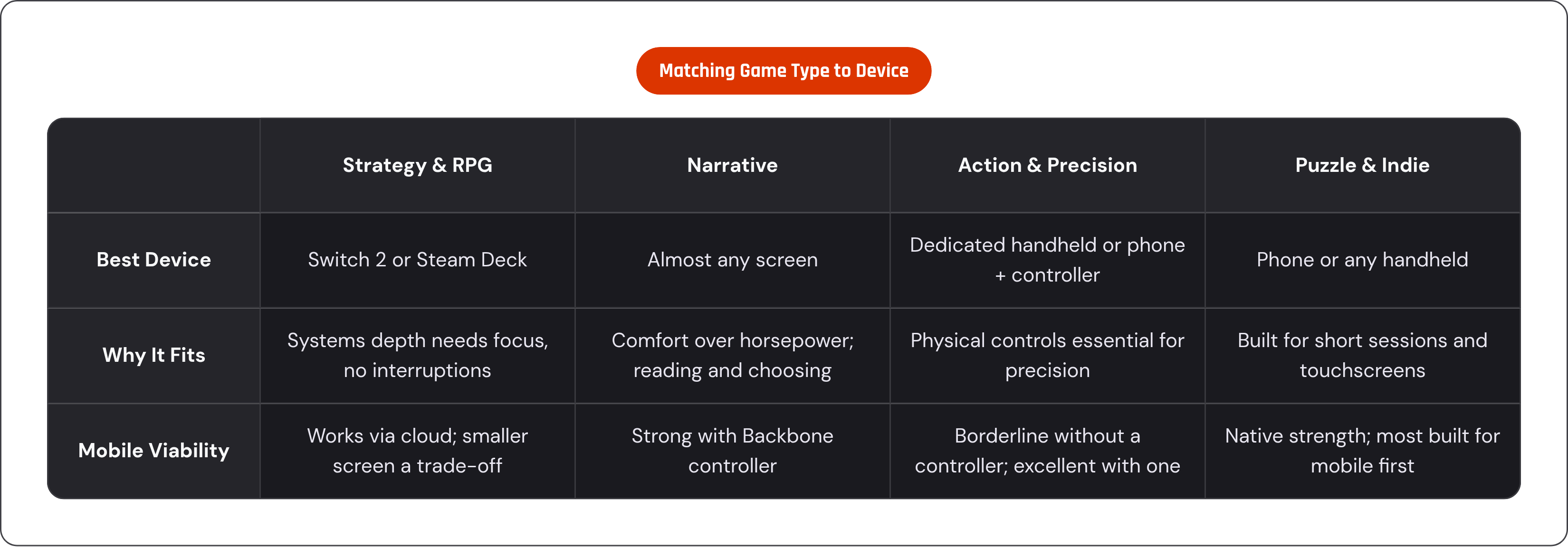
Not every game belongs on every device. Session structure, control scheme, and screen size all pull in slightly different directions depending on what's actually in front of you.
Long, systems-heavy games like Baldur's Gate 3, Civilization VII, and XCOM 2 do best on a Switch 2 or Steam Deck, somewhere you can sit and actually think without a notification breaking your train of thought. Cloud streaming to mobile works too, if you're fine trading screen size for not carrying a second device. Narrative games are more forgiving; they hold up on nearly anything with a decent screen, and mobile with a physical controller is a completely legitimate way to play them, since comfort matters more than horsepower when the core loop is reading and choosing.
Action and precision games are where the rules tighten. Dead Cells, Hollow Knight, and Celeste genuinely need a physical controller on mobile; touch controls and real platforming precision have never worked well together. A physical controller turns these from borderline unplayable into excellent, which is a bigger jump than it sounds on paper. Puzzle and indie games sit at the other end entirely, the strongest case in this whole piece for mobile-native play, since most of them were built for a touchscreen from the start and lose nothing by staying there.
For the adult who travels or commutes and doesn't want a dedicated handheld taking up bag space, a Backbone paired with Xbox Cloud Gaming or GeForce NOW covers most of what's in this piece already. The Switch 2 and Steam Deck aren't competing against a phone setup here; they're doing a different job. Different situations, different tools, no single winner.
What makes a handheld game genuinely worth an adult's time
No stat needed for this one. It's a synthesis question: what do all these games, across five very different categories, actually have in common?
They respect session length. They save anywhere, or they build in a natural stopping point, or they just wrap up in under an hour so you're not left mid-thought when the kid wakes up or the train arrives. They also carry depth forward instead of resetting it. Each sitting adds to something, whether that's story, strategy, or muscle memory, rather than dumping you back at zero every time you open the app.
They tend to skip the compulsion loop, too. No energy timer ticking down, no daily-login guilt waiting on day three. The good ones pull you back because you want to be there, not because a notification convinced you you'd lose something by staying away. Meanwhile, control quality matters more than most people assume going in: games built for or well-adapted to physical input hold up, while touchscreen-only experiences stay a compromise most adults will eventually reject for anything beyond the truly casual.
Here's the broader thought worth sitting with: handheld gaming might have always suited adult life better than the living room console ever did. It's portable, it pauses when you need it to, it's private in a way a shared TV never is, and none of that has anything to do with age. Which loops back to where this started: the phone already in your pocket, paired with the right controller, reaches almost everything covered here. The barrier to good handheld gaming, as an adult, has never been lower, and there's a decent chance a physical mobile controller is all that's standing between you and realizing it.