Dedicated Handheld vs Phone for Competitive Mobile Games
Dedicated handhelds cut input lag and stay powered longer than phone-controller combos.
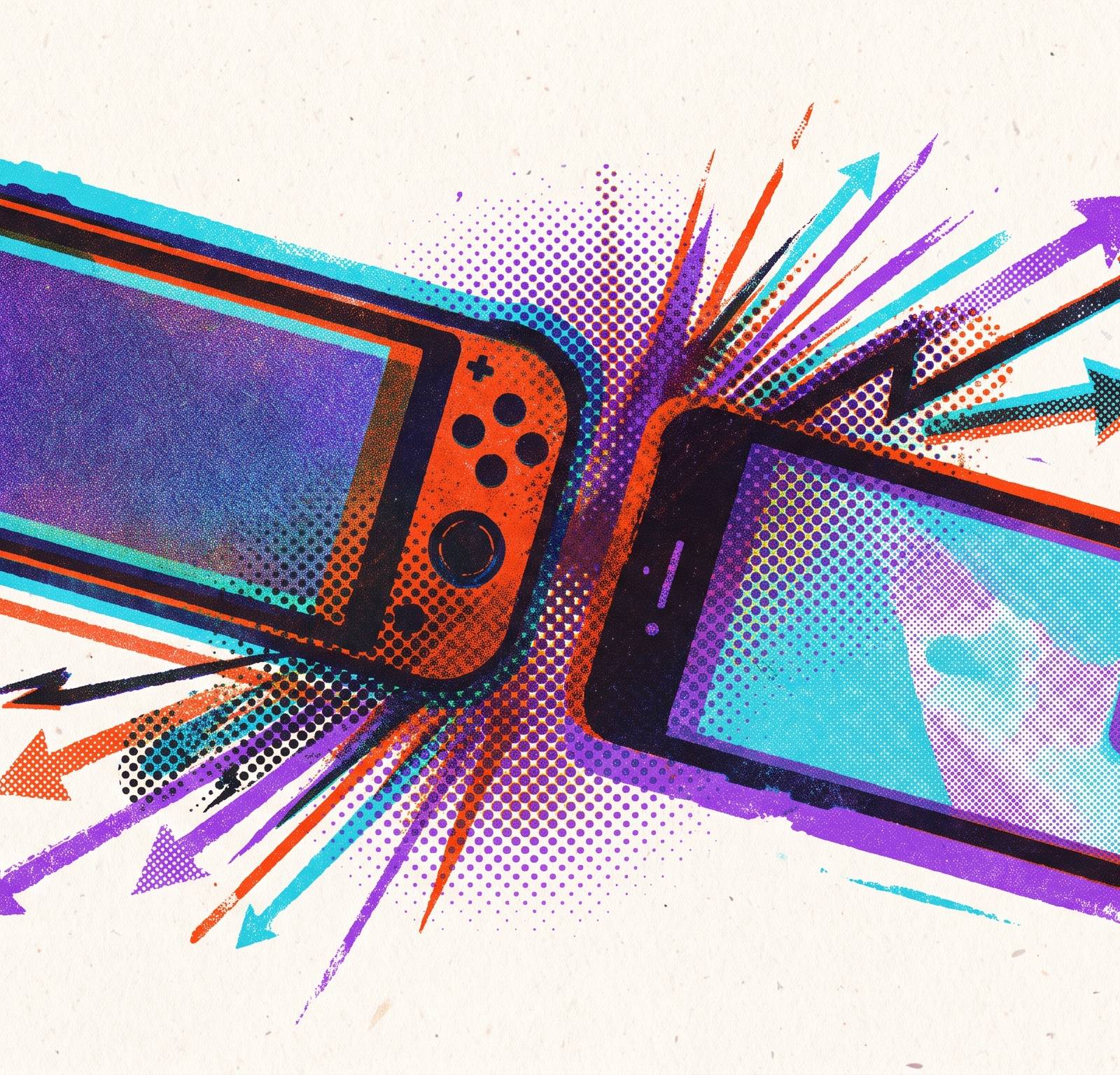
Does a dedicated handheld beat a phone with a controller strapped to it for competitive mobile gaming? That's the question people actually mean to ask, even when they phrase it wrong. Mobile gaming is projected to reach $105.70 billion in 2025, and Statista puts it at $118.90 billion by 2027, and I had to sit with that second number for a minute. It implies people are staying put, cycling past a free-to-play phase rather than quitting; the people spending that money are adults with disposable income and opinions about frame pacing.
Calling this "convenience vs. performance" is a lazy way to split it. Both setups can be convenient, both can perform, depending on what you bolt onto them. What actually separates competitive setups comes down to four things: input latency, display responsiveness, which games you can even run, and how long the thing survives before you're hunting for an outlet. A dedicated handheld has one job, so nothing interrupts a match with an incoming call or eats your processor quietly in the background while you're lining up a shot. Phones are generalists by design; gaming is one item on a long list the hardware juggles, and juggling costs something every time.
So which tradeoffs actually bite you mid-match, and which just look bad on a spec sheet? Let's go factor by factor, since the answer flips depending on which factor you're standing on.
This is a habit for a large number of people, not a fringe hobby. Mobile gaming draws around 3 billion players worldwide, more than PC and console combined, and the average mobile gamer is 36 years old, putting in 8.5 hours a week. PUBG Mobile and Genshin Impact launch simultaneously on mobile and PC now, so the hardware underneath deserves a real look instead of the usual eye-roll about "phone games."
Input latency: where milliseconds decide competitive outcomes
Competitive players start noticing lag above roughly 80 milliseconds of total system latency. Casual players won't blink until somewhere around 120 to 150. That 80ms figure is the budget this whole section lives inside.
Break it down and the controller itself needs to stay under 10ms, leaving room for network lag, which alone can add 20 to 80 milliseconds depending on how far you sit from the server. Network distance is basically fixed once you've picked your couch. Controller lag, on the other hand, responds to the gear you choose, and that's why it gets picked apart here.
A dedicated handheld wires its controls straight into the same board as the processor. No wireless hop, no pairing handshake, nothing to negotiate. Bluetooth controllers paired to a phone tack on roughly 10 to 20 milliseconds on top of everything else, and that sounds trivial until you're already near your latency ceiling and that sliver is what tips you over it.
A wired USB-C controller skips the Bluetooth tax completely, putting a phone on close to equal footing with a dedicated handheld for raw input latency. For shooters and competitive racing, that gap matters more than it sounds like it should. It's the difference between landing the shot and watching a killcam trying to piece together what just happened.
Then there's the phone itself. Standard flagship phones throttle their CPU under sustained load, and that throttling shows up as creeping input lag the longer a match drags on. Phones built specifically for gaming, the ROG Phone series with a Snapdragon 8 Gen 3 being one example, are built to hold peak output instead of tapering off after twenty minutes. Staying consistent matters more than whatever number is printed on the box. These phones target touch response under 25 milliseconds, a mark standard flagships stop hitting once they've been running hot for a while.
Display responsiveness and what high refresh rate actually changes in a match
Two terms get thrown around like they mean the same thing, and they don't. Refresh rate is how smooth motion looks on screen. Touch sampling rate is how fast the screen notices your finger landed on it at all. Competitive play needs both pulling their weight.
Nintendo's Switch display prioritizes portability over the kind of response specs competitive play demands, and dedicated handheld panels vary widely in how they compare to flagship phone screens. Gaming phones tend to run AMOLED screens with high refresh rates and elevated touch sampling, and that's a real edge for anything that rewards fast reactions. The ROG Phone line stands out here, with hardware tuned to sustain performance under load rather than just posting a good number during a short benchmark run.
Still, the display only matters if the game itself doesn't cap the frame rate lower. A 120Hz panel does nothing for you if the title tops out at 60 frames per second on that platform anyway, so check what a given competitive title actually supports before assuming better hardware buys you anything.
Flagship gaming phone panels tend to lead on both refresh rate and touch sampling compared to most dedicated handheld screens. Here's a counterpoint people skip past, though: a dedicated handheld's screen stays locked on the game for the whole session, because nothing else is running on it to steal a frame. No notification banner sliding down mid-match.
Game ecosystem access and what each setup can actually run
Nintendo's Switch library is built around Nintendo's own ecosystem, which means mobile-native competitive titles fall outside it. Android gaming handhelds run the real Google Play store, though they typically receive fewer major OS version updates than flagship phones do. Phones have full native access to whatever their operating system's competitive catalog holds, no compatibility gap for mobile-first titles at all.
Cloud gaming changes the calculation, though. Xbox Cloud Gaming runs through a browser on iOS and a native app on Android, and Microsoft has rolled out native touch controls across a broad and growing catalog of titles. GeForce NOW streams games you already own across Steam, Epic, GOG, and PC Game Pass, which fits great if you've already built a PC library; its free tier goes up to 1080p at 60 frames per second. PlayStation splits the difference: PlayStation offers its own streaming options for handheld and phone users, with different tiers streaming from either Sony's servers or your own console.
Cloud gaming closes a lot of that ecosystem gap. A phone with a decent controller can stream the same console and PC titles a dedicated handheld runs. The business models differ too: Xbox Cloud Gaming hands you rotating library access, while GeForce NOW streams whatever you personally own. Which one fits depends on whether you're already a PC gamer to begin with.
Android's cloud and web-app distribution is growing faster than any other channel in the space right now, and that trajectory points toward ecosystem access tilting further toward the open platform in the years ahead.
Battery life and portability under real competitive conditions
Streaming through GeForce NOW at 1080p and 60 frames per second drains roughly 18 to 22% of a phone's battery every hour. Do the math and that's about three hours before a year-old phone starts needing a charger. That's a real problem if your session, or your tournament bracket, runs longer than that.
Dedicated handhelds carry bigger batteries in bigger bodies, built from the ground up for sessions with no wall outlet in sight. Gaming phones split the difference: bigger batteries than a standard flagship, sure, but the chassis is still fundamentally a phone, so screen drain and heat management are constantly competing with the game for the same power budget. Sustained competitive sessions mean the practical battery ceiling matters just as much as whatever peak performance number gets printed in the marketing copy.
Here's the tradeoff in plain terms. A phone is already in your pocket, so it adds zero bulk. A dedicated handheld is one more thing to carry, but it shows up with controls built in and a battery sized specifically for gaming. Strap a controller onto a phone and you've basically built your own dedicated handheld, minus the battery advantage that came baked into the real thing from day one.
Network hardware tips things back toward phones, at least on connectivity. Global 5G subscriptions passed 1.9 billion in 2025, and phones are positioned to benefit most from ongoing 5G infrastructure improvements, putting them ahead on raw network capability for online competitive play. Phones win on how easy they are to carry. Dedicated handhelds win on how long they last once you're actually playing.
What physical controls contribute that software alone cannot replicate
Touch controls have a built-in problem for anything demanding quick, precise analog input. A virtual button gives you zero physical feedback, and worse, it can shift slightly under your thumb the moment you're stressed and gripping harder than usual without noticing it. A dedicated handheld sidesteps this by building the controls into the chassis, so there's little gap between what you mean to do and what the device registers.
Phones tackle the same problem differently, by bolting on a physical controller, which raises the real question: how good is that controller under actual competitive load, not in a five-minute demo? Hall-effect sticks are one clear answer. They read stick position through electromagnetic fields instead of physical contact, meaning no drift as months of hard use pile up. That's a real advantage for anyone logging serious hours who doesn't want their stick degrading mid-season.
Ergonomics matter more than people give them credit for. Wrist posture during long sessions is a performance variable, not just a comfort footnote, because a hand cramping in hour two isn't a hand hitting frame-perfect inputs. Controller shells fall into roughly two camps: clip-style, cheaper and more flexible but rougher on long stretches, and shell or split-style, pricier but holding up better across a multi-hour session, closer to how a dedicated handheld feels in your hands. A genuinely well-built companion app, one that handles cloud streaming setup, button remapping, and screenshot capture without a fight, ends up mattering more than people expect when picking between controllers.
Which setup gives competitive players the real edge, and under what conditions
I went into this looking for a single winner. There isn't one, because it depends entirely on what you're playing and how you're playing it.
A dedicated handheld makes sense when the game only exists on that ecosystem, whether that's a Nintendo exclusive or a title tied to a specific Android handheld. It also wins when sessions regularly run past three hours away from an outlet, or when what you want is a single-purpose device with minimal setup friction and little temptation to check a text mid-match.
A phone with a controller wins under a different set of conditions. If the competitive title is mobile-native, something like PUBG Mobile, no dedicated handheld touches that native ecosystem access, full stop. If cloud gaming is how you mostly play, a phone with a wired USB-C controller on strong 5G or Wi-Fi can match or beat a dedicated handheld's latency profile. If display responsiveness is what you care about most, flagship gaming phone panels tend to beat most dedicated handheld screens on both refresh rate and touch sampling. And if you're already carrying a phone everywhere, the case for a second device gets harder to justify by the day.
The controller is really what this whole thing comes down to, once you strip away the rest of the noise. A phone without a proper physical controller struggles to hold its own in competitive play; a phone with the right wired controller genuinely competes. For most competitive mobile players, the phone-plus-controller path ends up more flexible and more future-proof, riding the growth curve of cloud gaming and 5G expansion while keeping access to the widest possible game catalog, provided the controller meets the standard the game demands. The hardware to turn a phone into a practical gaming console is already sitting in your pocket.