Handheld Console Trade-In and Resale Value Guide
Understanding what drives resale value helps you cash out before your handheld plummets.
The handheld gaming market isn't just Nintendo's backyard anymore. It now stretches across portable PCs, retro cartridge relics, and cloud-capable devices spanning wildly different price tiers. That range explains why "just selling the old thing" doesn't work the way it used to: the right move depends heavily on which device sits in the drawer, what's replacing it, and what the resale market is doing at that moment. A Switch OLED and a Steam Deck age in completely different ways, on completely different clocks, for reasons that have nothing to do with how well either one was cared for. Players who understand why prices move, rather than shrugging and accepting whatever number a kiosk spits out, tend to walk away with meaningfully more cash. This piece is about the mechanics behind that number: not a spreadsheet of prices frozen in time, but the forces that push those prices up or down, and how to read them before they read you.
The three forces that set any handheld's resale price
Resale value isn't a mystery, even though it can feel like one when two seemingly similar devices sell at wildly different price points. Gizmogo's guide states three forces set the baseline for any console's resale value: new hardware availability, generation age, and how relevant its game library still is. Think of these as gravity, not opinion. A new hardware launch pulls the floor out from under the old model almost immediately, and the only real question is how far it falls and how fast. Generation age works on a slower timer: a device still mid-cycle, still getting new software, holds its ground, while one whose generation has visibly ended starts sliding no matter how well it was maintained.
It's about whether the software tying a player to that hardware is still exclusive to it. Exclusives that only run on one box sustain demand for that box; the minute a beloved exclusive jumps to PC or lands in a subscription service, the hardware loses one of its best arguments for existing. That's why a console can be the same age, in the same condition, and still fetch a wildly different price than its closest competitor. The library is doing work the spec sheet can't.
Dropping from excellent to good condition typically shaves 10 to 20% off a payout, and going from good to fair costs a further, meaningful margin on top of that. Market forces decide the ceiling. Condition decides where, under that ceiling, a specific unit actually lands.
How Nintendo handhelds hold value
Nintendo runs its pricing like a company allergic to discounts, and that discipline drives the resale market directly. MSRP cuts are rare, sales on first-party software rarer still, and that scarcity builds a price floor under used Nintendo hardware that competitors simply don't get to stand on. The Switch OLED shows used units have historically sold for 65 to 80% of their original price, years after launch. That figure reflects genuine hardware retention and consumer demand, not a typo or nostalgia. It's a hardware upgrade, the improved screen and sturdier build, that buyers can actually see and feel, not a spec-sheet difference that only matters to people who read spec sheets.
The arrival of the Switch 2 changed the math for everyone still holding an original Switch. IGN's console resale value guide already shows a notable depreciation hit to original Switch units since the newer model launched, and current used Switch market tiers reflect that split clearly. Meanwhile the Switch 2 itself is in an odd early-life position, with best current resale price around $286.00 against an average market value closer to $172.50, a gap that BankMyCell shows reflecting condition spread and channel variance. That gap is wide, reflecting condition spread and channel variance rather than any confusion. It reflects condition spread and channel variance more than any mix-up between models.
What keeps both machines from cratering entirely is the software. Mario Kart 8 Deluxe, the Zelda pair of Breath of the Wild and Tears of the Kingdom, and Super Smash Bros. No amount of cloud streaming substitutes for owning the actual cartridge and the actual console it plugs into. Original Switch values will keep drifting downward as Switch 2 adoption deepens, and the best window for recovering strong value on an original Switch is now.
PC handhelds depreciate on a different clock
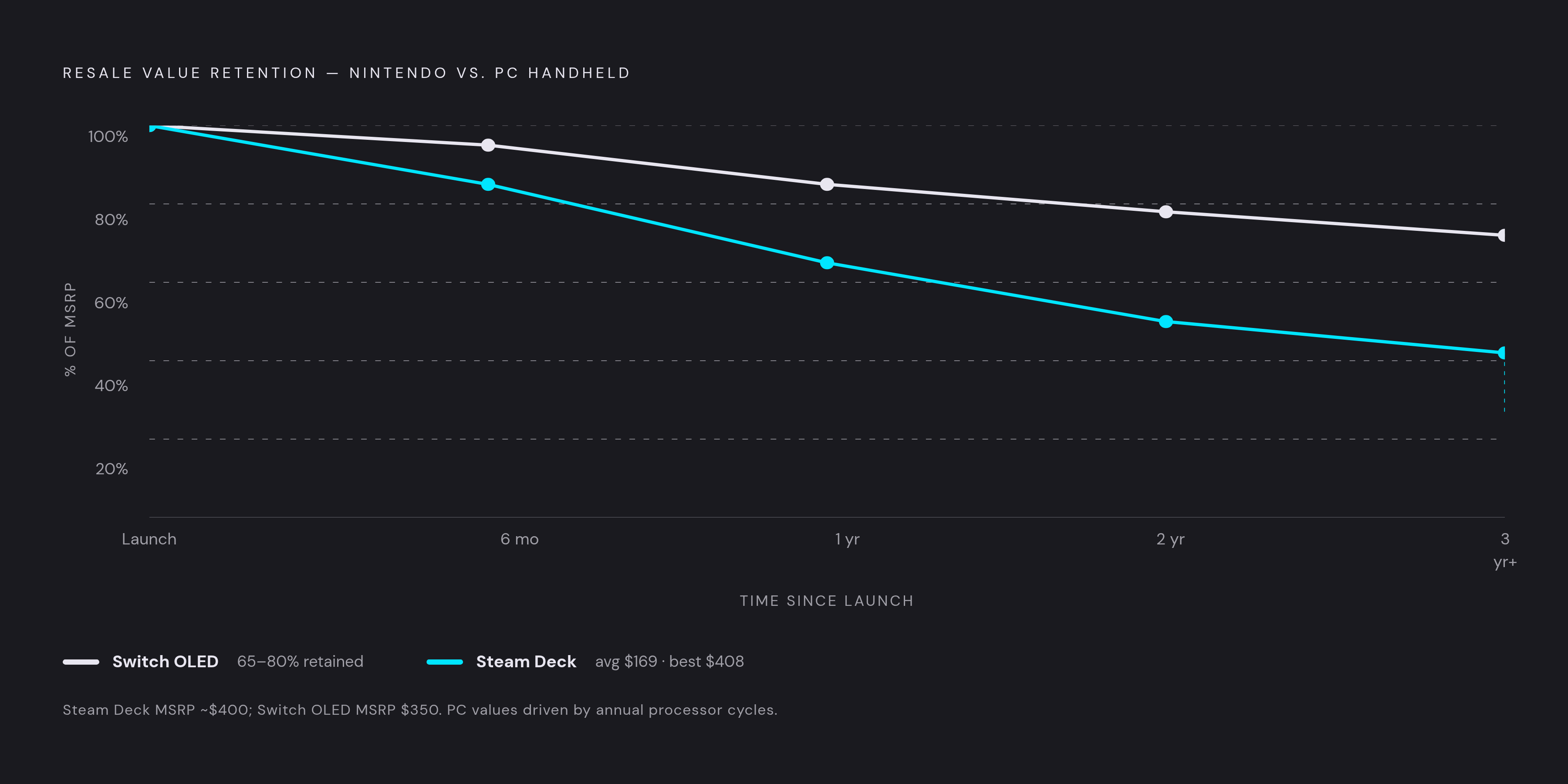
Nintendo hardware ages like a console. Devices like the Steam Deck, the ROG Xbox Ally, and the Lenovo Legion Go age like PCs, because that's fundamentally what they are: portable computers wearing a controller shell. Processors on these machines improve on annual, sometimes near-annual, semiconductor cycles, and that means last year's chip starts looking outdated the moment a newer one ships, regardless of how well the older unit still runs the games it was bought for.
The Steam Deck's current resale numbers show how unstable that comparison window gets. Best resale price is around $408.00, but the average market value is closer to $169.32, a spread wide enough to swallow a used console whole. The OLED holds its value better because the hardware upgrade is tangible to buyers, not just a spec-sheet difference. And the used supply pool keeps growing: IDC figures covering 2022 through mid-2025 show substantial cumulative PC handheld shipments, with Steam Deck making up the majority of that volume. More supply flowing into the secondary market pushes prices down independent of anything happening at retail.
Valve's own May 2026 price increases, blamed on rising memory and storage costs, create a genuinely strange dynamic here. Retail prices went up while used-market averages stayed well below them, which could actually narrow the discount buyers have come to expect on a used unit. It's a rare case where a manufacturer's cost problem accidentally does sellers a favor. Retail prices right now show the ROG Xbox Ally lists at $599.99, the ROG Xbox Ally X at $999.99, and the Lenovo Legion Go 2 starts from $1,199. None of that changes the core advice for anyone holding an aging PC handheld: sell before the next processor generation lands and before used supply builds up further, because waiting rarely pays off in this category.
When old handhelds become collectibles: the retro resale market
Not every handheld follows a straight line down. Some bottom out, sit flat for a while, and then, almost defiantly, start climbing back up. The PS Vita is the cleanest example running right now. That's not a typo, and it's not a fluke either: that's a device getting more expensive the older it gets.
The real driver behind that is a thriving homebrew and modding community. The real driver is a thriving homebrew and modding community, and browser-based jailbreaking advances pushed search interest to an all-time peak in April 2026. When a device can still be tinkered with, hacked open, and repurposed, its usefulness doesn't end when the manufacturer stops making new games for it. If anything, that's when the second life starts. This isn't isolated to one handheld, either: the broader retro gaming console market is projected to hit $4.18 billion in 2026, up from $3.8 billion in 2025, a tailwind lifting collector values across the category.
This is the section where the standard advice flips. For a PC handheld, the instruction is sell now, because the clock only runs one direction. For a device trending toward collectible status, the smarter move might be holding, provided the unit stays in excellent condition while it waits its turn. Storage matters here in a way it doesn't for a device destined to be traded in next year. A Vita left in a drawer collecting dust and battery corrosion isn't participating in that 32% climb; it's opting out of it. Retro handheld reference prices from ValueSnap's April 2026 guide are detailed in the following breakdown.
Condition, completeness, and the details that move the price
Everything above sets the ceiling. Condition decides where, underneath that ceiling, a specific unit actually lands, and the drop is steeper than most sellers expect. Moving from excellent to good condition costs 10 to 20% of the payout, and dropping further from good to fair compounds that loss fast, especially on higher-priced devices.
Screen damage is the cosmetic issue that hurts the most. Deep scratches on glossy plastic, or burn-in on an OLED panel, can knock a meaningful chunk off resale value under the depreciation models buyback services use. Stick drift deserves its own paragraph, honestly, because it functions almost like a disqualifier rather than a deduction. Joy-Con drift, or analog drift on any handheld's built-in controls, forces a grade down from "Good" to "Fair" almost automatically, and that single grade shift cascades into a lower offer across every channel a seller tries. A stick that drifts is the resale equivalent of a squeaky door hinge that turns out to be load-bearing.
Completeness helps, even if the boost is modest rather than dramatic. The original box adds a small but real bump to resale value, and full accessories with original cables can add a noticeable amount depending on the platform. On home consoles, a working disc drive commands a real premium, largely because buyers want the flexibility to shop cheap physical games rather than being locked into digital pricing. Bundled software matters too, but unevenly. Nintendo's first-party lineup, Mario Kart 8 Deluxe, the Zelda titles, Super Smash Bros. Ultimate, holds strong used value and genuinely lifts a bundle's price. An annual sports title bundled in, on the other hand, is basically dead weight within months of its release. It's the fruitcake of the trade-in world: technically still there, not really wanted by anyone.
Where you sell matters as much as what you sell
Two identical devices in identical condition can sell for wildly different amounts depending purely on where the transaction happens. ValueSnap's PS5 resale guide puts GameStop's trade-in pricing consistently 30 to 40% below private market value, and a disc edition console that would do well on the private market might get handed a noticeably lower offer at the counter. That's not a knock on the store so much as a description of what it's optimized for: GameStop's trade-in program covers a large share of the physical used game market, making it the dominant convenience channel rather than the best-return one. Trading in there makes sense when the credit gets applied immediately toward something else in-store, or when speed outweighs squeezing out maximum value.
Manufacturer-run programs sit in an interesting middle ground. PlayStation's own trade-in setup, run through Back Market, currently offers an extra voucher for trading a PS4 toward a PS5 or PS5 Pro purchase, with vouchers expiring on June 30, September 30, or December 31, 2026 depending on when the trade-in was received. Anyone upgrading within an existing hardware ecosystem rather than switching platforms should compare that directly against third-party offers before committing.
Private marketplaces, eBay, Facebook Marketplace, OfferUp, generally return more money, but that return comes with homework attached: accurate condition descriptions, decent photos, and actual pricing research before hitting list. OfferUp functions similarly to Facebook Marketplace, local, cash-based, but tends to have a smaller user base in most regions, and its shipping option introduces fees and risk that make it a weaker choice than eBay for anything not sold locally. The channel that wins depends entirely on the device. A limited-edition PS Vita finds its real buyer on eBay, where the audience is global and collectors are actually looking. A common Switch Lite, meanwhile, probably sells faster to a local parent scrolling Facebook Marketplace than it ever would shipped across the country.
Timing the sale
Everything up to this point, the framework, the Nintendo floor, the PC handheld clock, the collectible curve, the condition math, the channel choice, feeds into one decision: when to actually sell. And the timing signals, it turns out, are more legible than most sellers assume.
The single clearest signal is a successor announcement or launch. Original Switch values dropped noticeably the moment the Switch 2 arrived, and that decline is set to deepen as adoption climbs. Waiting on an original Switch sale is a bet against a trend that's already visible. PC handhelds run on a different signal entirely: the next processor generation. AMD's roughly two-year Ryzen Z-series refresh cycle means a handheld that was current last year is already being benchmarked against newer silicon, and that comparison suppresses used prices. Retail price hikes can occasionally buy sellers a bit of breathing room, too: the Steam Deck OLED's roughly 44% retail jump in May 2026 may have narrowed the gap buyers expect between new and used units, opening a short window where used prices can sit a little higher than usual.
Calendar timing matters on top of all this. GameStop's trade-in generosity tends to track inventory tightness, better during shortages, worse when shelves are full, while private market demand peaks in November and December as buyers gift-shop, making the fourth quarter the strongest stretch for private sales. So the hold case and the sell-now case really do split by category, not by gut feeling. Devices trending toward collector status, the PS Vita, certain limited-edition 3DS XL runs, can outperform an immediate sale if kept in excellent condition while the market catches up. Devices in categories with active new hardware and improving chips underneath them, PC handhelds especially, or an original Switch watched against rising Switch 2 adoption, punish waiting with depreciation that's measurable, not theoretical. Timing a sale well isn't about catching some mythical peak price. It's about noticing which direction a device's value curve is already bending, and choosing to move with it instead of against it.
Playing your next device without a console attached to the equation
Every trade-in decision doubles as a chance to ask a bigger question: does the next purchase even need to be a dedicated console? Cloud gaming has quietly lowered the hardware ceiling required for high-quality play. Services like Xbox Cloud Gaming and PS Plus Premium stream titles directly, and GeForce Now goes a step further by streaming from libraries players already own on Steam, Epic, Ubisoft Connect, and GOG. None of that requires the newest chip or the biggest screen sitting in a pocket.
That doesn't make the resale calculus in the earlier sections irrelevant, it reframes it. A seller offloading an aging PC handheld isn't necessarily buying a newer PC handheld in return; a phone, a decent controller clip, and a stable connection might cover the same ground for a fraction of the cost and none of the depreciation curve described above. The resale market rewards people who read it correctly. The smarter move, sometimes, is simply staying out of that market.
Sources
- Trade In and Trade Up
- Gaming Console Resale Value 2026: PS5, Xbox, Switch, and Retro Compared | ValueSnap Blog
- How Much Cash Can You Get for a Used Console in 2026? - Gizmogo
- PS5 Resale Value 2026: Real Sold Prices by Model | ValueSnap Blog
- Retro Gaming Console Sales Statistics 2026
- How to Source PS Vita Units in 2026