Handheld Gaming Systems That Actually Fit Your Life
Smartphones win portable gaming when paired with the right controller and cloud service.
The best handheld gaming system for most people is already in their pocket. The smartphone’s advantage is that it fits the life around the game. Unlocking its potential means matching its library and streaming options to what you want to play, then adding the physical controls that make those games feel at home.
Why the smartphone already wins the handheld portability argument
A dedicated handheld has to earn a place in your bag. A phone already has one, because its purpose extends well beyond gaming. That makes the smartphone the world’s most widely used gaming device and lowers the cost of getting started. For someone who owns one, the entry cost of the gaming hardware is effectively zero.
Dedicated handhelds still have the appeal of a fixed-form gaming device with physical controls built in. Their appeal is not difficult to understand, because a device designed around play removes decisions about how to hold and operate it. But portability also depends on whether something comes with you at all. The phone almost wins that argument before a game opens, except for the controls.
How mobile gaming actually fits into a modern person's day
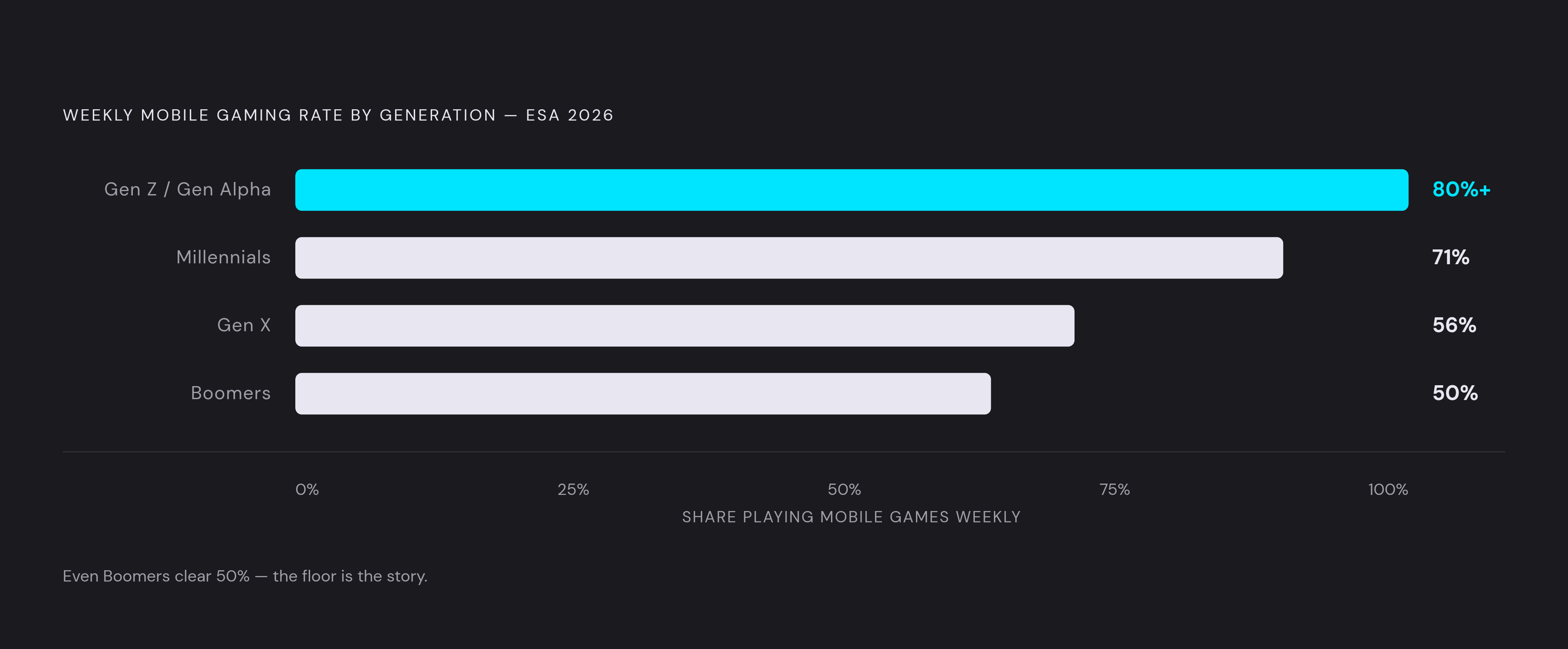
The ESA’s 2026 Essential Facts report says the average US player is 37 years old and the gender split is close to even. That is a different starting point from the familiar picture of a teenager with unlimited couch time. Adults with other things to do need chances to play as well as the graphical power to make their games look good. A device can produce a beautiful image and still be in the wrong room.
Adults 35–44 are the most overrepresented group among US mobile gamers relative to their share of the population, suggesting that the platform particularly serves people with busy schedules. ESA data collected through 2026 puts mobile at 80% overall and shows it is the most popular platform in every age group. Weekly play rates vary, with Gen Z and Gen Alpha above 80%, Millennials at 71%, Gen X at 56%, and Boomers at 50%. The reach is broad even though the frequency of play differs.
That breadth makes sense when portability is understood as access to small openings in the day. Games that checkpoint frequently and pick up instantly suit a commute, a lunch break, or time between meetings. Short, frequent sessions are not an apology for missing a longer evening session, but a useful form of play in their own right. A Switch also offers portable gaming, so this is not a claim that phones invented freedom from the TV. A dedicated handheld is another device to remember, while the phone has already made the trip.
What the game library on a phone actually looks like in 2026
The strongest answer to the objection that mobile lacks “real games” begins with premium titles. Balatro, Stardew Valley, Dead Cells, and Terraria are available on both iOS and Android without microtransactions. Bloons TD 6 is also available on both platforms, though it has optional microtransactions. These are recognizable games, each with its own demands and rhythms. The availability of the games you want is increasingly important.
Full ports make that change especially clear. Dave the Diver arrived on Android and iOS on September 17, 2026, with the whole game of fishing and running a sushi restaurant on mobile. Its opening portion is free on iOS, with a one-time purchase unlocking the full game, while Android uses a full paid purchase. Disney Epic Mickey: Rebrushed arrived on Android, iPhone, and iPad on September 16, 2026. It has the full single-player campaign reworked for touchscreen play, including the paint/thinner choice system.
Live-service hits and full cross-platform titles add breadth, but premium games are a better place to start for a reader who has doubts and wants a game that stands on its own. Still, breadth does not mean completeness. For the highest-fidelity console exclusives and some competitive PC titles, the phone’s role changes from running the game to receiving it.
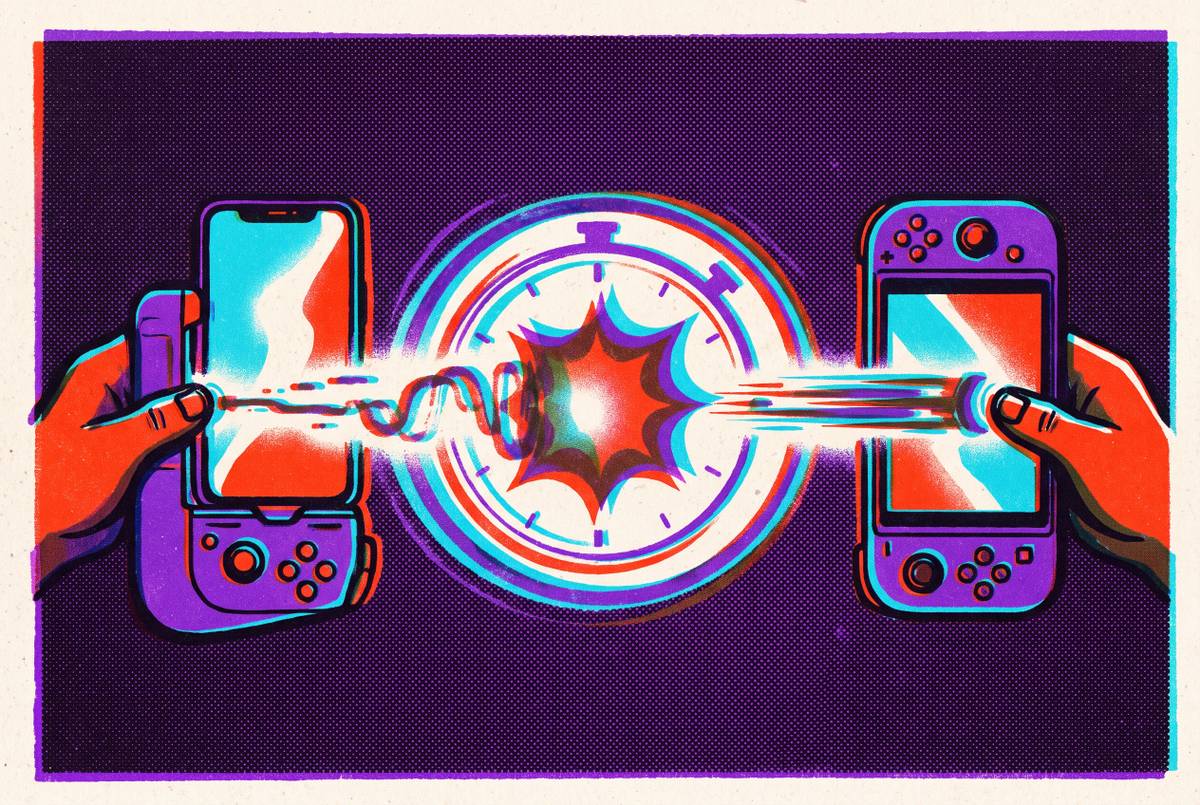
How cloud and remote play turn a phone into a full-library device
Cloud and remote play extend the library by separating the screen in your hands from the hardware running the game. That sounds like one solution, but it contains different arrangements with different costs and dependencies. Players can use a library they already own, play games from a subscription catalog, or stream from their own hardware. Which fits best depends less on an abstract winner than on what you already own.
GeForce NOW suits a player who already has a PC library and wants to play through the cloud while keeping ownership of those games. Its supported title list is an important boundary, because owning a game does not by itself establish that the service supports it. Xbox Cloud Gaming gives Game Pass subscribers a different way to play a wide range of games on mobile. Before subscribing, players also need to check the hour caps on Xbox and GeForce NOW, which limit how long they can play through the cloud. Library fit and access limits are part of the same purchasing decision.
Steam Link takes another route by using a PC at home to run the game and send the stream to the phone. It requires no subscription beyond owning the game on Steam, making it a natural option for someone who already has a PC library. A strong home network gives it a latency advantage, but the experience depends on that connection. Playing on the same network is the simple case, while playing from elsewhere needs a fast enough connection. This is not cloud hardware for hire, but another way to use hardware already at home.
Sony’s subscription offering needs a separate qualification. PlayStation Plus Premium costs $19.99/month and streams PS5 titles at up to 4K/60fps, but it does not support mobile streaming. As 5G reaches more places, it is lowering latency and making mobile cloud gaming work better outside the home. That progress widens the opportunities to play, but a network remains part of the setup.
Why touch controls are the real ceiling, and what physical controls change
Once a phone can reach the games, the next question is whether it can give you proper control over them. Touch controls take up space on the screen and have no tactile feedback. The analog precision of thumbsticks and the responsiveness of physical triggers matter most in shooters, action games, platformers, and games streamed from a console or PC. A thumb covering the action is doing two jobs, and one of them is not helpful.
Cloud and remote play make the mismatch clearer because their games are designed around controller input. In that situation, the immediate ceiling is the input layer. Physical controls restore the sticks, triggers, and grip around which the experience was designed. Good ergonomics then make sustained play feel less like holding a compromise, with a shape that fits the hands and distributes weight evenly.
What to look for in a mobile controller, and which options are worth considering
A controller should make those games easier to control without being just as awkward to carry. The main choices concern wired simplicity, wireless freedom, compactness, and platform support. None of those priorities is automatically superior, because the right balance depends on where and how the controller will be used. A full-size grip may be better for long play sessions, while a smaller shape suits someone whose setup has to fit into a pocket.
Joystick technology is a firmer starting point. Hall-effect or TMR (True Magnetic Resonance) joysticks are the minimum standard because they eliminate wear-based drift and are no longer confined to premium controllers. Compatibility is equally important, particularly for iPhone owners. Apple’s MFi certification helps buyers check for native controller support, so they should check that a controller will work before buying one that is not explicitly certified. Android allows greater hardware freedom, with most USB-C and Bluetooth controllers working without certification barriers.
The abxylute S9 offers a full-size telescopic design with Hall-effect joysticks, interchangeable D-pads, and customizable joystick heights. It can be fitted with an octagonal gate, making it an option for players who want precision in fighting games. The 8BitDo Ultimate Mobile Xbox Edition takes a different emphasis through its platform support. 8BitDo lists it as officially licensed by Xbox, officially supported by Apple, and compatible with Apple and Android devices. Its Hall Effect sticks and triggers and enhanced grip make it a relevant choice when compatibility and a substantial handhold matter.
Compactness has its own options. The MCON uses a magnetically mounting wireless design, with full-sized TMR joysticks, hall-effect triggers, and an adjustable phone mount supporting iOS and Android smartphones, including foldables. That makes it relevant when pocketability is the priority. Across these designs, the useful ergonomic details include weight distribution, trigger travel depth, button layout relative to thumbstick placement, and added bulk. Those details decide how comfortable a controller feels long after its list of features has lost its appeal.
How to build a phone-based gaming setup that actually fits your life
The library you already use provides a practical starting point. If you subscribe to Xbox Game Pass, Xbox Cloud Gaming with a certified controller gives you a straightforward way to get console-quality play on mobile without buying a console. If you have a large Steam or PC library, the choice is between GeForce NOW for supported titles and Steam Link for streaming from your own PC. Neither should be chosen simply because it has a longer list of features.
If you want native mobile games, Apple Arcade or Netflix Games with a controller lets you play premium titles without ads or microtransactions. That route avoids making a streamed library the center of the setup. If Sony exclusives are a must, PlayStation Plus Premium’s lack of mobile streaming still limits what you can play on a phone, even with a controller. A setup fits your life only if it fits your games as well.
The last choice is how much equipment you are willing to carry. A phone and a suitably compact controller can make a light, versatile gaming setup, but controller bulk still deserves the same scrutiny as handheld bulk. The controller is the decisive upgrade when touch input is the remaining obstacle, because it changes the connection between the player and the game. For many people, one well-matched controller purchase therefore brings a satisfying handheld experience within reach. Gaming can fit into the day that already exists, rather than waiting for a TV, a couch, and an empty evening.