What Stick Depth and Trigger Travel Actually Do to How You Play
Controller geometry shapes aim precision and reaction speed based on what each game demands.
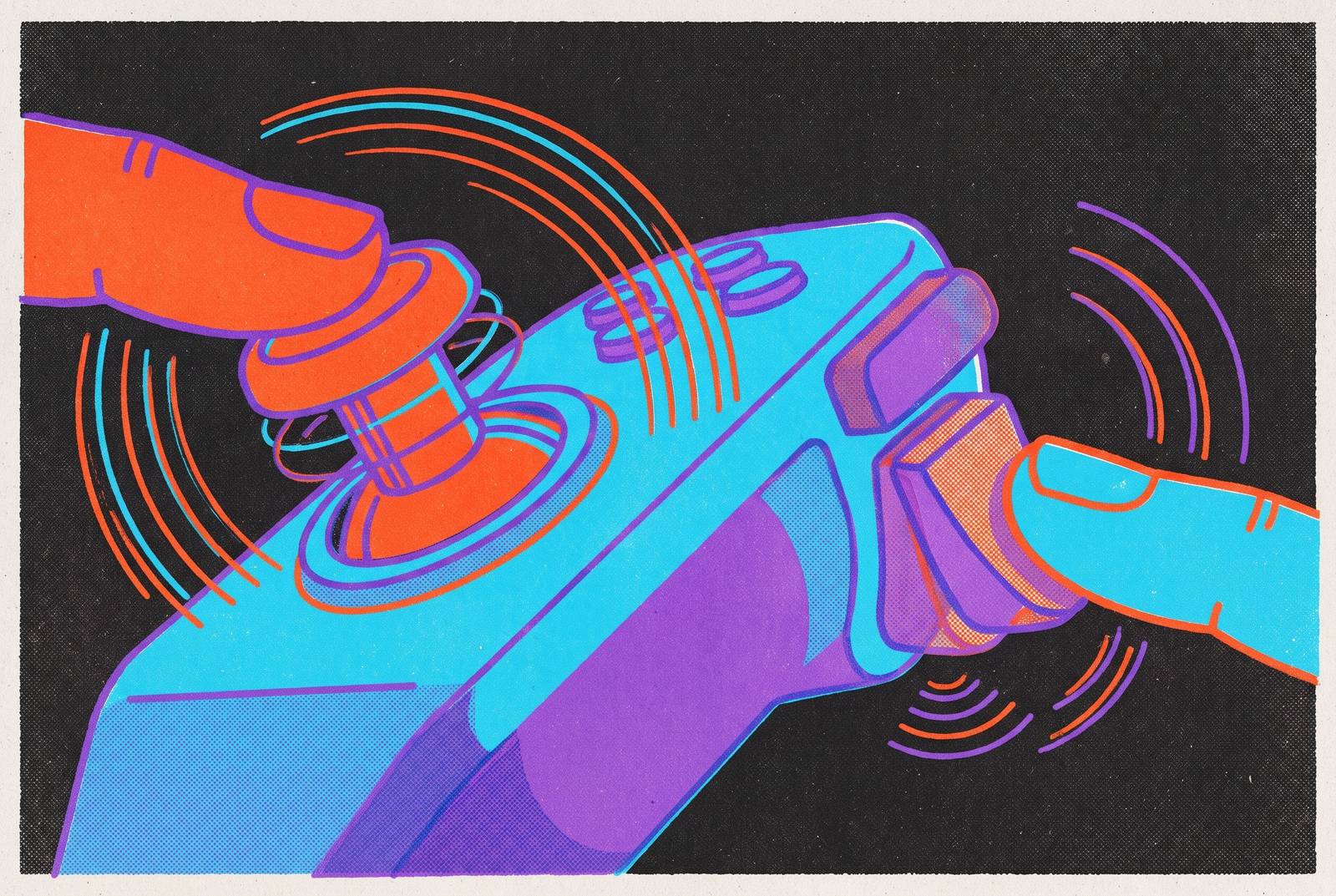
Stick depth and trigger travel shape how precisely a player aims, how soon a shot fires and how comfortably a hand lasts through a session. They are not cosmetic specifications. The right choices depend on what the game asks the fingers to do, which makes the game library a better starting point than a controller’s feature list.
Why stick depth and trigger travel are performance variables, not cosmetic specs
A thumbstick is a lever moving through an angle. Its effective height, or stick depth, determines the arc the thumb travels from the centre to the edge. Trigger travel is how far a finger moves before the controller registers an input. Both make the finger travel before the controller can act. That journey can make a small correction easier or delay the moment an input reaches the electronics.
These dimensions belong to the mechanism. Remapping a button cannot shorten a lever or remove the distance before a trigger actuates. Yet buyers often evaluate these properties after price and connectivity, giving Bluetooth versions and RGB more attention than the parts their fingers must move. Connectivity has its own role, but it cannot explain the whole feel of a controller. To understand that feel, the useful starting point is the relationship between finger movement and registered input.
How stick depth changes the geometry of aiming and movement
A taller thumbstick gives the thumb a longer lever. Because the stick reads angle, increasing its height means the thumb must sweep a larger arc to produce the same angular change. That spreads the available input across more physical movement. A small movement of the thumb therefore produces a finer adjustment than it would on a shorter stick, making the response less sensitive to tiny movements. Precision comes with a longer journey attached.
In a long-range gunfight, tracking a slow target, adjusting a marksman rifle or controlling recoil calls for careful changes. A taller stick gives the thumb more room between those small corrections. At close range, however, the same geometry can become a liability. For a fast 180-degree reaction, the thumb must reach the extreme angles quickly, and a taller stick gives it farther to go.
Is this really physics, or just personal fit? It is both, because the hand supplies the movement that the lever translates. Larger hands can gain more leverage from taller sticks, while the same height can be awkward for a smaller hand span. Understanding the trade-off gives a player a direction in which to experiment instead of treating height as an arbitrary preference.
The two sticks need not make the same compromise. An asymmetric setup, with a taller aiming stick and a shorter movement stick, follows from their different jobs. The right thumb gets more room for fine corrections, while the left has less distance to cover for quick directional movement. That is a mechanical reason for asymmetry. It also explains why a useful aiming configuration need not be equally useful for every input.
How trigger travel determines when a shot fires and how long a finger can sustain it
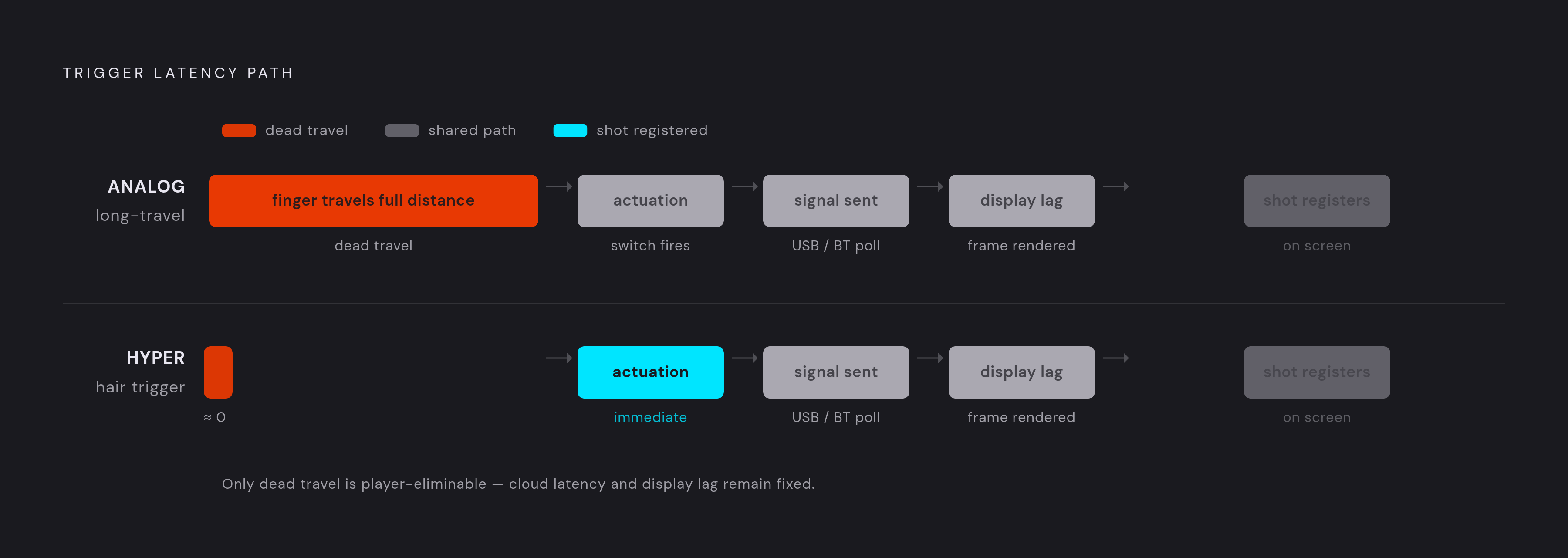
A trigger’s critical point is actuation, the moment the controller sends the input signal. Before that point, the finger is moving but the shot has not been requested. With a standard long-travel analog trigger, the finger has farther to move before actuation than with a short-travel trigger, which adds delay. The finger is the bottleneck before the electronics engage. Shortening that journey lets the same reaction reach actuation sooner.
Digital hair triggers cut that distance to near-zero travel. Instead of a long analog pull, they use mouse-click-style microswitches to register the input almost immediately. Razer’s Raiju V3 Pro implements this choice through its Pro HyperTriggers, which toggle between analog and digital instant-actuation modes. The toggle changes the physical input available to the player. It lets the player choose a graduated pull or a short click to suit the task.
The finger must also overcome actuation force, and that resistance can accumulate into fatigue across a long session. Too little force makes accidental presses easier, while too much turns repeated inputs into repeated exertion. The useful range lies between those failures. A trigger that is quick to press is not necessarily comfortable to press hundreds of times.
Very short travel with high force can be tiring in a different way from long travel with low force, and shallow triggers can feel uncomfortable during sustained play. Neither dimension alone describes the whole interaction. The shortest possible pull may solve the delay before a shot while leaving the finger just as prone to fatigue. A well-suited trigger must accommodate both the event of pressing and the repetition of pressing.
Why the right settings for a shooter are the wrong settings for a racing game
SCUF’s product documentation draws the genre dividing line explicitly. It describes standard triggers with a full range of motion as suited to games requiring nuanced, pressure-sensitive inputs, such as driving simulators. Its Instant Triggers instead click immediately with near-zero travel, like a mouse click, for competitive shooters. The distinction is between two different kinds of instruction a game needs to receive.
In a competitive shooter, a shot is a binary event. The trigger either fires or does not, so reaching actuation sooner is an advantage for that task. Racing asks a different question of the same finger. Throttle and braking are continuous inputs, and the analog range lets a player vary them. A digital hair trigger removes that range, taking away the nuance needed to manage traction and braking.
The stick follows the same genre-dependent logic. A high-rise aiming stick can help with long-range tracking, but its extra travel takes up time in a fighting game that calls for fast directional inputs. More room for adjustment is useful only when adjustment is the task.
Adjustable triggers appear to settle the conflict neatly. On hardware that provides an analog-to-digital toggle, they let the player change the mechanism to match the game. Most mobile controllers, however, do not offer that choice, so the compromise remains part of the purchase. Let the library determine the hardware requirements. Brand preference cannot turn an on/off switch into a pressure dial.
How cloud gaming raises the stakes for both variables
Cloud gaming adds another journey after the finger’s journey. An input must reach a remote server, be processed and rendered, and return as a visible response. In remote play too, the input must pass through a connection from the controller to the machine running the game. On a local console, display lag is a main contributor to delay, while streaming adds the remote round-trip. Physical trigger travel contributes its share before that process can begin.
A short trigger can avoid adding unnecessary physical delay to latency that is already present. A 40ms cloud delay feels negligible in a turn-based RPG but can break competitive play in a fast shooter. In that environment, trigger travel affects both feel and the response budget. Stick depth also needs to suit the task, with room for fine corrections weighed against how long the thumb takes to reach an extreme angle.
The DualSense’s adaptive trigger resistance uses Sony’s resistance-motor mechanism, but GeForce NOW and most third-party cloud services do not support it. On PS Remote Play, availability depends on the game and platform, and it is not available on every platform, including Android. Without that support, the trigger functions as a basic analog trigger. The long pull still puts competitive cloud shooters at a disadvantage when the adaptive feature has no support.
The connection must be considered with the mechanism. Wired USB-C connections deliver materially lower latency than Bluetooth for latency-critical cloud play because they remove Bluetooth’s added overhead. NVIDIA’s official system requirements also qualify controller compatibility, stating that additional gamepads may work and that some need drivers or software updates. Compatibility is therefore not the same as complete feature support. A controller can send inputs to a service without bringing every feature advertised on its box.
Why sensor technology underneath the stick now determines whether depth calibration holds over time
Stick geometry helps only if the sensor reads it consistently. A player can choose a height that makes small corrections easier, but that choice assumes the reported position matches the stick’s physical position. Wear can break that relationship. When the sensor begins registering movement that the thumb did not make, the extra control offered by a carefully chosen lever loses its foundation. Depth and sensing are parts of the same precision problem.
Potentiometer-based sticks read position through parts that touch. An arm rubs against a resistive strip, and wear on that strip can eventually make the reading inaccurate even when the thumb is at rest. That is stick drift. It introduces an error beneath the player’s corrections, so a height chosen for fine control no longer produces the same dependable result. A longer lever cannot compensate for a sensor that misreads where it is.
Hall Effect joysticks avoid that kind of wear. They use permanent magnets and solid-state sensors with no parts touching inside the sensor housing, so there is no friction to wear down the resistive surface. This preserves consistent sensing over a much longer lifespan. The physical adjustment remains useful because the position reading stays dependable for longer.
Hall Effect has consequently become a baseline expectation in mobile controllers. Options exist even at budget price points. For a player investing thought in depth and travel, sensor type is therefore not a luxury to consider after the interesting decisions are finished. It is the substrate on which the precision decision depends. Choosing a potentiometer-based stick leaves that investment exposed to the contact wear the magnetic approach avoids.
What these variables mean when choosing a mobile controller for different game libraries
Cloud play through Xbox Cloud or GeForce NOW, native mobile titles that need precise inputs, and emulator play each need different things from a controller. Session length adds another constraint because a mechanism must remain comfortable beyond the first few minutes. Decide genre first, then examine trigger travel, then stick height and sensor type.
For competitive cloud shooters, the priorities follow the delay chain. Short trigger travel, or an adjustable trigger with a short mode, reduces the finger’s journey before actuation. A moderate-to-high aiming stick gives room for fine corrections, subject to hand fit and the need for quick reactions. A wired or low-latency connection avoids stacking avoidable delay onto the cloud round-trip. None of these choices cancels the others, because they address different parts of the input path.
Full analog travel preserves the range needed for measured throttle and braking, while a hair-trigger-only setup removes a core control mechanism. For a library that mixes racing and shooters, adjustable triggers provide a way to change that compromise between games. Where the hardware lacks that option, the decision must reflect which kind of input the player needs most. The shortest pull is not a useful prize if it costs control of the car.
Native mobile shooters and emulation put sustained use into focus. Hall Effect sensors help keep calibration steady with frequent play, while ergonomic stick depth helps keep the hand comfortable through longer sessions. Trigger force deserves attention here too, rather than being hidden behind a claim about travel distance. The mechanism must ask the hand to make the movements the game actually needs.