Best iPhone Games for Airplane Mode Free
Play offline games built to work at 35,000 feet without a signal.
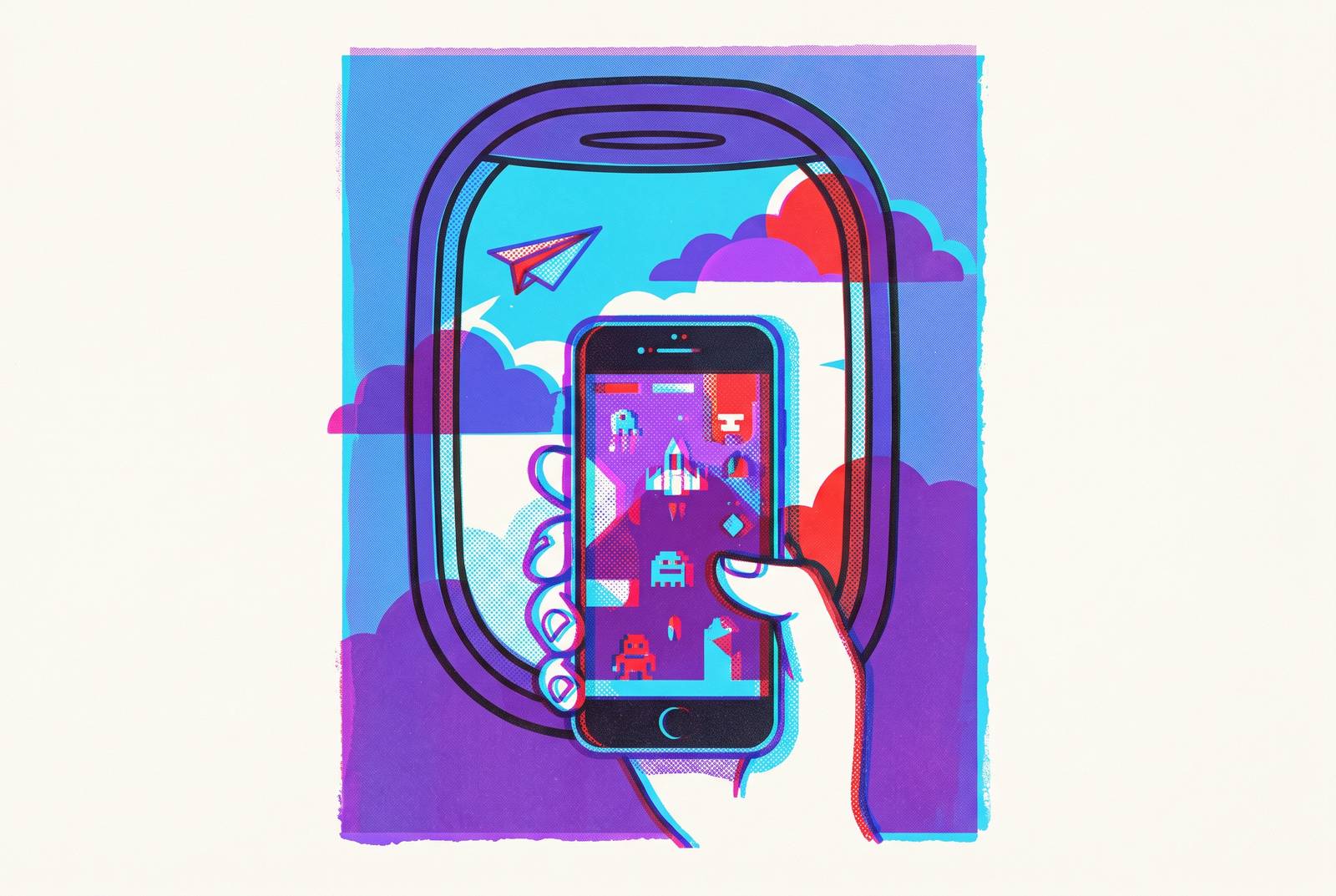
Mobile gaming crossed $200 billion globally in 2025, and mobile alone out-earned PC and console spending combined. Newzoo found that roughly 3 billion people played a mobile game that year, making the phone in your pocket the single most-used gaming device around. None of that matters, though, when you're at 35,000 feet with no signal and a dead row of Wi-Fi icons. This piece is about the narrower, weirder slice of that market: games built to work with zero connection, and specifically which free ones on iPhone are worth downloading before you board, not after you've already hit "airplane mode" and realized your app wants to phone home first.
What makes a game work at 35,000 feet
Not every game labeled "offline" actually behaves that way. Plenty require a login check or a server handshake the first time you open them, and if that handshake happens somewhere over open ocean instead of at the gate, the app just sits there spinning. Test it at home. Open the game, put your phone in airplane mode, and see if it still loads. That's the whole test, and it takes thirty seconds.
The setup trap catches more people than it should. A lot of these games need to pull down a chunk of assets, textures, level data, sometimes hundreds of megabytes, the first time you launch them, and that download has to happen over real Wi-Fi, not airport Wi-Fi that wants your email address in exchange for twenty minutes of access. Do this the night before. Or do it in the terminal, sure, but do it before boarding, not after the seatbelt sign turns off and you're staring at a loading bar that's never going to finish.
Storage isn't the constraint anymore, not with modern phones. Battery is. A 10,000 mAh power bank weighs about 6 ounces, roughly 180 grams, and gets you around two full recharges, letting you land able to actually call someone instead of landing with your battery nearly drained. It belongs in the seat pocket in front of you, not buried in a bag in the overhead bin you can't reach until the seatbelt sign goes off. Airplane mode itself is doing you a favor here too: no background searching for cell towers, no notification pings. That means real battery savings beyond just the fact that you're not supposed to have a live radio signal at cruising altitude. Dim the screen. It sounds like a small thing, but over a six-hour flight it adds up to real playtime.
A flight isn't one long uninterrupted block of time, so session length matters more than people give it credit for. A flight isn't one long uninterrupted block of time, it's constant interruption: drink service, turbulence, the captain telling you about a weather system over a city below. A game that demands you finish a 45-minute mission in one sitting is a bad match for that rhythm. The best travel games flex, good for a 10-minute burst when the tray table goes up, and good for a two-hour run when the cabin lights dim and everyone else is asleep.
Free games you can download today and play through an entire flight
"Free" here means no upfront App Store cost. Some of these have optional purchases sitting in a menu somewhere, cosmetic skins, extra currency, that sort of thing, but none of them wall off actual progress behind a paywall in a way that ruins offline play. You can ignore the shop entirely and still finish what you started.
Alto's Odyssey is the standout. It's a free download on the App Store (also playable through Apple Arcade as a remastered version, more on that below), and it's an endless sandboarding runner with one-tap controls, procedurally generated terrain, and weather that actually changes what a run looks like: sandstorms roll in, shooting stars streak overhead, and no two runs feel like they're reusing the same background art. There are 180 goals spread across six playable characters, which gives the whole thing legs well past a single flight. It's one of the cleanest, most visually confident games built for exactly this kind of use case, with no pushy monetization tricks: low-stress, flow-state play where you're not trying to win anything, just trying to glide. It's one of the cleanest, most visually confident games built for exactly this kind of use case: low-stress, flow-state play where you're not trying to win anything, just trying to glide.
Subway Surfers is the game everyone already knows, and for good reason. It's free, in-app purchases start around $0.99, and the loop is simple enough that anyone can pick it up in ten seconds: dodge trains, grab coins, don't get caught. The HD visuals hold up fine on a phone screen. It can feel repetitive if you're leaning on it for four straight hours, so treat it as a warm-up game or something for a short regional hop rather than the main event on a transatlantic flight.
Hill Climb Racing 2 rounds this tier out. Free to download, with optional in-app purchases, it's a physics-based driving game where the fun comes from the wobble and the near-misses, not from precision control. Different vehicles handle completely differently, whole levels download for offline play ahead of time, and the level progression is close to endless. It's a good fit for anyone who wants tactile, slightly chaotic fun without signing up for a story or a character arc.
Free-via-subscription games that punch well above the free tier
Apple Arcade is bundled into Apple One at $16.95 for an individual plan, $22.95 for family, $32.95 for the Premier tier. No ads, no in-app purchase prompts, playable offline across Apple devices, and shareable with family members on one account. If you're already paying for it, or thinking about it right before a trip, the timing lines up better than almost any other use case for the subscription.
Balatro+ is the one worth building a trip around. It's a poker-inspired roguelike deck builder, and "fiendishly addictive" undersells it slightly: you tell yourself "one more run," then look up and the flight attendant is doing the final beverage service. Offline mode saves your unlocks and achievements locally, so nothing gets lost between flights, and the deck variety and hidden challenges mean it holds up across a lot of trips, not just one. Session length flexes hard here too: five minutes between one hand, two hours if the flight's long enough and the person next to you is asleep. The standalone version, just called Balatro (no plus), is available separately as a one-time $9.99 App Store purchase for anyone not subscribed to Arcade. Balatro+ is the Apple Arcade version of the game.
Alto's Odyssey, Remastered is the Apple Arcade version of the game already covered above, sitting alongside the original App Store release. Subscribers get it ad-free and friction-free, which for a game this meditative is a real upgrade, not just a cosmetic one.
Premium picks worth the one-time cost before a long-haul flight
Premium games skip the ads, skip the energy timers, skip the progression walls that some free games use to nudge you toward spending money. Pay once, own the whole thing. On a flight running ten hours or more, spending $4.99 to $9.99 on something that can last many hours of actual playtime is, by any reasonable math, cheaper than the drink cart.
Monument Valley 2 costs $4.99 on the App Store, and it's less a game than a small, quiet piece of moving architecture: perspective-based puzzles where you rotate impossible staircases and floating platforms to guide a mother and child through a series of visually stunning environments. The soundtrack shifts with each scene. It's short, around 90 minutes start to finish, but it sticks with you, and it's widely considered one of the better offline experiences on iOS regardless of price point. Play it early in the flight, before you settle into something longer.
Slay the Spire is the other premium pick, a turn-based deck-building roguelike that rewards careful thought over fast reflexes. Nothing about it demands split-second timing, which makes it forgiving of exactly the kind of interruptions a flight throws at you. Play one fight, rethink your deck, close the app when the meal cart comes by, pick it back up twenty minutes later without losing the thread. It's held its place as one of the best deck-builders on any platform for years now, and that same tight, replayable loop is the reason it travels well.
How a controller changes offline iPhone gaming on a plane
Several games on this list, Dead Cells, GRID Autosport, and others among them, support MFi or Bluetooth controllers, and the jump from touchscreen taps to actual physical buttons is bigger than it sounds on paper. Touch controls work fine for endless runners where the input is one tap or one swipe. They get clumsy fast in anything with real combat timing or precise movement, where your thumb is covering part of the screen you need to see.
Tray-table space on a plane is basically nonexistent, which is the real argument for a controller that clips straight onto the phone rather than one that needs its own surface to sit on. No stand, no separate battery to manage, no risk of the whole rig sliding off a tray table the second the plane hits a bump. It's a small piece of gear, but it lets you actually play the game the way it was designed to be played, four inches from a seatback screen showing someone else's in-flight movie, instead of fumbling through a boss fight with your thumbs.