Gaming Console Subscription Services Compared
Microsoft and Sony price their top tiers $116 apart annually.
Two companies just moved their subscription pricing in opposite directions within seven months of each other, and the gap between them tells you almost everything about how Microsoft and Sony think about their own game libraries. Microsoft pushed Game Pass Ultimate to $29.99 a month in October 2025, watched subscribers push back hard enough that it walked the price down to $22.99 by April 21, 2026. Sony, meanwhile, raised PlayStation Plus Premium from $17.99 to $19.99 on May 20, 2026, and didn't blink. That's not a coincidence of timing. It's two different bets about what a subscriber is actually paying for.
The bigger structural news sits underneath the price tags. Microsoft quietly pulled day-one Call of Duty access from Game Pass, meaning new entries in the series now show up roughly a year after release instead of on launch day. Sony did something almost the opposite of flashy: it held 12-month plan pricing flat across all three PS Plus tiers even as monthly prices rose, which sounds like a footnote until you do the math (more on that below). Both companies also now let most free-to-play multiplayer titles run without any subscription at all, though Sony's exemption isn't universal across every title, so the baseline "what do I even need a subscription for" question has shifted under everyone's feet.
What each tier actually gets you, across both services
PlayStation Plus stacks three tiers, and each one builds cleanly on the last. Essential runs $10.99 a month and covers online multiplayer, monthly rotating games, cloud saves, and store discounts, basically the minimum toll for playing anything online on a PS5. Extra, at $16.99, adds the Game Catalog: a rotating library of PS4 and PS5 downloadable titles that runs up to around 400 games at a time. Premium, at $19.99, throws in roughly 300 to 400 classic titles from the PS1, PS2, PS3, and PSP eras, streamed rather than downloaded, plus cloud streaming on select games. Anyone who locked in a 12-month code before the May 2026 hike is still paying pre-2026 rates: $79.99 for Essential, $134.99 for Extra, $159.99 for Premium.
Xbox Game Pass runs four tiers, and they don't stack quite so neatly. Essential ($9.99) gets a rotating library, online multiplayer, and cloud gaming, but nothing on day one. Premium ($14.99) widens the catalog and speeds up the cloud queue, though Microsoft's own published games still arrive after their release date on this tier. PC Game Pass ($13.99, cut down from a higher price in April 2026) gets day-one Xbox Game Studios titles on PC plus EA Play, but skips cloud gaming entirely. Ultimate, at $22.99, is the only tier anywhere in this comparison that bundles day-one console and PC releases, the best cloud streaming quality Microsoft offers, EA Play, Ubisoft+ Classics, and Fortnite Crew, all in one subscription. It's also the only tier across either platform that folds in a rival publisher's entire catalog for free.
Here's the asymmetry worth sitting with: no PS Plus tier, at any price, guarantees a day-one release. Game Pass Ultimate does, for everything except Call of Duty now. That single caveat is the biggest crack in an otherwise unmatched pitch. For readers outside the US, UK pricing runs PS Plus Essential at £7.99, Extra at £11.99, Premium at £14.99, while Game Pass sits at £6.99, £10.99, and £16.99 for Essential, Premium, and Ultimate respectively.
The real annual cost once you account for how billing actually works
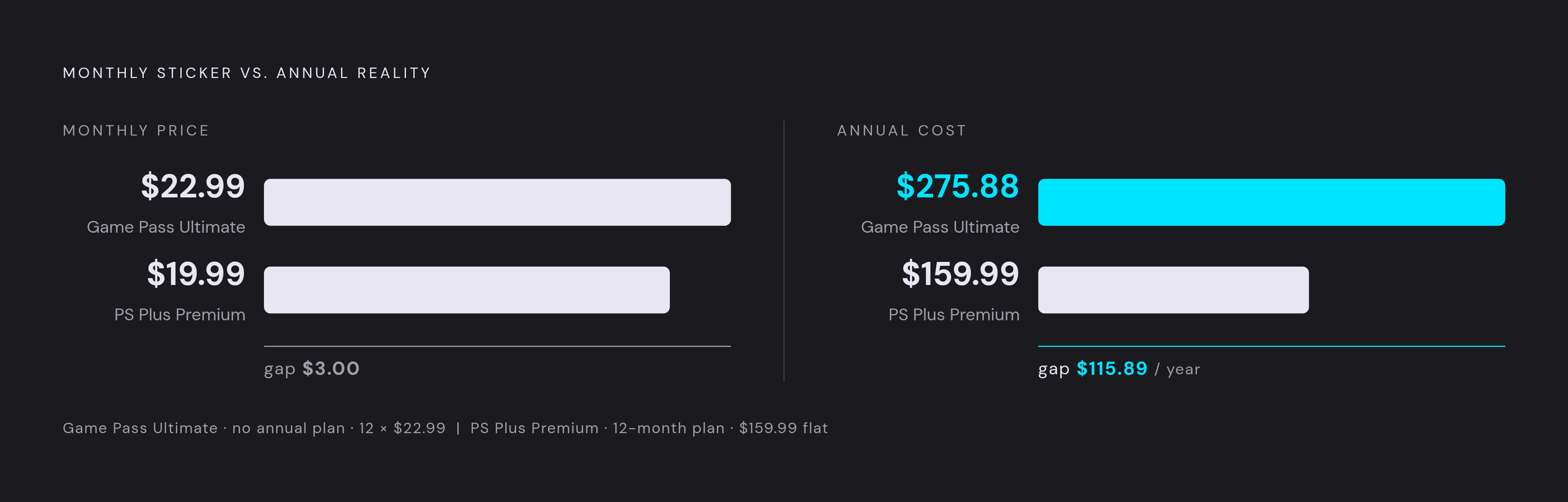
Monthly pricing is where the real story hides, mostly because Microsoft doesn't offer an annual plan for Ultimate at all. Paying $22.99 every month for twelve months adds up to $275.88 a year. PlayStation Plus Premium's 12-month plan costs $159.99 flat. That's roughly $115 a year separating the two top tiers, a gap that the $3 monthly difference between them completely hides if you're just eyeballing sticker prices.
Sony's discount structure runs consistently across all three tiers. Essential costs $131.88 if paid monthly across a year, versus $79.99 for the annual plan, a savings of about $52. Extra runs $203.88 monthly versus $134.99 annual, saving around $69. Premium goes from $239.88 monthly to $159.99 annual, a difference of roughly $80. Sony left every one of those annual figures untouched during the May 2026 price increase, so anyone who locked in a 12-month plan before that date is sitting outside the hike entirely, at least until renewal.
That's the part that changes the comparison. Looked at monthly, Ultimate and PS Plus Premium look like they're separated by pocket change. Annualized, the gap turns into real money, more than enough to cover a couple of full-price game purchases. There's no official annual plan from Microsoft to point to as a fixed reference.
Where Xbox Game Pass has a genuine structural edge
Day one is still the whole argument. Every Bethesda release, every Playground Games title, every Obsidian project lands in Game Pass Ultimate the moment it launches, no waiting period, no asterisk (apart from Call of Duty, which now trails by roughly a year). For anyone who buys games the week they come out anyway, that's the entire value proposition in one sentence.
EA Play riding along inside Ultimate at no extra charge adds a second publisher's back catalog that PlayStation hasn't tried to match on any tier. Combine that with the fact that Ultimate spans Xbox console, PC, and cloud under one subscription, and Microsoft is selling reach that PlayStation Plus, built specifically around the PS5 ecosystem, simply doesn't offer. There's no PC-first PS Plus tier waiting in the wings.
Cloud gaming is where the scale argument gets concrete. Xbox Cloud Gaming logged 1.7 billion hours of streaming in 2025, up 45% year-over-year, a significant cloud gaming footprint among the console services covered here. For anyone who wants console-caliber games on a phone without owning a console at all, cloud access through a mobile browser or dedicated app extends the reach of the subscription considerably. Subscriber numbers land around 30 million, solid scale, though still behind PlayStation Plus's confirmed 47.0 million.
Where PlayStation Plus has a genuine structural edge
Sony's numbers do a lot of the talking here: 47.0 million PlayStation Plus subscribers against 93.6 million PS5 units sold, according to the company's FY2025 earnings. Owning a PS5 and playing online basically implies a PS Plus subscription already, which is less a marketing pitch and more a description of how the ecosystem is built.
The Classics catalog is the sharpest thing Sony has going. Roughly 340 titles from the PS1, PS2, PS3, and PSP eras are available through Premium, streamed rather than sold piecemeal, and Xbox has nothing structured quite like it. Extra, meanwhile, holds up to 400 downloadable PS4 and PS5 titles, including Sony's own tentpole exclusives (God of War, Spider-Man, the Horizon series) once they've cleared a year or two past release.
Annual pricing is the quiet advantage that compounds over time. The gap between monthly billing and the 12-month plan is large enough on every tier that committed subscribers are functionally getting a discount for planning ahead, and Sony holding those annual prices flat through the May 2026 increase only sharpens that. Cloud streaming tops out at 4K on select titles under Premium, a narrower selection than Xbox offers but a higher resolution ceiling on the games it does support. For PS5 owners, the tiered climb from Essential to Extra to Premium reads less like choosing a platform and more like choosing how much of the ecosystem to unlock.
Nintendo Switch Online and what it offers a different kind of player
Nintendo Switch Online plus the Expansion Pack costs $49.99 for a full year, the lowest annual price of any subscription discussed here by a wide margin. What that buys is a retro library that's grown steadily: about 45 N64 games, 51 Sega Genesis titles, 30 Game Boy Advance games, and 7 Virtual Boy games that launched February 17, 2026. GameCube support arrived June 5, 2025 alongside Switch 2, launching with The Legend of Zelda: The Wind Waker, SoulCalibur 2, and F-Zero GX, with Luigi's Mansion, Fire Emblem: Path of Radiance, and Wario World added since, with Super Mario Sunshine confirmed as a future addition. Pokémon Colosseum is confirmed as a future addition, no date attached yet.
There's a catch worth flagging clearly: GameCube games are exclusive to Switch 2. Anyone still on an original Switch, Expansion Pack subscription or not, doesn't get access. Switch 2 Edition upgrades for Breath of the Wild and Tears of the Kingdom were folded into the Expansion Pack benefits in June 2025, and the tier also throws in select DLC, including the Mario Kart 8 Deluxe Booster Course Pass and the Happy Home Paradise expansion for Animal Crossing: New Horizons. A family membership covers up to eight Nintendo Accounts, which makes the per-person cost look genuinely reasonable for a household.
Outside of players who are already committed to Nintendo's ecosystem, though, the package reads thin next to Xbox or PlayStation. No day-one releases, no third-party publisher tie-ins, nothing resembling meaningful cloud gaming. It's a retro vault with a family plan attached, not a competitor on the same axis as the other two.
Apple Arcade and what a mobile-first subscription actually looks like
Apple Arcade runs over 200 games across iPhone, iPad, Mac, and Apple TV, and every one of them downloads locally. No streaming, no ads, no in-app purchases nagging for one more dollar. The library includes titles like Dead Cells, Stardew Valley+, Vampire Survivors, and enhanced editions such as Angry Birds Reloaded. Progress syncs across devices through iCloud, and the service supports external controllers, which makes it the closest thing to a console experience that exists on a phone without any streaming involved at all.
It's sharable with family members via Family Sharing and slots into Apple One bundles for anyone already paying for other Apple services. What's changing is the ambition behind it: Apple is reportedly pursuing moves to expand its gaming footprint. Broader ambitions around social and multiplayer features within the Apple ecosystem have also been reported, though details remain unconfirmed.
The structural difference from everything else in this piece matters more than it sounds. Games are downloaded, not streamed, so Apple Arcade works fully offline with no latency to worry about. That makes it the right fit for anyone who wants a curated, premium library on a phone or tablet without needing decent internet or any cloud infrastructure at all.
Cloud gaming as a layer that sits on top of any subscription
Search interest in "cloud gaming" has climbed 975% over the past five years, and usage is catching up to the curiosity: Xbox Cloud Gaming alone logged 1.7 billion streaming hours in 2025, up 45% year-over-year. Three services dominate the space right now, Xbox Cloud Gaming, NVIDIA GeForce NOW, and PlayStation Plus Premium's streaming catalog, and each one runs on a genuinely different model.
Xbox Cloud Gaming comes bundled into Game Pass Essential ($9.99) and Ultimate ($22.99), streaming the Game Pass library directly, no need to own anything separately. The iOS Home Screen add-to-device trick means it's usable without ever appearing as a proper App Store listing. GeForce NOW works the opposite way: it streams games already owned through Steam, Epic, GOG, PC Game Pass, or Ubisoft Connect, covering over 2,100 supported titles and adding more each week. Server hardware brings real-time ray tracing and DLSS to the cloud, and both DOOM: The Dark Ages and Avowed joined the supported library at their PC launch. Native apps run on Samsung smart TVs from 2020 through 2025 and on LG sets from 2020 through 2025, plus the Fire TV Stick 4K Plus (2nd Gen) and Fire TV Stick 4K Max, with Steam Deck streaming support at high resolutions and frame rates.
PS Plus Premium's streaming catalog covers a selection, not the full library, topping out at 4K on select titles, but it's gated behind the single most expensive PS Plus tier with no cheaper cloud-only option underneath it. Remote play options, PS Remote Play, Steam Link, Moonlight, are free across PlayStation, Xbox, and Steam, though each requires owning the hardware being streamed from. And for anyone bouncing between services, PlayStation controllers work fine with both Xbox Cloud Gaming and GeForce NOW, even if the button prompts on screen don't always match what's in hand.
Playing any of these services on mobile, and what that requires
Cloud gaming on a phone stopped being a workaround a while back. Xbox Cloud Gaming's 1.7 billion streaming hours in 2025 reflect real usage at scale, and a meaningful chunk of that is happening on handsets, not living room TVs. Access varies by platform: Xbox Cloud Gaming works through a browser or the iOS Home Screen add, plus a dedicated app on Android, streaming the Game Pass library directly. GeForce NOW runs through mobile browsers and its own app, streaming whatever's already owned across supported storefronts. PS Remote Play is free but requires an actual PS5 to do the streaming. Apple Arcade, meanwhile, just runs natively on iOS, fully offline.
Touch controls are the sticking point everywhere. A subscription can put a console-quality game on a five-inch screen, but tapping glass isn't the same as pressing a trigger, and that gap doesn't close on its own. A physical controller that connects to the phone, with real analog sticks, triggers, and bumpers, cuts the latency between what a thumb does and what happens on screen, and that's often the actual difference between a cloud session that feels like console play and one that feels like fighting the interface. One piece of hardware like that works across every cloud service in this piece: the subscription changes, the controller doesn't.
Matching the right service and tier to how you actually play
None of this resolves into one obvious winner, and that's kind of the point. A player who buys big first-party releases the day they drop, on console or PC, is paying for something specific with Game Pass Ultimate that PlayStation Plus structurally cannot offer at any price: day-one access. A PS5 owner who plays online and wants deep back catalog access, especially into the PS1 through PSP era, is getting more for the dollar out of PlayStation Plus Premium, particularly if the 12-month plan gets used instead of monthly billing.
Nintendo Switch Online plus Expansion Pack isn't competing on the same terms as either. It's a retro library with a family discount, priced for households rather than day-one chasers. Apple Arcade solves a different problem entirely: no cloud infrastructure, no latency, just a clean library that lives on the device. And cloud gaming itself, through Xbox Cloud Gaming or GeForce NOW, isn't really a fourth choice so much as a layer that sits on top of whichever subscription already makes sense, assuming the internet connection and the controller situation are both sorted.
What separates one setup from another comes down to a handful of concrete questions: does day-one access to a first-party catalog matter, or is a deep, rotating library of older titles worth more? Is the play happening on a console, a PC, or mostly a phone during a commute? And does the household paying for this include one person or eight? Answer those honestly, and the pricing tables above stop being an abstract comparison and start looking like a specific bill with a specific number attached to it.
Sources
- PlayStation Plus vs Xbox Game Pass 2026: Price, Games & Value
- Game Pass vs PlayStation Plus 2026: $22.99 vs $19.99
- PlayStation Plus Went Up While Xbox Game Pass Got Cheaper: The 2026 Gaming Subscription Decision Guide - SubBuddy
- Xbox Game Pass vs PlayStation Plus: $22.99 vs $19.99 [2026]
- PlayStation Plus vs. Xbox Game Pass Ultimate (2025): Which Subscription is Worth It?